Day after day, deep cups brimming with wine; morning after morning, flowers opening in my little garden. I sing for myself, dance for myself, cheer myself up, and delight in being free of every tie.
How many spring dreams have passed through the history books, how many rare talents through this dusty world! No need to scheme and plan: just take what is here and now.
This lyric was written by Zhu Xizhen of the Song dynasty, to the tune "West River Moon." It says that fame, rank and riches in a person's life are all settled by Heaven, so one might as well enjoy what is in front of one. Look through all of history, through the sixteen dynastic chronicles, and see how many heroes and great men who deserved wealth never got rich, and who deserved high rank never rose. A man of letters could dash off a thousand words leaning on his horse, yet when no one had use for him, his pages would not even cover a jar of soy paste. A man of arms could pierce a willow leaf at a hundred paces, yet when no one had use for him, his arrows would not even boil a pot of rice as firewood. And then there are the dullards and blockheads born lucky: never mind how shallow their learning, they still pass the examinations one after another; never mind how ordinary their martial skills, they still win great posts and great pay. Truly, as they say: it is the times, it is luck, it is fate. There is a good old saying in two lines: "If your fate is poor, the gold you dig turns to copper; if your fate is rich, the blank paper you pick up turns to cloth." In the end it all lies with the Office of Destiny, which turns things upside down as it pleases. That is why Wu Yangao wrote in another lyric: "The child Creation has no fixed rule; it flips things over and back, sets them crosswise and upright—everything we see is like that."
The monk Hui'an also wrote: "Who does not want a house of gold? Who does not want a thousand measures of grain? But the Five Elements of fate do not set that question. It is no use to scheme and calculate; sons and grandsons will have their own fortune." Su Dongpo too wrote: "Empty fame on a snail's horn, petty gain the size of a fly's head—what is all the rush for? Everything is fixed beforehand; who is weak, and who is strong?" These famous men say it in different ways, but it all comes to the same thing. Best of all is the old saying: "All things are already settled; in this floating life we bustle in vain." Now someone may object: "Storyteller, by your account there's no need to be good at letters or arms—the lazy can just wait for a career to drop from the sky; no need to trade or build a business—the wastrel can just wait for Heaven to earn him a fortune. Won't that chill every heart that strives upward?" Gentle listeners, you do not understand. If a family produces a lazy man, then it is his fate to be lowly; if it produces a wastrel, then it is his fate to be poor—that is the ordinary rule. Yet there are also cases where wealth and poverty turn over in the blink of an eye, beyond anyone's expectation, so that what lies before you cannot be reckoned to the smallest degree.
Let me first tell of a man from Bianjing, the Song capital, surnamed Jin, with the given name Weihou, who worked as a broker. Naturally he rose early and slept late, and as soon as he woke he would think a thousand thoughts and make ten thousand calculations, taking on only what was to his advantage. Later, when he had earned a comfortable living, he hit on a long-term plan. For everyday use he spent only loose bits of silver; whenever he came across one or two pieces of fine silver, he kept them aside untouched. When he had about a hundred taels, he melted them into one big ingot, braided a hank of red thread into a cord, tied it round the ingot's waist, and set it by his pillow. Every night he fondled them for a while before going to sleep. Over a whole lifetime he melted down exactly eight ingots; after that money came and went, he never again saved up a full hundred taels, and he let it be. Old Jin had four sons. One day, on his seventieth birthday, the four sons laid out wine to toast his long life. Seeing his four sons gathered all around, Old Jin was delighted, and said to them: "By the grace of Heaven, though I have toiled all my life, our household has enough to live on. What's more, I've always been careful, and I have eight big silver ingots, melted down and never to be spent, right by my pillow, tied together in pairs with silk cord. I'll pick a lucky day and divide them among you, a pair each, to be the treasure that guards each of your households." The four sons thanked him happily, and they parted after a joyful evening.
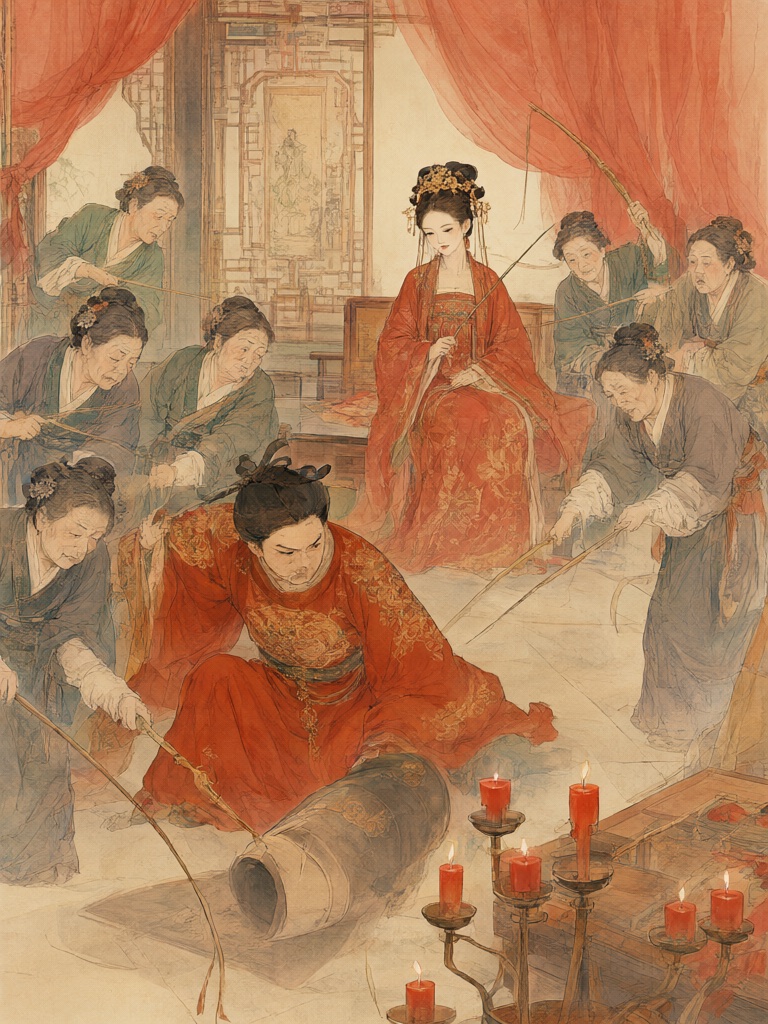
That night Old Jin, a little tipsy, lit the lamp and went to bed. Through bleary eyes he saw the eight great ingots lying in a gleaming white row by his pillow. He stroked them a few times, gave a hearty laugh, and lay down. Before he had settled into sleep, he heard footsteps in front of the bed and suspected a thief. Listening more carefully, it sounded as though the walkers wanted to come forward yet held back, each yielding to the other. The lamp before the bed glowed faintly; he lifted the curtain and saw eight big men dressed in white, with red sashes round their waists, bowing as they came forward. They said: "We brothers were assigned by Heaven to serve in your house. You have loved us more than we deserve, raised us into shape, never put us to work, and treasured us for many years; now our allotted time is nearly up. We should have waited until you departed this world before seeking somewhere else to go. But we hear that you mean to divide us now among your sons to serve them. We have no bond of fate with your sons, so we have come to take our leave first. We are going to put ourselves in the care of a certain Wang, in such-and-such a village of such-and-such a county. Our fate together is not entirely spent; we shall meet once more." When they had finished, they turned and walked off. Old Jin, not knowing what was going on, was startled. He leapt out of bed and, with no time to put on his shoes, ran after them barefoot. In the distance he saw the eight men go out of the bedroom door. Chasing them in a hurry, he tripped on the threshold and fell flat—and woke with a start. It had all been a dream. He jumped up, trimmed the lamp until it burned bright, and looked by his pillow: the eight great ingots were gone. Thinking over what had been said in the dream, he found every word was true. He sighed all day long and choked back his grief for a good while, then said: "Who would have thought that what I scrimped for my whole life wouldn't go to my sons, but would belong to someone else's family! They clearly gave the place and the name, so I'll slowly track down where they went." He did not sleep all night.
Next morning he told his sons about it. Some of them were alarmed, and some were doubtful. The alarmed ones said: "They weren't meant to be in our hands, and so they have plainly turned strange." The doubtful ones said: "The old man promised them to us in a happy moment, then thought it over and couldn't bear to part with them, so he made up this ghost story. It's not impossible." Seeing that his sons believed and doubted in varying degrees, Old Jin was eager to prove the truth. So he went to that village in that county, and there was indeed a family named Wang. He knocked and went in, and saw lamps and candles blazing in the main hall, with the three sacrificial meats and offerings laid out—they were in the middle of making offerings to the gods. Old Jin asked: "What is the happy occasion in your house?" A servant went in to announce him and asked the master to come out. The master, Old Wang, greeted Old Jin with a bow, offered him a seat, and asked why he had come. Old Jin said: "I have something puzzling on my mind, and I've come especially to your house to ask about it. Seeing that you are making offerings to the gods, there must be a reason; may I ask you to tell me plainly?"
Old Wang said: "My wife had a slight illness, so I went to have her fortune told, and the diviner said she'd be well if we moved her bed. Yesterday, while she was ill, she had a hazy vision of eight big men in white with red sashes, who said to her: 'We used to live with the Jin family, but our time with them is over, and we have come to stay in your house.' When they had spoken, they all crawled under the bed. My wife broke out in a cold sweat, and then felt well again. When we moved the bed, we found eight big silver ingots in the dust, each with a red silk cord round its waist, and no idea where they came from. It's all the blessing of the gods, so we bought offerings to give thanks. Now that you have come asking, sir, perhaps you know something of where they came from?" Old Jin stamped his foot and said: "That is all I saved in my whole life! The other day I had a dream too, and then they were gone. In the dream they gave your name and address exactly, which is how I found my way here. It's plain that Heaven has decided, and I have nothing to complain of. I only ask that you bring them out and let me see them once, so I can put my mind at rest." Old Wang said: "Easily done." Smiling, he went inside and called four servant boys, who carried out four trays. On each tray were two ingots, all tied with red silk cords—Old Jin's very own. Old Jin looked at them, helpless, with his eyes wide open, and before he knew it tears came streaming down. Stroking them, he said: "My fate is so thin I'm not fit to enjoy them!" Although Old Wang had the servant boys carry them back inside, seeing Old Jin like this he could hardly bear it.
So he wrapped up three taels of loose silver separately and gave them to Old Jin as a parting gift. Old Jin said: "I'm not even lucky enough to keep my own things—why would I need your kindness?" He refused again and again and would not accept it. Old Wang forced it into Old Jin's sleeve; Old Jin wanted to fish it out and give it back, but couldn't find it right away, and his face went red. Then, unable to resist Old Wang's pleading, he could only bow and take his leave. When he got home he told his sons everything that had happened, one by one, and they all sighed over it. He mentioned how kind Old Wang had been, giving him three taels of silver as he left—but when he searched all through his sleeve, it was not there, and he could only say it had dropped on the road. In fact, when Old Jin was refusing, Old Wang had stuffed it hastily into his sleeve, and it had landed in the outer layer of the sleeve. The sleeve had a split seam, and while Old Jin was fumbling for it in Old Wang's house, it had already fallen out through the gap beside the threshold. After the guest left and the doorway was swept, it was Old Wang who picked it up again. So you see, every sip and every peck is fixed beforehand. What is not meant to be yours—never mind eight hundred taels, even three taels you cannot carry off. What is meant to be yours—never mind eight hundred taels, even three you cannot push away. What one had is lost, what one never had arrives, and none of it is up to human scheming.
Now I shall tell of a man who walked on solid ground yet stumbled at every step, poor and wretched to the utmost, and who, in a far, misty place beyond his wildest dreams, came by a fortune out of nowhere and became immensely rich. Such a thing has seldom happened—news never heard since ancient times. There is a poem to prove it:
Fame that is yours and money in your chest come not from cleverness, nor from being a fool. If your fate truly holds the stars of wealth and rank, even beyond the seas treasure will be sent to you.
In the Chenghua reign of our own dynasty, outside the Chang Gate of Changzhou County in Suzhou Prefecture, there lived a man named Wen Shi, styled Ruoxu. He was born clever and deft: whatever he tried he could do, and whatever he studied he picked up. Zither, chess, calligraphy and painting, piping, strumming, singing and dancing—he knew a little of each. When he was young, someone had read his face and said he would have a fortune of countless thousands. Trusting in his own talents, he never put much effort into making a living, but sat and ate his way through his inheritance, until the family fortune of a thousand gold his ancestors had left him was visibly wasting away. Later, realizing his means were limited and seeing that other people in trade often made several times their outlay, he too thought of doing some business—yet of a hundred ventures, he failed in a hundred.
One day he heard someone say that fans sold well in Beijing, so he took on a partner and started laying in fans. For the top grade, finely made with gilt faces, he first sent gifts to famous men to beg poems and paintings—naturally from the likes of Shen Shitian, Wen Hengshan and Zhu Zhishan—and with a few strokes from them a fan was worth over a tael of silver. For the middle grade, there were always tricksters who could imitate those masters' calligraphy and painting with one hand, good enough to fool people into buying fakes as genuine—and he could do that much himself. The lowest grade, with no gilt and no writing, sold for a few dozen coppers apiece, and still doubled their cost, as anyone could see. He picked a day, packed his cases and went to Beijing. Who would have guessed that in Beijing that year it rained every day from the start of summer, with not a breath of heat, so the market opened late? Autumn came in cool. Though it was past the season, luckily the weather cleared, and some dandies wanted to buy fans made in Suzhou to tuck in their sleeves and wave about. When buyers came and he opened his cases, he could only groan. In Beijing the rainy season falls in the seventh and eighth months, and the damp from the earlier rains had worked on the glue and ink of the fans, so that they had all stuck together into one mass and could not be pulled apart.
When he pried them apart by force, here a layer tore off, there a piece was missing; every fan with writing or painting, every valuable one, was worth nothing at all. What remained were the cheap plain white fans, which were undamaged—but how much could they fetch? He sold them for what he could to cover his fare home, and his capital was gone. Year after year, whatever he did turned out more or less like this. Not only did he lose his own money; whoever went in with him lost too, partners included. So people gave him a nickname: "the Luckless Man." Within a few years he had run through his family fortune completely, and had never even managed to marry. All day he got by with a daub of painting here, a scribble there, knocking about from place to place, but it came to little. Still, he had a glib tongue, could talk and laugh, and his friends liked him for being amusing, so no outing was complete without him; but he could only get by from day to day, with no way of building a household. Besides, since he had lived in grand style, he never quite fit in among the hangers-on who flattered the rich for a living. Some, pitying him, wanted to recommend him as a private tutor, but honest families thought him a jack-of-all-trades, too good for some posts and not good enough for others. So both the hangers-on and the tutors pulled faces when they saw him and mocked him as "Luckless." But enough of that.
One day some neighbors who sailed the seas trading goods—led by the likes of Zhang the Eldest, Li the Second, Zhao and Qian, more than forty men in all—formed a partnership and were about to set off. When he learned of it, he thought to himself: "I'm down and out, with no way to make a living. I might as well go to sea with them and see the sights abroad—then my life won't have been wasted. Besides, they surely won't turn me down, and I'll be spared worrying about firewood and rice at home. That would be a pleasure too." Just as he was turning this over, Zhang the Eldest came strolling by. This Zhang, whose real name was Zhang Chengyun, traded abroad and had an eye for rare treasures; he was open-handed and liked to help good people, so the neighbors had nicknamed him "Zhang the Connoisseur." Wen Ruoxu told him his idea in full. Zhang said: "Good, good! We get bored and lonely on the ship; if you came along, chatting and joking on board, the days would fly by. I'm sure all the brothers would be glad. There's just one thing: we're all taking goods, and you have nothing, so it seems a pity for you to make the trip for nothing. Let us talk it over and pool a little to help you, so you can lay in something to take along." Wen Ruoxu said: "Thank you for your kindness—only I'm afraid no one else will be as generous to me as you." Zhang said: "Let me go and ask." And off he went.
Just then a blind fortune-teller came along, striking his little gong. Wen Ruoxu felt in his pocket for a copper and stopped him to cast a hexagram about his prospects for wealth. The fortune-teller said: "This is no ordinary reading—you have a hundredfold fortune in store, nothing small." Wen Ruoxu thought: "I just want to ride along overseas for fun and pass the time—what business could I possibly pull off? What help do I need? And even if I got some, how much would it be? Where would such a stroke of wealth come from? This fellow is talking nonsense." Then Zhang came back fuming and said: "As soon as money comes up, there's no luck. These people are a joke. When I said you were coming, they were all delighted; when I talked of chipping in some silver for you, not one of them made a sound. Two good friends and I have scraped together one tael of silver here. It won't buy any proper goods; buy yourself some fruit to eat on board. Your daily meals are on us." Ruoxu thanked him over and over and took the silver. Zhang went ahead, saying: "Pack quickly, we're about to sail." Ruoxu said: "I've nothing to pack; I'll follow right behind." With the silver in his hand, he looked at it and laughed, laughed and looked again, saying: "What goods could this buy?" Wandering along, he saw the baskets and hampers all down the street were full of these for sale:
Red as spurting flame, large as hanging stars. The skins not yet wrinkled, with a trace of tartness still; the frost not yet fallen, so they are hard to come by. They are unlike the trees of the Suzhou orchards, nor are they Li Heng's "thousand wooden slaves." Compared with Canton oranges, they are hard to tell apart; compared with Fujian oranges, they have all the same virtues.
In the middle of Lake Tai there is Dongting Hill, where the land is warm and the soil rich, no different from Fujian and Guangdong. Canton and Fujian oranges are famous all over the land, and Dongting has a kind of orange tree very much like them, the same color, the same fragrance. Only when they first come out they taste a little sour; once ripe they are sweet as well. They cost a tenth as much as Fujian oranges and are called "Dongting Reds." When Ruoxu saw them, he thought: "With one tael I can buy over a hundred catties. On the ship they'll quench my thirst, and I can hand some out to thank everyone for helping me." He bought them, packed them into a bamboo basket, and hired an idler to carry them on a pole, along with his luggage, down to the ship. Everyone clapped and laughed: "Here comes Mr. Wen with his precious cargo!" Wen Ruoxu was so ashamed he wished the ground would swallow him; he swallowed his pride and went aboard, and never again dared to mention buying oranges.
Once they set sail and gradually left the harbor mouth, they saw silver billows rolling up snow and snowy waves churning silver. When the current whirled, the sun and moon seemed startled; when the waves heaved, the Milky Way seemed to overturn. For three to five days they drifted with the wind, hardly aware how far they had gone. Suddenly they reached a place; looking out from the ship, they saw crowds of people and towering city walls, and knew they had come to the capital of some kingdom. The crew poled the ship into a small sheltered harbor, drove in stakes, dropped the iron anchor and made fast. Most of those aboard went ashore. On inquiry, it turned out to be a place they had visited before, called the Kingdom of Jiling. Chinese goods brought there fetched three times their price; trade them for local goods and bring those back to China, and it was the same again. One round trip yielded eight or nine times the outlay, which is why people risked their lives on this route. Everyone had traded there before and had his own brokers, inns and interpreters; they all went ashore to find buyers for their goods, leaving only Wen Ruoxu to watch the ship. He didn't know the way and had nowhere to go anyway.
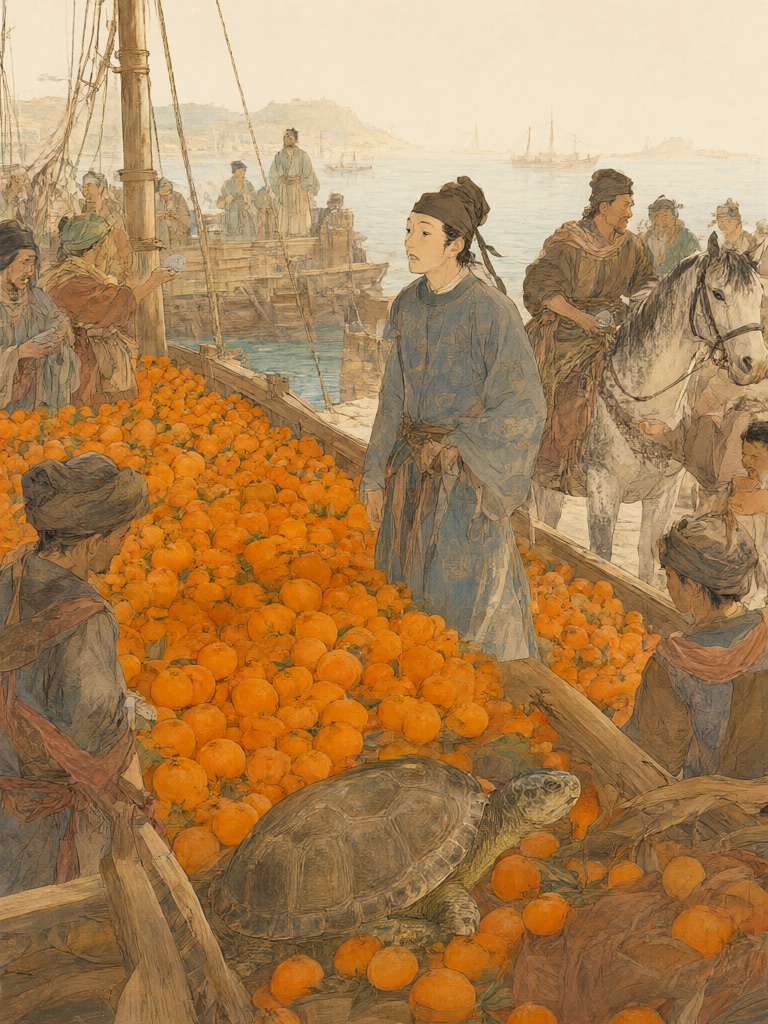
As he sat there bored, it suddenly struck him: "That basket of red oranges of mine—I haven't opened it since we came aboard. Could the stuffy air down there have made them rot? While everyone's away, let me take a look." He had a sailor dig it out from under the deck boards, opened the basket, and saw the top ones were all fine. Still uneasy, he carried them all out and laid them across the deck. It was his destiny to make his fortune; his time had come and luck came with it. Spread out, they turned the whole ship blazing red; seen from afar, they were like ten thousand points of fire, a sky full of stars. People walking on the shore all crowded round asking: "What fine things are these?" Wen Ruoxu didn't answer. He spotted one with a small bad spot, picked it out, broke it open and ate it. Still more people gathered on the shore to watch, laughing in surprise: "So they can be eaten!" One of them, a busybody, came to ask the price: "How much for one?" Wen Ruoxu couldn't understand their speech, but the crew could, and made up a price to fool him: holding up one finger, they said, "One qian of silver apiece." The man lifted his long robe, revealing a red sash of fine tula brocade, pulled out a silver coin with one hand and said: "I'll buy one to try."
Wen Ruoxu took the silver coin and weighed it in his hand: it was nearly an ounce. He thought: "I don't know how many this silver is supposed to buy, and I don't see them weighing it. I'll give him one first as a sample." He picked out a larger one, a lovely red, and handed it up. The man took it, hefted it and said: "Good stuff!" With a snap he split it open, and the fragrance hit everyone's nose, so that the many people standing near and smelling it all cried out in admiration. The buyer didn't know how to eat it; watching how the people on the ship did it, he peeled it too, but without dividing the segments, stuffed the whole thing into his mouth. Sweet juice filled his throat; he didn't even spit out the pips, but swallowed it all. He roared with laughter: "Wonderful! Wonderful!" Then he reached into his sash, took out ten silver coins, and said: "I'll buy ten to present at court." Wen Ruoxu was delighted beyond his hopes and picked out ten for him. When the onlookers saw that man buy them, some bought one, some two or three, all paying with the same kind of silver coin. Those who bought went off overjoyed.
It turned out that in that country silver was used as money, stamped with designs. Those with dragons and phoenixes were the most valuable; next came figures of people, then birds and beasts, then trees; the lowest, in common use, bore water-weed. Yet all were cast of silver and of the same weight. Those who had just bought oranges had all paid with the same water-weed coins, and they were pleased because they thought they had bought something good with low-grade money. That small-bargain mind is just the same as a Chinese one. In no time two thirds of the oranges were sold. Those who had no money on them were sorely vexed and hurried off to fetch some and come back. By then Wen Ruoxu had few left, so he put on airs and said: "Now I'm keeping the rest for myself—no more for sale." One man gladly added another coin, paying four coins for two, and grumbled aloud: "Bad luck! I came too late." Seeing that he had raised the price, those beside him complained: "We still want to buy some—why did you push the price up for him?" The buyer said: "Didn't you hear him just now? He wasn't going to sell any more!"
In the middle of this argument, the man who had first bought ten came galloping to the ship's side on a dappled grey horse, jumped down, pushed through the crowd and shouted to the ship: "Don't sell them one by one! Don't sell them one by one! I'll buy all you have. My chief wants them to present to the Khan." Hearing this, the onlookers moved away and stood at a distance to watch. Wen Ruoxu was a quick-witted man; seeing how things stood, he understood at once and knew this was a big customer. He hurriedly tipped out everything in the basket; there were only fifty-odd left. He counted them, then put on airs again and said: "I said just now I was keeping them for myself and wouldn't sell. If you're willing to pay more, I'll let a few go. I've already sold them at two coins each." The man dragged a big bag down from his horse's back and pulled out coins, but these were another kind, with a tree design, and said: "One of these coins apiece, then."
Wen Ruoxu said: "No thanks—just the same kind as before." The man smiled, reached in again and brought out one with dragons and phoenixes: "How about one of these?" Wen Ruoxu said again: "No thanks, just the kind from before." The man laughed again: "One of these is worth a hundred of those; I never meant to give it to you, I was only teasing. You won't take this one and want that kind—you're a fool! If you'll give me all your stuff, I'll throw in one more of that kind; it's no matter." Wen Ruoxu counted: there were fifty-two, and he asked exactly a hundred and fifty-six water-weed silver coins. The man took the bamboo basket too, tossed in one more coin, tied the basket to his horse, and rode off smiling with a crack of the whip. Seeing there was nothing more for sale, the onlookers scattered at once.
When the crowd had gone, Wen Ruoxu went into the hold and weighed a coin: it came to a little over eight qian and seven fen. He weighed several more, and they were all the same. Counting them all, he had nearly a thousand. He gave two to the boatmen as a tip and packed the rest into his bundle. With a laugh he said: "That blind man's reading was spot on!" He was overjoyed, and could hardly wait for his shipmates to come back so he could share the joke with them.
Now someone may say: "Storyteller, you've got it wrong! If silver was so cheap in that country, and trade went like this, why did those seasoned sailors bring mostly silks and satins? Why not sell for plenty of silver coins and bring them back—wouldn't that make a hundredfold profit?" Gentle listeners, you don't understand. In that country, silks and the like were always bartered for other goods. Our people too only made a profit by taking their goods; if they sold for silver coins, the locals would pay in dragon-and-phoenix or figure coins at a high reckoning, while the weight of silver was the same as ever, so it was no bargain. This time the buyers were paying for something to eat and thought they were paying in low-grade money, while he cared only about the weight, so he came out ahead. "Storyteller, you're wrong again! By your account, why don't the sea traders just bring things to eat and take the low-grade coins—wouldn't that pay? Why lay out heavy capital on goods?" Gentle listeners, that's not it either. This man just happened on a windfall: what he brought happened to hit the mark. Had he deliberately brought another load on a second trip, three or five days without such luck and they would have rotted to mush. His fan-selling when his luck had not yet turned is the example. Fans keep well, and still that happened—how much worse with fruit? Such things can't be judged by a single rule.
But enough idle talk. The others brought their brokers back to the ship to unload their goods, and Wen Ruoxu told them what had happened. They were all astonished and delighted: "What luck! What luck! We all came together, and you, with no capital, are the first to strike it rich!" Zhang the Eldest clapped his hands: "Everyone calls him luckless—now it looks like his luck has turned!" Then he said to Wen Ruoxu: "If you buy goods here with those silver coins, they won't be worth much. Better to pass them on to us partners in exchange for a few hundred taels' worth of Chinese goods, take those ashore and trade for some rare local products. Bring those back and there's a big profit—better than leaving the coins idle on you, of no use." Wen Ruoxu said: "I'm the luckless one. Every time I've put up capital to seek profit, I've lost the capital too. Now, thanks to you all bringing me along, I've had this no-capital business, a rare stroke of luck—truly a heaven-sent blessing. Why should I try to make money from money? What foolish dreams! If I lose it all again like before, will there really be another Dongting Red that sells so well?" They all said: "What we need is silver, and what we have is goods. If we accommodate each other, we all profit—what's wrong with that?" Wen Ruoxu said: "Once bitten by a snake, three years afraid of a rope. When it comes to goods, I've lost my nerve. I'll just take these coins home." They all clapped their hands: "Turning down several times the profit—what a pity! What a pity!" He went ashore with the rest, and at the merchants' houses they handed over their goods and exchanged them. For about half a month, Wen Ruoxu saw all manner of fine things, but he was already satisfied and paid them no mind.
When everyone's business was done, they all boarded, burned offerings to the gods, drank wine, and put out to sea. After several days, the sky suddenly turned. There was:
Black clouds blotting out the sun, dark waves heaving to the sky. Serpents and dragons dancing up into the void, fish scared and diving to the depths. The great ships tossing like a few winter crows that cannot find a perch; the islands bobbing like pairs of water birds too slow to flee. Inside the ship, it was like a winnowing basket tossing rice; outside, like a pot of rice at full boil. All because the Lord of the Wind was so heartless that every helmsman lost his color.
When the crew saw the wind rise, they hoisted half a sail and, not caring whether east, west, north or south, drifted with the wind. Faintly they saw an island, so they trimmed the sail and steered toward its shore. As they drew near, it proved to be an uninhabited island. There was:
Trees reaching to the sky, wild grass everywhere. A desolate land with nothing but tracks of hares and foxes; gently sloping ground, surely no dragon's pool or tiger's den. In all that wilderness, no telling which kingdom it belonged to; since the world began, no knowing if anyone had ever set foot there.
The crew dropped the iron anchor astern and carried stakes ashore to fasten the ship securely, then called into the hold: "Sit tight and wait for the wind to pass." Now that Wen Ruoxu had silver on him, he longed to sprout wings and fly home, and was eager to be on his way; sitting idle waiting out the wind made him restless. He said to the others: "I'll go ashore and have a look around the island." They said: "It's a barren island—what's there to see?" Wen Ruoxu said: "We've nothing to do anyway—what's the harm?" The others, dizzy from the tossing, kept yawning and would not go with him. So Wen Ruoxu pulled himself together and leapt ashore alone. And because of this one outing, it came about that: the ten-year-old empty shell revealed its magic, and a pauper found riches. If the storyteller had been born in the same year as he and grown up beside him, and had some way of knowing the future, then even if his own legs could not walk he would have gone along on a crutch.
Wen Ruoxu, seeing that no one else would go, was all the more determined. Clambering up by vines and creepers, he went straight to the island's highest point. The island was not very high and took no great effort, only the wild grass grew everywhere and there was no proper path. When he reached the top and looked around, there was nothing but endless water on every side, and he felt like a single leaf; before he knew it, sad tears fell. He thought: "Clever as I am, my whole life has been unlucky. My family fortune gone, nothing left but myself, I've drifted all the way overseas. Even though by luck I have a thousand or so silver coins in my bag, who knows whether fate means them to be mine? Here I am in the middle of a lonely island, not yet back on solid ground, and my life is still shared with the Dragon King of the Sea!" As he was grieving, he saw something rising high in the grass far off. He went closer and found it was a broken tortoise shell as big as a bed. Astonished, he said: "I'd never have believed there was such a big tortoise in the world! Who has ever seen one? People won't believe it if I tell them. I came all the way overseas without buying a single foreign thing; if I take this back, it will be a curiosity to show people, so they won't say, when I talk about it, that Suzhou men tell tall tales. And another thing: saw it apart, the top and the bottom, put four legs on each, and that's two beds—wouldn't that be something!" So he took off his two foot-bindings, tied them together, threaded them through the middle of the shell, knotted them, and dragged it off.
When he reached the ship, the crew saw him like this and laughed: "Mr. Wen, where have you been hauling that from?" Wen Ruoxu said: "Let me tell you all: this is my overseas cargo." They looked up and saw something like a hard bed with no posts but with a bottom. Startled, they said: "What a huge tortoise shell! What did you drag that here for?" Wen Ruoxu said: "It's a rare thing; I'm taking it back." They laughed: "You won't buy a single decent piece of goods—what use is this?" One said: "It does have a use. If you have some enormous doubt, you can scorch it and read the cracks—only nobody needs a divining shell that big." Another said: "Doctors make tortoise-shell jelly. Smash it up and boil it, and it's worth several hundred small shells." Wen Ruoxu said: "Never mind whether it's useful—it's rare, and it cost nothing, so I'll take it home." Then and there he had a sailor help carry it down into the hold.
Out in the open at the foot of the hill it hadn't looked so remarkable; in the hold it looked even bigger. Had it not been a sea-going ship, there would have been no room for such a clumsy thing. Everyone had a good laugh and said: "When we get home and people ask, we'll tell them Mr. Wen came back from a whopping tortoise deal." Wen Ruoxu said: "Don't laugh. It'll be good for something, for sure; it's no piece of junk." Let them tease as they liked, Wen Ruoxu was quite pleased with himself. He fetched water, washed it clean inside and out, wiped it dry, stuffed his money bag and luggage inside, and tied a rope round both ends, so that it served as a big leather trunk. Laughing, he said: "See, it's useful already!" Everyone burst out laughing: "Clever! Clever! Mr. Wen is a smart man after all."
That night passed without incident. The next day the wind died down and they set sail. Within a few days they reached another place, which turned out to be Fujian. No sooner had the ship moored than a crowd of petty brokers and agents, who made a living meeting sea traders, swarmed round, one praising the Zhang house, another the Li house, pulling and tugging and shouting without end. The people on the ship picked one they had long known and followed him, and the others gave up.
They came to a great shop run by a Persian and sat down. When the master inside heard that sea traders had arrived, he hurriedly paid out silver and had the cooks prepare several dozen tables of food and wine. Once everything was arranged, he came strolling out. The master was a Persian with an odd surname—the character "Ma" as in "agate"—named Ma Baoha. He dealt exclusively in exchanging treasures and goods with sea traders and had capital of who knows how many tens of thousands. The others, all sea traders, knew him well as an old host and old customers; only Wen Ruoxu had never met him. Looking up, he saw that the Persian, having lived in China a long time, differed little from the Chinese in dress, speech or manners; only his shaved eyebrows, clipped beard, deep-set eyes and high nose looked a bit strange. He came out to greet them, they exchanged the courtesies of host and guests, and sat down. After two cups of tea, he rose and invited them into a great hall. The banquet was all ready, and very neatly laid out. By old custom, when a ship arrived, the host first gave this banquet, and only afterward were the goods unloaded and prices discussed. The host, holding a set of enamel cups and saucers with a chrysanthemum pattern, cupped his hands in greeting and said: "Please let me see your lists of goods, so I can arrange the seating."
Gentle listeners, what do you suppose this meant? Persians put profit first. Whoever had rare treasures worth ten thousand taels or more on his list was given the place of honor; the rest sat in order according to the value of their goods, regardless of age or rank—that had always been the rule. The people from the ship knew each other's goods, valuable or cheap, many or few, and each knew his place, so they more or less took their cups and sat down. Only Wen Ruoxu was left standing there, at a loss. The host said: "I haven't met this gentleman before; he must be new to overseas trade and not have much in the way of goods." They all said: "This is a good friend of ours who came along overseas for the fun of it. He has silver with him, but wouldn't buy any goods. There's nothing for it today but to ask him to put up with the lowest seat." Wen Ruoxu, his face burning with shame, sat down in the last place.
The host sat at the end of the table. Over the wine, one said he had so many cat's-eyes, another that he had so many emeralds, each boasting in turn. Wen Ruoxu grew even more silent, and in his heart he felt a twinge of regret: "I should have listened to them the other day and bought some goods. Now I have a few hundred taels' worth in my bag and can't put in a single word." Then he sighed to himself: "I had no capital at all to begin with. I've already been lucky; I must learn to be content." Lost in his thoughts, he had no heart for drinking. The others were playing finger-guessing games and drinking hard, leaving the table a mess. The host, an old hand, could tell Wen Ruoxu was unhappy but didn't like to say so, and pressed a few cups on him as a matter of form. At last they all rose: "We've had enough wine, and it's late. Let's get back to the ship and unload tomorrow." They took leave of the host and went.
The host cleared away the banquet and went to bed. Early the next morning he went first to the ship on the shore to pay his respects to these traders. As soon as he stepped aboard and looked around, that huge clumsy thing in the hold caught his eye. He was startled: "Which of you gentlemen owns this treasure? You didn't mention it at the banquet yesterday—could it be you don't intend to sell it?" They all pointed, laughing: "That's the treasure of our friend, Brother Wen." One of them chimed in: "Another piece of unsellable junk." The host looked at Wen Ruoxu, his face flushed bright red, and with anger he reproached the others: "I've dealt with you gentlemen for years—how could you make a fool of me like this? You had me offend a new guest and slight him with the lowest seat—what's the meaning of this?" He grabbed hold of Wen Ruoxu and said to the others: "Hold off unloading. Let me take this gentleman ashore first and apologize." No one knew why. A few who knew Wen Ruoxu fairly well, and a few who loved excitement, sensed something strange, and more than ten of them followed, going back to the shop to see what would happen. The host, holding Wen Ruoxu, straightened a chair and, paying no attention to the others, sat him down in the first place, saying: "I offended you just now—forgive me, forgive me. Please sit a while." Wen Ruoxu was bewildered too and thought: "Could this thing really be a treasure? Could I have such luck?"
The host went inside and soon came out again, inviting everyone to the place where they had drunk before. Several tables had already been laid again, and the head table was even finer than before. Raising a cup, he bowed to Wen Ruoxu and said to the others: "This gentleman should sit at the head table. All your shipload of goods put together still can't match him. I was disrespectful before—forgive me." The others found this both laughable and strange, and sat down along the side half believing and half not. After three rounds of wine, the host said: "May I ask, sir, would you be willing to sell that treasure?" Wen Ruoxu was a shrewd man and answered at once: "If the price is good, why not?" Hearing that he would sell, the host was overjoyed as if a blessing had dropped from heaven, beamed all over, and rose, saying: "If you truly will sell, name your price—I won't haggle." Wen Ruoxu really had no idea what it was worth. If he asked too little, he'd look like an amateur; if he asked too much, he'd be laughed at. He thought it over, his face red and his ears hot, but could not bring himself to name a price.
Zhang the Eldest winked at Wen Ruoxu, laid his hand on the back of the chair, held up three fingers, then flicked his second finger in the air, and said: "Just ask him for this much." Wen Ruoxu shook his head, held up one finger, and said: "I can't even bring myself to ask this much." But the host saw it and asked: "So what's the price?" Zhang played a trick and said: "From Mr. Wen's gesture, it looks like he wants ten thousand!" The host roared with laughter: "That means he doesn't want to sell—he's just teasing me. A treasure like this is worth far more than that!" Hearing this, everyone stared open-mouthed. They all got up and pulled Wen Ruoxu aside to confer: "What luck! What luck! It must be worth a lot. We honestly don't know how to price it; Mr. Wen, you'd better name a big figure and let him bargain you down." Wen Ruoxu still felt too embarrassed to say it; he started to speak and stopped. They said: "Don't be so timid!" The host urged again: "What's the harm in telling me honestly?" So Wen Ruoxu asked fifty thousand taels. The host still shook his head: "Oh dear, oh dear, that won't do."
He pulled Zhang aside and asked him privately: "You gentlemen have been back and forth overseas more than once. Everyone calls you Zhang the Connoisseur—how can you not know what this thing really is? He must not want to sell it, and is just making fun of my humble shop." Zhang said: "To be honest with you, this is a good friend of mine who came along overseas for the fun of it, which is why he bought no goods. That thing he found by chance on an island where we sheltered from the wind; he didn't pay for it, so he doesn't know its value. If you really give him the fifty thousand, it's enough to keep him rich for life, and he'll be perfectly content." The host said: "In that case, I want you to stand as guarantor for the deal—you'll be well rewarded—and there must be no going back on it!" He had the shop boy bring out brush, ink, paper and inkstone, folded a sheet of fine cotton-paper, and handed the brush to Zhang: "May I trouble you, sir, to take charge and write a contract, so we can close the deal?" Zhang pointed to one of the others who had come with them: "This gentleman, Chu Zhongying, writes a fine hand." He passed the paper and brush to him. Chu ground the ink thick, spread out the paper, took up the brush and wrote:
Contract drawn up by Zhang Chengyun and others: Wen Shi, a merchant of Suzhou, has brought from overseas one large tortoise shell to the shop of the Persian Ma Baoha, who agrees to buy it for fifty thousand taels of silver. Upon signing this contract, one party shall deliver the goods and the other the silver, and neither shall go back on it. Whoever goes back on it shall pay a penalty of one tenth over the sum herein. This contract stands as proof.
He wrote two identical copies, put the year, month and day at the end, and below them listed the dozen or so merchants present, with Zhang Chengyun first. Since Chu Zhongying held the brush himself, he put his own name last. In the blank space in front of the date, he laid the two sheets side by side and wrote a line across the join, half on each sheet: the four characters "Contract Agreement." Below he wrote "Merchant Wen Shi, Host Ma Baoha," and each signed with his mark. Those named on the contract signed from the bottom up, and when it came to Zhang Chengyun, he said: "Our signing fees had better be generous—it's thanks to us this deal got done." The host laughed: "They won't be light, they won't be light."
When they had finished, the host went inside and first had a chest of silver carried out, saying: "I'll pay the commission up front, and then I have something more to say." Everyone crowded round. The host opened the chest: packets of fifty taels each, twenty packets in all, exactly a thousand taels. He handed it with both hands to Zhang Chengyun, saying: "Please count it, sir, and share it among everyone." While they had been drinking and writing the contract, everyone had been joking and fooling about, and some still half doubted it; now, seeing him bring out gleaming white silver as their commission, they knew it was real. Wen Ruoxu felt as if he were dreaming or drunk; he couldn't say a word and just stared. Zhang tugged at him: "How to divide this commission is for you to decide, Brother Wen." Only then did Wen Ruoxu manage a sentence: "Let's finish the main business first and see to that later." Then the host said to Wen Ruoxu with a smile: "There's something I'd like to discuss with you, sir. The silver for the price is in the loft inside, all weighed long ago, not a fraction short. I only ask that you, sir, and one or two others come in and look over one packet and weigh it to check; the rest needn't be weighed. But there's another thing: this is a great deal of silver, and moving it is no quick job. Besides, you are on your own, sir—how could you get it onto the ship? And then you'd have to sail back across the sea; it would be very inconvenient." Wen Ruoxu thought for a moment and said: "You're quite right. So what should we do now?"
The host said: "In my humble opinion, you can't go back just yet, sir. I have a silk shop here with three thousand taels of capital in it. Its halls, rooms and upper storeys front and back, large and small, number over a hundred—quite a big place, worth two thousand taels, half a li from here. My idea is to reckon the shop's stock and the deeds to the property at five thousand taels and hand them all over to you, sir, and you stay on here and run that business. The silver can be moved over in several trips, without anyone noticing. Later, if you want to go home, you can leave a trusted manager in charge and come and go unencumbered. Otherwise, it's easy for my shop to pay out the silver, but hard for you to keep it safe. That is my humble suggestion." Hearing this, Wen Ruoxu and Zhang both stamped their feet: "Truly spoken like a master of the trade—every word makes sense." Wen Ruoxu said: "I have no wife or children at home, and my family property is all gone. Even if I took all this silver back, I'd have nowhere to put it. If I do as you say and set up a household here, why not? This stroke of luck, every chance and every meeting of it, has been arranged by Heaven; I'll just go along with it. Even if the goods and property aren't worth five thousand, it's all a windfall anyway." Then he said to the host: "What you proposed just now is truly the safest plan. I'll do just as you say."
The host then led Wen Ruoxu inside to look at the loft, and asked Zhang and Chu "to come and look too. The rest of you needn't; please sit a moment." The four of them went in. Those left outside craned their necks and talked in threes and fours: "What a strange thing! What luck! If we'd known, we'd have gone for a walk when we moored by that island—maybe there were more treasures, who knows." Some said: "That's heaven-sent fortune that just fell on him; how could you force it?" While they were marveling enviously, Wen Ruoxu came out with Zhang and Chu. Everyone asked: "Well, what happened inside?" Zhang said: "The tall loft inside is a strongroom where the silver is kept, all in barrels. We just went in and looked: ten big barrels of four thousand each, and five small boxes of a thousand each—forty-five thousand in all. They've been sealed with Brother Wen's seals and marks; as soon as the goods are handed over, it's his." The host came out and said: "Here are the property deeds and the silk-shop accounts, making up the full fifty thousand. Now let's go to the ship and fetch the goods." They all went in a crowd to the ship.
On the way Wen Ruoxu said to the others: "There are lots of people on the ship—please don't say a word! I'll reward you handsomely." The others, for their part, feared that if the crew found out they would want a share of the commission, so they all understood without a word. When Wen Ruoxu reached the ship, he first took his bundles and bedding out of the tortoise shell. Stroking the shell, he murmured to himself: "What luck! What luck!" The host had two young men from his shop carry the shell away, instructing them: "Carry it in carefully, and don't leave it outside." When the crew saw the shell carried off, they said: "So that piece of junk's been sold too—I wonder how much it went for?" Wen Ruoxu said nothing, picked up his bundle in one hand and headed ashore. Those few who had first gone up with him ran ashore again, looked the tortoise shell over carefully from end to end, peered inside and groped around in it, then looked at each other blankly: "What's so good about it?"
The host again took the dozen or so men back with him. At the shop he said: "Now let's go with Mr. Wen to see the house and shop." They all went with the host to a place in the middle of the busy market, a very large house. In front, at the center, was a shop; beside it was a lane, and going in and around a corner there were two great stone-slab doors. Inside was a big courtyard, and beyond it a great hall with a plaque reading "Hall of Treasures Arriving." Beside the hall were two side rooms, with cabinets on three sides, all filled with damask, gauze and silks of every color. Behind were inner rooms and many upper storeys. Wen Ruoxu thought to himself: "To live in a place like this—a prince's house is no grander. And with a silk shop for a living, the profits will never end. I'll just settle here as a sojourner; why would I think of home?" He said to the host: "It's very fine, but I'm all alone; I'll need to find some servants before I can live here." The host said: "That's no trouble. Leave it all to my shop."
Wen Ruoxu, overjoyed, walked back to the shop with the others. The host called for tea, and when they had drunk it he said: "Mr. Wen, you needn't sleep on the ship tonight; stay at the shop. There are servants there already, and you can hire more gradually." The other merchants said: "The deal is done; there's no more to be said. But we still can't help wondering: what's so special about this shell that it's worth such a price? We'd like you to explain it to us." Wen Ruoxu said: "Yes, yes." The host laughed: "You gentlemen have sailed the seas so many times, and you don't even know this! Haven't you heard that the dragon has nine sons? One of them is the alligator-dragon, whose hide can be stretched over a drum that is heard for a hundred li—hence the name 'alligator drum.' After ten thousand years, the alligator-dragon finally sheds this shell and becomes a true dragon. This shell has twenty-four ribs, matching the twenty-four solar terms of heaven, and inside the joint of every rib is a large pearl. If the ribs are not yet complete, it cannot become a dragon or shed its shell. Some people have caught them alive, but then the hide is only good for drums, and there's nothing in the ribs yet. Only when all twenty-four ribs are complete and every joint is full of pearls does it shed the shell and go off as a dragon. So this one was shed naturally, its time fully come, all its ribs and joints complete—unlike one caught alive before its years were full—which is why it is so huge. We know of such things, but who knows when one will be shed? And where could you lie in wait for it? The shell itself is worthless, but the pearls all shine at night—they are priceless treasures! Today, by heaven's favor, it came our way by chance, found without even looking."
The others heard him out half believing and half not. Then the host went inside for a while and came out smiling, took from his sleeve a packet of Western cloth, and said: "Please have a look, gentlemen." He untied it, and there, wrapped in a ball of silk floss, was a luminous pearl about an inch across, dazzling to the eye. He asked for a black lacquer tray and set it in a dark place; the pearl rolled about restlessly, glittering and flashing, lighting up more than a foot around it. Everyone gaped, so astonished that their tongues hung out and would not go back in. The host turned and thanked each of the merchants in turn: "I owe it to you all for bringing this about. This one pearl alone, taken back to my country, is worth the whole price I just paid; all the rest is your gift to me." Each of them felt a jolt, but having agreed, they could not go back on their word. Seeing that their faces had changed somewhat, the host put away the pearl, hurried inside, and had a chest of silks carried out. To everyone except Wen Ruoxu he gave two lengths of silk, saying: "For all your trouble—make yourselves a couple of robes, as a small token from my humble shop." From his sleeve he took a dozen or more strings of small pearls and gave one string to each, saying: "A trifle, a trifle—just for a cup of tea on your way home." For Wen Ruoxu there were, separately, four strings of larger pearls and eight bolts of silk, "for a few suits of clothes for now." Wen Ruoxu and the others thanked him happily.
The host then went with the others to see Wen Ruoxu to the silk shop, where he had all the clerks and apprentices come and pay their respects, saying: "From now on, this gentleman is your master." The host then took his leave, saying: "I'll go back to my shop and return shortly." In no time, dozens of porters arrived with a good many carrying poles and brought over all ten barrels and five boxes that Wen Ruoxu had sealed earlier. Wen Ruoxu had them moved into a secluded, secure bedroom, then came out and said to the others: "Thanks to all of you bringing me along, I've had this unexpected fortune. I can't thank you enough." He went in and poured out the silver coins from his bundle—the money from selling the Dongting Reds—and gave each of them ten; only Zhang and the two or three who had chipped in silver for him at the start got ten more besides, "as a small token of thanks."
By now Wen Ruoxu thought nothing of these silver coins. The others, though, were delighted and thanked him endlessly. Wen Ruoxu took out several dozen more and said to Zhang: "May I trouble you, brother, to share these among our shipmates, one each, for a cup of tea. Once I've got things in order here, I'll come back home in due course. I can't travel with you this time, so let us say goodbye here." Zhang said: "There's still the thousand taels of commission that hasn't been divided. What about that? You'd better divide it, Brother Wen, so there won't be any complaints." Wen Ruoxu said: "I'd forgotten about that." He talked it over with the others: they gave a hundred taels to the crew, and divided the remaining nine hundred into shares according to the number of men present, adding two extra shares; each man got one share, while Zhang as leader and Chu Zhongying as scribe each got an extra share. Everyone was overjoyed and had nothing to say against it. One of them said: "It's just that this Muslim got a bargain. Mr. Wen, you ought to stir up a fuss and get some more out of him to make up the difference." Wen Ruoxu said: "Don't be greedy. Look at me—a luckless man who lost money on everything he did—yet when good fortune arrived, this windfall came to me out of nowhere. So you see, everyone's lot in life is fixed, and there's no need to force it. If this host hadn't known the thing's worth, it would have been so much junk to us. We only found out thanks to him—how could we, in good conscience, quarrel with him?" They all said: "Mr. Wen is right. It's because he is honest and generous at heart that he deserves this fortune." With a thousand thanks, they each took what they had received and went back to the ship to unload their goods.
From then on Wen Ruoxu was a rich merchant in Fujian. He took a wife there and established a household. Only once in several years did he make a trip to Suzhou to see old friends, then went back again. To this day his descendants are numerous and the family remains prosperous. Truly:
When luck runs out, gold loses its color; when your time comes, dull iron shines.
Don't tell your dreams to fools who'd think of searching overseas for tortoise shells.