The branch is east of the wall, the flower to the west; once fallen, the flower is the wind's to toss. A branch without flowers will blossom again; a flower that leaves the branch can never climb back.
These four lines come from an old poem called 'The Cast-off Wife.' They say that a wife follows her husband as a flower clings to its branch. If the branch loses its flowers, it blooms again when spring comes; but once a flower leaves the branch, it can never be joined to it again. They urge the women of the world to do their full duty by their husbands, share the sweet and the bitter with them, and stay with one man to the end; never to covet wealth and scorn poverty, never to be fickle and double-minded, and so bring regret upon themselves.
Let us begin with a famous minister of the Han dynasty. Before he made his name, his wife failed to see the mountain in front of her eyes, left him, and later regretted it when it was too late. Where was this minister from, you ask, and what was his name? His surname was Zhu, his given name Maichen, his courtesy name Wengzi, and he came from the commandery of Kuaiji. He was poor and had not yet found his chance, and he and his wife lived just the two of them behind a thatched door in a shabby lane. Every day Maichen went up into the hills to cut firewood, carried it to the market and sold it to get by. He loved reading by nature and never let a book out of his hand: though a load of firewood sat on his shoulder, he still clutched a book, reading aloud and savouring it, chanting as he walked. The market folk grew used to it; as soon as they heard the sound of reading they knew Maichen was coming with his firewood, and because they pitied him as a scholar, they all bought from him. And since Maichen never haggled and let people name their own price, his wood sold more easily than anyone else's. There were also some flippant young men and children who, seeing him carry firewood and read at the same time, gathered in little gangs to mock and tease him. Maichen paid them no mind at all.
One day his wife went out to draw water and saw a crowd of children trailing after Maichen's load of firewood, clapping their hands and laughing together, and she felt deeply ashamed. When Maichen came home from selling his wood, she pleaded with him: "If you want to read, stop selling firewood; if you want to sell firewood, stop reading. A grown man your age, neither mad nor simple, carrying on like this and letting children laugh at you. Isn't it shameful enough to die of?" Maichen answered, "I sell firewood to save us from poverty and I read to win wealth and rank. The two don't get in each other's way. Let them laugh." His wife laughed. "If you could win wealth and rank, you wouldn't be out selling firewood. Since ancient times, who ever saw a firewood seller become an official? What nonsense!" "Wealth and poverty each have their season," said Maichen. "Someone cast my horoscope, and at fifty I am bound to make my name. As the saying goes, 'You can't measure the sea with a peck basket.' Don't sell me short." "That fortune-teller saw what a crackpot you are and was making fun of you on purpose," said his wife. "Don't believe him. By fifty you won't even be able to lift a load of firewood. Starving to death, that's what's coming to you, and you're thinking about office! Unless they're short of a judge in the court of the King of Hell and are waiting for you to fill the post!"
"The Grand Duke Jiang was still fishing in the Wei River at eighty," said Maichen. "Then he met King Wen of Zhou, who carried him home in his own carriage and honoured him as his Revered Father. In our own dynasty, Chancellor Gongsun Hong was still herding pigs by the Eastern Sea at fifty-nine. Only at sixty did he win the favour of our present Emperor and rise to be made a marquis. If I make my name at fifty, that's later than Gan Luo, but earlier than those two. You must just wait patiently." "Stop dragging in people from the past and present," said his wife. "The fisherman and the pig herder had real learning in their heads. You read a few lines of dead books, and even if you read till you're a hundred, you'll still have that same face. What will ever come of you? Bad luck to me for being your wife! The children jeer at you and drag me down too, so I can't show my face. If you won't listen to me and throw away your books, I'll never stay with you for life. Let's each go our own way and stop holding each other back." "I'm forty-three this year," said Maichen. "In seven more years I'll be fifty. Most of the wait is behind us and only a little is left; even if you have to be patient, it won't be long. If you're so heartless as to leave me, you're bound to regret it later!" "The world's not short of men who carry firewood," said his wife. "What's there to regret? If I stick with you another seven years, I don't know where my bones will end up after I starve. Better you let me go out of the door and do me a kindness, and save my life."
Seeing that his wife was determined to go and that he could not keep her, Maichen sighed. "Enough, enough! I only hope you marry a man who's better than Zhu Maichen." "Whoever he is, he'll be a bit better," said his wife. With that she bowed twice and went happily out of the door without looking back. Maichen was deeply moved, and wrote four lines of verse on the wall:
"Wed a dog, follow the dog; wed a cock, follow the cock. My wife has cast me off; I have not cast off my wife."
When Maichen turned fifty, Emperor Wu of Han issued an edict seeking men of talent. Maichen went to the western capital to submit a memorial and waited at the Office of Official Carriages for the emperor's summons. Yan Zhu, a man from his own county, recommended Maichen's abilities. The Son of Heaven, knowing that Maichen was from Kuaiji and must understand the people and the troubles of his home region, appointed him Governor of Kuaiji and sent him off by post horse to take up his office. When the officials of Kuaiji heard their new governor was coming, they called up a great many labourers to repair the roads. Among them was the second husband of Maichen's former wife, and she came along, hair unkempt and feet bare, to bring him his meals. She saw the governor arriving in a great procession, with attendants before and behind, and peeped from the roadside: it was her former husband, Zhu Maichen. Maichen, in his carriage, spotted her at once and recognized his former wife, so he sent someone to call her over and had her ride in a carriage behind him. When they reached his residence, his former wife was so ashamed she did not know where to put herself, and she knocked her head on the floor begging forgiveness. Maichen had her second husband invited in to see him. Soon the man was brought in, and he threw himself flat on the ground, not daring to look up. Maichen laughed aloud and said to his former wife, "A man like this doesn't look any better than me, Zhu Maichen." She knocked her head again and again and repented of having eyes that could not see; she begged to be taken back even as a maid or concubine, to serve him for the rest of her life. Maichen ordered a bucket of water brought and poured it out below the steps. "If spilt water can be gathered up again," he said to her, "then you and I can be together again. For the sake of our marriage when we were young, I grant you and your husband a plot of empty ground in the back garden to farm and feed yourselves." She followed her second husband out of the residence, and the people on the road all pointed at her and said, "That's the new governor's wife!" At that, utterly ashamed and unable to face anyone, she went into the back garden and drowned herself in the river. There is a poem to bear witness:
Even the washerwoman pitied the starving young man; how could his own wife cast off a poor scholar? Had she known spilt water can't be gathered back, she'd have rued not letting him read in peace.
There is another poem saying that to scorn the poor and fawn on the rich is the way of the world, and not just Zhu Maichen's wife. It goes:
Everyone judges high and low by success and failure; who can see the dragon lying in the mud? Don't blame a woman for lacking discerning eyes: in all the world, how many wives are like Fu Ji's?
That story was about a wife who abandoned her husband. Now let me tell one about a husband who abandoned his wife: he too scorned the poor and fawned on the rich, betrayed loyalty and forgot kindness, and in the end got nothing for it but the name of a heartless man, for people to talk about.
In the Shaoxing reign of the Song dynasty, Lin'an, though it was the capital and a rich and thriving place, still had plenty of beggars. Among the beggar households there was a chief called the 'tuantou,' who ruled over all the beggars. When the beggars came back with what they had begged, the chief took a daily cut. When it rained or snowed and there was nowhere to beg, the chief would boil up thin gruel to keep the whole band alive. He also saw to their rags and tatters. So the beggars were careful and humble, obeyed their chief like slaves and never dared cross him. The chief collected his regular dues without lifting a finger, and lent money to the beggars at interest as well. As long as he did not whore or gamble, he could build up a substantial fortune. He lived by this and for the time being had no thought of changing trades. There was just one thing: 'beggar chief' was an ugly name. However much land you gained and however many generations you prospered, you were still a beggars' boss, not the equal of ordinary decent folk. No one showed you respect when you went out, so you could only shut your gate and play the great man inside your own house.
Even so, when it came to the line between respectable and base, only four sorts were counted as base: prostitutes, actors, yamen runners and soldiers. Beggars were not on the list. It seems that a beggar merely has no money, but bears no stain. Why, in the Spring and Autumn period, when Wu Zixu was a fugitive, he too played the flute and begged in the market of Wu; and in the Tang, Zheng Yuanhe was a funeral singer and sang beggars' 'lotus songs,' and later rose to wealth and honour, with a brocade quilt to cover all that up. These were outstanding men among beggars. So you can see that, though people look down on them, they are not as low as prostitutes, actors, runners and soldiers.
But enough idle talk. Now we come to a beggar chief in the city of Hangzhou named Jin Laoda. His family had been beggar chiefs for seven generations down to him, and he had built up a complete and solid household. He lived in a fine house, farmed fine fields, wore fine clothes and ate fine food; his granaries were full and his purse had money to spare, he lent money out and kept maidservants, and though he was not the very richest, he was certainly one of the rich men worth counting. Jin Laoda had some pride; he handed the post of beggar chief to a clansman, Jin the Scabby, and enjoyed what he already had, no longer getting mixed up with the beggars. Even so, the neighbours had grown used to calling his the beggar chief's house, and the name stuck. Jin Laoda was over fifty, his wife had died and he had no son, only a daughter named Yunu. Yunu was extremely beautiful. How beautiful? There is a poem to bear witness:
Flawless enough to rival jade, so graceful she would shame the flowers. Dress her as a palace lady, and she would be Zhang Lihua herself.
Jin Laoda treasured this daughter like a jewel. He had her taught to read and write from childhood, and by fifteen or sixteen she was well versed in poetry and rhapsody and could write and compose with an easy hand. She was also skilled at needlework and could play the zither and the flute; she was clever at everything. Proud of his daughter's talent and beauty, Jin Laoda set his heart on marrying her to a scholar. Truth be told, even among the great old families, a girl like her would be hard to find at short notice. The pity was she had been born into a beggar chief's family, so no one came asking for her; and as for ordinary tradesmen with no prospects, Jin Laoda would not stoop to them. So between high and low nothing came of it, and his daughter reached eighteen without being betrothed.
Then one day a neighbour, an old man, came by and said, "Down by Taiping Bridge there's a young scholar named Mo Ji, twenty years old, a fine figure of a man and well read. Only his parents are both dead and his family is poor, so he isn't married yet. He's just passed his examination and been made a student of the Imperial Academy, and he's willing to marry into a family and live with his wife's people. He'd be just right for your daughter. Why not take him as a son-in-law?" "Then may I trouble you to act as go-between?" said Jin Laoda. The neighbour agreed and went straight to Taiping Bridge, found Mo the scholar and told him: "To be honest with you, the family's forebears were beggar chiefs, though they gave it up long ago. It's just that they have such a fine daughter, and they're well off too. If you don't object, sir, I'll see the match through right away." Mo Ji said nothing aloud, but he thought to himself, "I don't have enough to eat or wear and can't afford a wedding. Why not condescend to marry into their family and kill two birds with one stone? I can't worry about people laughing." So he said to the neighbour, "What you say is splendid, uncle, but my family is poor and I have no betrothal gifts. What can I do?" "As long as you agree, sir," said the neighbour, "it won't cost you so much as a sheet of paper. Leave it all to me."
The neighbour reported back to Jin Laoda. A lucky day was chosen, the Jin family even sent over a new suit of clothes for him to wear, and Mo the scholar moved in and was married. Seeing Yunu's talent and beauty, Mo Ji was happier than he had dared hope: without spending a penny he had got a lovely wife for nothing, and he was well fed and well clothed besides, with everything to his liking. Even among his friends, everyone knew how poor he had been and understood, so no one laughed at him.
When the first month of the marriage was up, Jin Laoda laid on a lavish banquet and had his son-in-law invite his classmates and fellow scholars to drink, to bring glory on the family, and the drinking went on for six or seven days in a row. Who would have thought it would anger his clansman Jin the Scabby? The Scabby had his own point of view. "You're a beggar chief and I'm a beggar chief," he said. "You've just done it for a few more generations and got some money in your hands. If you go by the ancestral line, there's no difference between us. When my niece Yunu takes a husband, I ought to be invited for a cup at the wedding. Now he's throwing a party for the first month, feasting for six or seven days, and not one invitation three inches long and one inch wide has come my way. Your son-in-law's a scholar; does that make him a minister or a chancellor? Am I not her own great-uncle? Am I not fit to sit on a bench? Treating people as if they don't exist! I'll go and give him a good rousting and spoil the fun for everybody!" He called up fifty or sixty beggars, and they all charged off together to Jin Laoda's house. Picture it:
Hats in tatters, shirts all knotted. Old bits of matting next to torn felt rugs, short bamboo sticks to go with chipped coarse bowls. Crying 'Father! Mother! Rich master!', there was nothing but uproar at the gate; snake charmers, dog handlers, monkey trainers, each showing off his tricks. Clacking boards and singing 'Willow Catkins,' their ugly voices grated on the ear; beating their chests with bricks and their faces smeared with powder, their antics were enough to drive you off. A gang of ruffian devils packed together, more than even Zhong Kui the demon-queller could round up.
Jin Laoda heard the commotion and opened the gate to look. Jin the Scabby came pouring in at the head of the beggars, and they filled the hall with their din. The Scabby went straight to the table, picked out the best wine and food and stuffed himself, shouting, "Quick, have my niece and her husband come and pay respects to their great-uncle!" The scholars were so frightened they could not stand their ground and all fled the feast; even Mo Ji followed his friends and hid. Jin Laoda had no choice but to plead with him again and again. "Today my son-in-law is the host. It's nothing to do with me! Another day I'll lay on a drink just for you and make amends." He also handed out a lot of money among the beggars, and brought out two jars of good wine and some live chickens and geese and the like, and had the beggars take them to the Scabby's house, in lieu of the feast. The uproar went on until dark before they finally left. Yunu wept with rage in her room. That night Mo Ji stayed at a friend's house and did not come back until the next morning. When Jin Laoda saw his son-in-law, he felt he had been disgraced and his face was full of shame; Mo Ji could not help being somewhat put out either, but neither of them said anything. As the saying goes:
When a mute tastes bitter bark, only he knows how bitter it is.
Now, Jin Yunu resented nothing so much as her family's low standing, and she was determined to rise above it, so she urged her husband to study hard. She spared no expense to buy him every book, ancient and modern, to read; she paid without stinting to have people come and hold essay meetings and lectures with him; and she gave money so he could make friends and spread his reputation. From then on Mo Ji's learning grew day by day and his name rose day by day. At twenty-three he came first in the provincial examination and went straight on to pass the palace examination. On that day, after the Qionglin banquet for the new graduates, he rode home in black official cap and palace robe. As he approached his father-in-law's house, a crowd of children in the street jostled to look at him and pointed: "The beggar chief Jin's son-in-law has become an official!" Mo Ji heard this from his horse, but it would not do to make a fuss, so he bore it.
When he met his father-in-law, he was perfectly correct on the outside, but inside he was swallowing a bellyful of resentment. "If I'd known I would have the rank I have today," he thought, "wouldn't princes and nobles have wanted me for a son-in-law? Instead I've bowed to a beggar chief as my father-in-law. That's a stain I'll carry all my life! When I have children, they'll still be a beggar chief's grandchildren, and people will make a joke of it. Now that it's done, and my wife is good and virtuous and hasn't broken any of the seven grounds for divorce, I can't very well cast her off. Truly, act without thinking thrice, and you'll regret it in the end." So he was gloomy and unhappy. Yunu asked him several times, but he would not answer, and she could not work out what was wrong. How laughable Mo Ji was! He thought only of his wealth and rank today and forgot his days of poverty, and let all his wife's help in making his name flow away like spring water. That was where his heart was crooked.
Not long after, Mo Ji went to the Ministry for appointment and was made revenue officer of Wuwei Military Prefecture. His father-in-law gave a farewell banquet. By this time the beggars would surely not dare to come and make trouble again. Happily, the way from Lin'an to Wuwei was all by water. Mo Ji took his wife and boarded a boat for his new post. After several days they reached the river at Caishi and moored on the north bank. That night the moon was as bright as day. Mo Ji could not sleep, so he dressed, got up and sat at the bow to enjoy the moon. Looking about and seeing no one, he thought again of the beggar chief business and grew sullen. Suddenly a wicked thought came to him: "Only if this woman were dead, and I married someone else, could I escape this lifelong shame."
He hit on a plan. He went into the cabin and coaxed Yunu to get up and look at the moonlight. Yunu was already asleep, but Mo Ji kept pressing her to get up. She could not bring herself to go against her husband's wishes, so she threw on her clothes, went to the cabin door and leaned her head out to look at the moon. Taking her by surprise, Mo Ji pulled her out onto the bow and pushed her into the river. Then he quietly woke the boatmen and ordered, "Get under way at once, and you'll be well rewarded! No dawdling." Not knowing what had happened, the boatmen hastily poled and rowed and moved the boat ten li away. Only when it was safely moored did he say, "Just now the mistress fell into the water while looking at the moon. It was too late to save her." And he gave the boatmen three taels of silver for wine. The boatmen understood; who would dare speak up? There were a few dull-witted maids on the boat too, but they thought their mistress really had fallen in, had a good cry, and let it go. Of that, no more. There is a poem to bear witness:
All because 'beggar chief' had no sweet ring to it, risen high, he could bear to cast off the wife of his lean years. But a bond tied by heaven is hard to undo, and all he won was the name of a heartless man.
Now, as luck would have it, after Mo Ji's boat had moved away, Xu Dehou, Transport Commissioner of Huaixi, who was also on his way to a new post, moored his boat on the north bank at Caishi, at the very spot where Mo Ji had pushed his wife into the river. Xu Dehou and his wife had opened the window to look at the moon and were drinking happily, not yet in bed. Suddenly they heard weeping from the bank. It was a woman's voice, so sad and bitter that they could hardly bear it. Xu at once called the boatmen to go and look, and sure enough there was a woman sitting alone on the riverbank. He had her brought aboard and asked who she was.
This woman was none other than Jin Yunu, wife of the revenue officer of Wuwei. When she first fell into the water she was frightened out of her wits and had given herself up for dead. Then suddenly she felt something in the water lift her feet, and she was carried along with the current close to the bank. Yunu struggled ashore and looked about her: the river stretched away, vast and empty, and the revenue officer's boat was nowhere to be seen. Only then did she understand that her husband, now high and mighty, scorned her lowly birth and had meant to drown her so he could make a better match. Now, though her life was saved, she had nowhere to go, and the more she thought of her plight the more bitter it seemed, so she wept aloud. When Lord Xu questioned her, she could not help telling the whole story from beginning to end. When she had finished, she wept on and on. Even Lord Xu and his wife were moved to tears. "Don't grieve any more," they said. "If you'll be our adopted daughter, we'll find a way." Yunu bowed and thanked them. Lord Xu told his wife to bring dry clothes and change her into them from head to toe, and arranged for her to sleep alone in the rear cabin. He told all his servants, men and women, to call her 'young mistress,' and ordered the boatmen not to breathe a word of the matter.
Before long Xu reached Huaixi and took up his post. Wuwei Military Prefecture lay within his jurisdiction, so Lord Xu was Revenue Officer Mo's superior, and Mo naturally came with the other officials to pay his respects. When Lord Xu saw Mo, he thought, "What a pity that such a fine-looking man should do such a heartless thing." After a few months, Lord Xu said to his subordinates, "I have a daughter of some talent and beauty who has come of age, and I would like to choose a fine young man to marry into my family. Have you anyone in mind, gentlemen?" They had all heard that Revenue Officer Mo had lost his wife young, and with one voice they recommended him as a man of uncommon talent and character, well worth choosing as a son-in-law. "I have had my eye on him for a long time myself," said Lord Xu. "But he passed the examinations young, and he's ambitious and expects a great deal. He may not be willing to marry into my house." "He comes from a humble family," said the officials. "To be taken up by Your Excellency would be like a reed leaning against a jade tree. What luck could be greater? Why would he object to marrying into your house?" "If you think it can be done, gentlemen," said Lord Xu, "then speak to Revenue Officer Mo about it. But say it is your own idea, to sound him out; don't mention me, in case it causes difficulties."
The officials did as he asked and put the matter to Mo Ji, offering to act as his go-betweens. Mo Ji was just looking for a way to climb higher, and a marriage tie with his superior was more than he could have hoped for, so he agreed with delight. "I rely entirely on you to bring this about, and I'll repay you as long as I live." "Of course, of course," said the officials, and at once they reported his answer to Lord Xu. "I'm grateful that the Revenue Officer doesn't think us beneath him," said Lord Xu. "But my wife and I dote on this daughter and have spoiled her, so we can hardly bear to marry her off. I'm only afraid that the Revenue Officer, being young and high-spirited, won't give way to her; and if some little quarrel arises, it will break our hearts. It must be agreed beforehand that he will be patient about everything; only then will I dare to take him in." The officials did as he asked and carried the message to the Revenue Officer, who agreed to everything. Now the Revenue Officer was not the scholar he had been: he sent gold flowers and coloured silks as betrothal gifts like anyone else, chose a lucky day, and, tingling with excitement from skin to bone, made ready to become the Transport Commissioner's son-in-law.
Meanwhile Lord Xu had first sent his wife to tell Yunu, "His Lordship pities you for being a widow and wants to take a young palace graduate into the family as your new husband. You mustn't refuse." Yunu answered, "Though I come from a humble family, I know something of what is proper. Since I was married to Master Mo, I must stay with him to the end. Even though Master Mo scorned me for being poor and low, and cruelly did me wrong, I must still do my own duty. How could I marry again and stain my honour as a wife?" When she had finished, her tears fell like rain. Seeing how sincere she was, Lady Xu told her the truth. "The young palace graduate His Lordship spoke of is Master Mo. His Lordship hates him for his heartlessness and is determined to bring the two of you together again. He has said only that he has a daughter of his own and wants a husband to marry into the family, and had the officials propose the match to Master Mo, who gladly agreed. He's coming to marry into our house this very evening. When he comes into the bridal chamber, this and this is what will happen, to let you vent your anger." Only then did Yunu dry her tears, powder her face afresh, and put on her finery again to get ready for the wedding.
That evening Revenue Officer Mo, in full cap and gown, with gold flowers in his hat and red brocade over his shoulders, rode a fine horse with a carved saddle, two bands of drums and pipes leading the way, and all his fellow officials came to escort him. All along the road, who did not cheer! As the verse goes:
Drums and pipes resounding, here comes the white horse! What a dashing bridegroom, how marvellous! Glad to trade the beggar chief's kin for a noble house, he finds what happened at Caishi nothing to grieve over.
That night, the Transport Commission was spread with carpets and hung with silk festoons, with a great blowing and beating of music, waiting for the new son-in-law to arrive. Revenue Officer Mo got down from his horse at the gate, and Lord Xu came out in full official dress to welcome him, while the other officials all took their leave. Mo went straight into the private quarters, and the bride, her head covered with a red veil, was led out supported by two nursemaids. The master of ceremonies called out the rites from beyond the threshold; together they bowed to Heaven and Earth, then to the bride's father and mother, and then to each other, and when the rites were done they were escorted to the bridal chamber for the candlelit wedding feast. At that moment Revenue Officer Mo felt as if he had climbed to the ninth heaven; his joy was beyond words. With his face turned up, he strode proudly in.
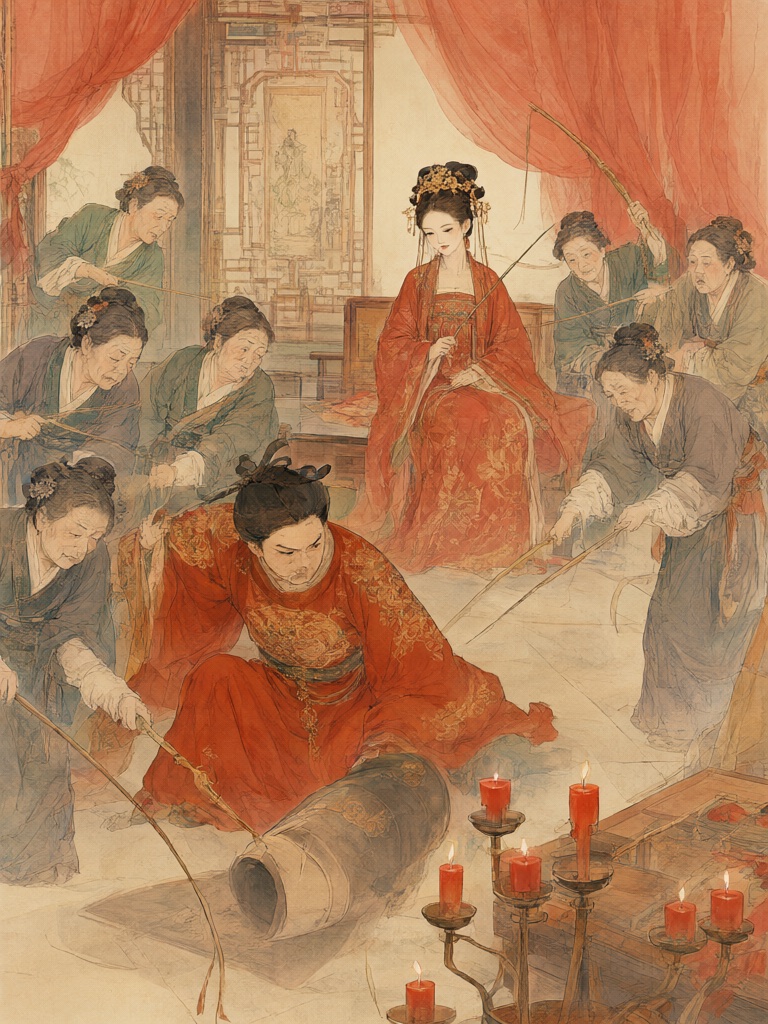
He had just stepped over the threshold when, from both sides of the doorway, seven or eight old women and maids sprang out, each holding a thin bamboo cane, and rained blows down on his head. They knocked his gauze cap clean off; the canes fell on his shoulders and back like rain, and he yelled and yelled, with no idea where to turn. Under the beating, Revenue Officer Mo collapsed in a heap on the floor and could only cry, "Father-in-law! Mother-in-law! Help!" Then from inside the room came a soft, sweet voice giving orders: "Don't beat the heartless man to death. Bring him here to see me." Only then did they stop. The seven or eight old women and maids, pulling his ears and hauling his arms, like the Six Thieves teasing the Laughing Buddha, swept him off his feet and bundled him before the bride. "What have I done wrong?" the Revenue Officer was still saying. He opened his eyes: the painted candles blazed, and there, sitting very straight at the head of the room, was the bride, and she was none other than his former wife, Jin Yunu. Mo Ji was frightened out of his wits and shouted wildly, "A ghost! A ghost!" Everyone burst out laughing. Then Lord Xu came in from outside and called, "Don't be alarmed, my good son-in-law. This is the adopted daughter I took in on the river at Caishi. She's no ghost." Only then did Mo Ji's heart stop pounding. He fell to his knees and clasped his hands. "I, Mo Ji, know my crime. I beg Your Excellency to forgive me." "This has nothing to do with me," said Lord Xu. "As long as my daughter has nothing to say, that's the end of it."
Yunu spat in his face and cursed him: "You heartless villain! Don't you remember what Song Hong said? 'Never forget the friends of your poor days; never cast out the wife who shared your husks and chaff.' When you first married into my family you came empty-handed, and it was my family's money that let you study and make your name, until you rose and had the luck to be where you are today. I hoped to share in my husband's glory, too. Who would have thought you would forget all that kindness and turn your back on where you came from, care nothing for the bond of our marriage, repay kindness with hatred, and push me into the middle of the river? By good fortune Heaven took pity on me, and I met my kind father, who rescued me and took me as his adopted daughter. If I had ended up in the bellies of the fishes while you married someone new, how could your conscience bear it? What face have you got now to be reunited with me?" With that she burst into loud weeping, and 'heartless' a thousand times, 'heartless' ten thousand times, she cursed him without stopping. Mo Ji's face burned with shame; he kept his mouth shut, said nothing, and only knocked his head on the floor, begging forgiveness.
When Lord Xu judged she had cursed him enough, he helped Mo Ji up and said soothingly to Yunu, "Calm down, my child. Now that your good husband has repented, surely he'll never dare slight you again. Though you two were husband and wife before, in my house this counts as your wedding night. For my sake, let all the hard words be crossed out with one stroke." Then he said to Mo Ji, "My good son-in-law, you were in the wrong yourself, so don't blame anyone else. Tonight you'll just have to be patient. I'll send your mother-in-law to talk things over with you." With that, he left the room. Presently Lady Xu came in and said a great deal more to smooth things over, and only then were the two of them reconciled.
The next day Lord Xu gave a banquet in honour of his new son-in-law, and returned all the gold flowers and coloured silks of the betrothal gifts, saying, "One daughter does not accept two sets of betrothal gifts. You already went to that expense once with the Jin family, my good son-in-law, so this time I wouldn't dare accept them a second time." Mo Ji hung his head and said nothing. "My good son-in-law," Lord Xu went on, "you were always ashamed of your father-in-law's low station, and so you and your wife fell out and nearly failed to stay together. How do I do as a father-in-law? I'm afraid my rank isn't high enough to satisfy you yet." Mo Ji turned purple in the face and could only leave his seat and beg forgiveness. There is a poem to bear witness:
A fool's dream of a lofty marriage: who'd have guessed the new bride was the old one? A beating and a scolding, a face full of shame. Ask him now: what did he gain from a new father-in-law?
From then on Mo Ji and Yunu lived in harmony, twice as loving as before. Lord Xu and his wife treated Yunu like their own daughter and Mo Ji like their own son-in-law; and Yunu treated Lord Xu and his wife no differently from her own parents. Even Mo Ji was moved, and he brought the beggar chief Jin Laoda to live with him at his post and cared for him until he died. Later, when Lord Xu and his wife died, Jin Yunu wore the deepest mourning for them to repay their kindness. The Mo and Xu families were like brothers for generation after generation and never stopped visiting each other. A poem says:
Song Hong kept faith and was praised for his integrity; Huang Yun cast off his wife and was cursed as heartless. Look at Master Mo's marriage, made twice over: matches are fixed by fate, and all the scheming is in vain.