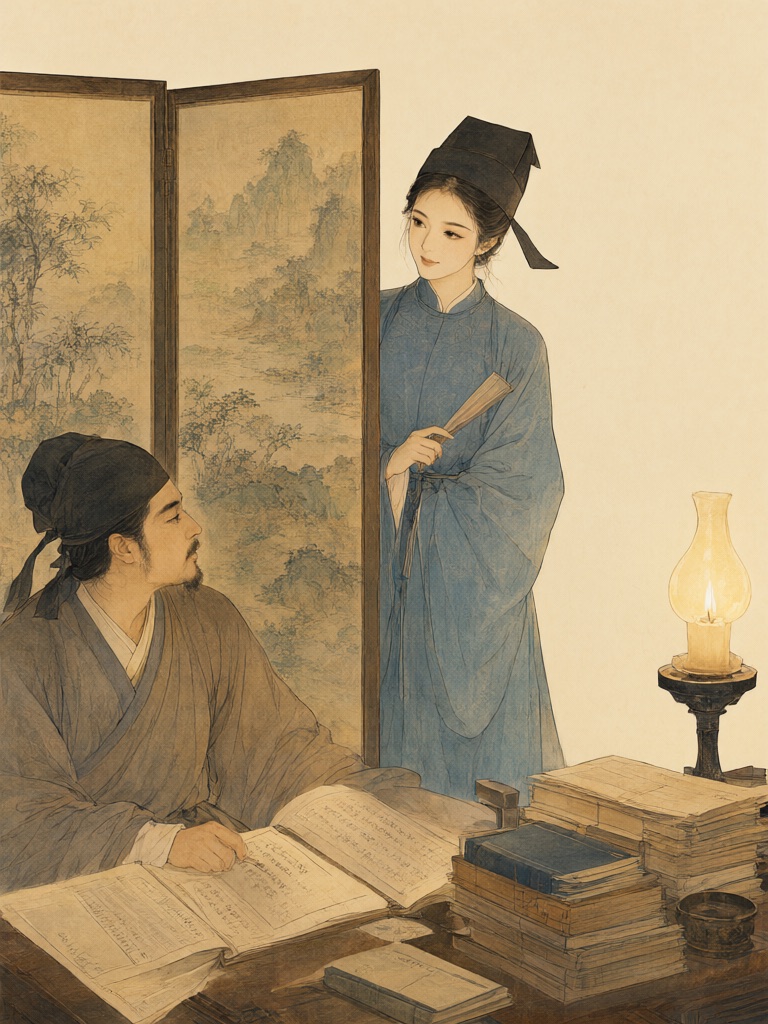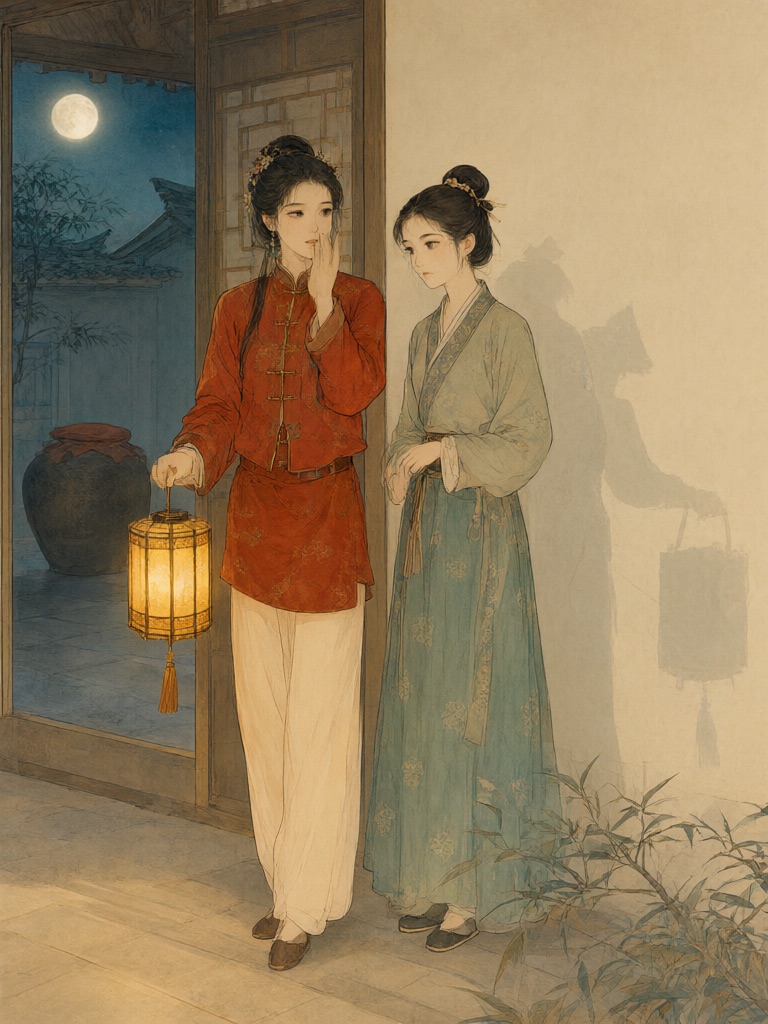
Feng of Guangping was frivolous as a young man and given to drink. Out walking one morning at first light, he came upon a young girl in a red cape, very pretty, followed by a little serving boy, hurrying along through the dew with her shoes and stockings soaked. He took a secret fancy to her. At dusk, coming home drunk, he passed an old temple by the roadside, long abandoned, and a girl came out of it — the same beauty as before. Suddenly seeing him approach, she turned and went back inside. Feng thought, "What would a beauty be doing in a temple?" He tethered his donkey at the gate and went in to look into this strange business. Inside, the walls were broken and crumbling and the steps were carpeted with fine grass. As he was wandering about, a grey-haired old man came out, neatly dressed and capped, and asked, "Where have you come from, sir?" Feng said, "I happened to be passing this old temple and wanted to look around." Then he asked, "And what brings you here, old sir?" The old man said, "I'm a wanderer with nowhere to live, and I have borrowed this place for the time being to settle my little family. Since you have honoured us with a visit, mountain tea will have to serve for wine." And he ushered his guest in. Behind the main hall Feng saw a courtyard whose stone paths were bright and clean, with no trace of brambles. Inside the room there were curtains, hangings and bed-drapes, and a cloud of fragrance met him. When they had sat down and exchanged names, the old man said, "My humble name is Xin." Feng, emboldened by drink, blurted out, "I hear you have a daughter not yet matched with a good husband. I may not be worthy, but I'd like to offer myself, with a mirror-stand as my betrothal gift." Xin smiled. "Let me discuss it with my wife." Feng at once called for a brush and wrote a poem: "A thousand in gold to seek the jade pestle — / I'd carry it gladly in my own two hands; / If Yunying should only be willing, / Myself I would pound the dark frost for her." The host smiled and handed it to his attendants.
Shortly a maid came and whispered in Xin's ear. Xin rose, asked his guest to be patient and sit a while, and went in through the curtain; a few indistinct words were spoken and he hurried out again. Feng felt sure there would be good news, but Xin simply sat chatting and laughing with him and said nothing more. Feng could not bear it and asked, "I still don't know what you think — please put my mind at rest." Xin said, "You are a man of rare distinction, sir, and I have long admired you, but I have private reasons I dare not speak of." Feng pressed him, and Xin said, "I have nineteen daughters, twelve of them married. Their marriages are left to my wife; I have no say." Feng said, "All I want is the one who was out this morning with a little serving boy, walking through the dew." Xin did not answer, and they sat facing each other in silence. Hearing soft, sweet voices murmuring inside, Feng, emboldened by drink, swept aside the curtain: "If I can't have her as my wife, at least let me see her face to ease my disappointment." Those inside, hearing the curtain hooks rattle, all stood up and stared in alarm. There indeed was the girl in red, shaking out her sleeves, her hair-knot bowed, standing slim and graceful and twisting her sash. Seeing Feng burst in, the whole room fell into a flurry. Xin was furious and had several people drag Feng out. The wine rose to his head more than ever; he collapsed among the brambles, and tiles and stones rained down around him, though luckily none struck him.
After lying there a while, he heard his donkey still munching grass by the road, so he got up, mounted and rode off unsteadily. The night was dark and murky, and he strayed into a ravine where wolves ran and owls shrieked, so that his hair stood on end and his heart went cold. He hesitated, looking all around, with no idea where he was. Far off in a dark wood he saw lamplight flickering, and thinking it must be a village, he rode straight for it. Looking up, he saw a tall gateway, and he rapped on the gate with his whip. A voice inside asked, "Who comes here in the middle of the night?" Feng said he had lost his way, and the voice said, "Wait while I tell the master." Feng stood shifting from foot to foot, craning his neck. Suddenly he heard the bolt drawn and the gate opened, and a sturdy servant came out and took the guest's donkey. Feng went in and found the house very fine, with lamps lit in the hall. After he had sat a little while, a woman came out and asked his name, and he told her. A moment later several maids in dark blue helped an old lady out, announcing, "Her Ladyship the Commandery Lady." Feng stood and was about to bow respectfully, but the old lady stopped him and had him sit. She said to him, "Aren't you the grandson of Feng Yunzi?" "I am," he said. "Then you must be my grand-nephew," said the old lady. "My bell has rung and my water clock has run dry; my years are nearly at an end, and among my own flesh and blood there are many I have lost touch with." Feng said, "I lost my father when I was little, and of the people my grandfather knew I can't name one in ten. I've never paid my respects to you before — please tell me who you are." The old lady said, "You'll find out for yourself." Feng dared not ask again, and sat there puzzling over it.
The old lady said, "What brings you here so late at night, nephew?" Feng, who prided himself on his nerve, told her everything that had happened. She laughed. "But this is splendid! Besides, you're a gentleman of note — you'd be no disgrace to any family. What right has that wild fox spirit to give herself airs? Don't you worry, nephew; I can get her for you." Feng thanked her over and over. The old lady turned to her attendants: "I had no idea the Xin family's daughters were so lovely." One of the maids said, "They have nineteen daughters, all of them graceful and stylish. Which one is it the gentleman wants to marry?" Feng said, "She's about fifteen or a little more." The maid said, "That's Fourteenth Daughter. In the third month she came with her mother to wish Your Ladyship a happy birthday — how could you have forgotten?" The old lady laughed. "Isn't that the one who wore high shoes carved like lotus petals and filled with scented powder, and walked about veiled in gauze?" "That's her," said the maid. "That girl knows how to put on airs and play the coquette," said the old lady. "But she certainly is lovely; my nephew has a good eye." Then she told the maid, "Send Little Cat to fetch her." The maid agreed and went.
A while later the maid came in to report, "Fourteenth Daughter of the Xin family is here." At once a girl in red appeared and bowed low to the old lady. The old lady said, "From now on you're to be my grand-nephew's wife — no need for a maid's curtsey." The girl rose and stood there, slender and graceful, her red sleeves hanging low. The old lady smoothed her hair at the temples and twiddled her earrings. "What have you been up to in your chamber lately, Fourteenth?" The girl answered softly, "Just a little embroidery when I've nothing else to do." Turning her head and seeing Feng, she shrank back shyly, ill at ease. The old lady said, "This is my grand-nephew. He kindly wanted to make a match with you — why did you let him lose his way and blunder about the ravines all night?" The girl hung her head and said nothing. The old lady said, "I called you here for no other reason than to act as go-between for my grand-nephew." The girl only stayed silent. The old lady ordered the couch swept and the bedding spread, to have them married on the spot. The girl blushed and said, "I must tell my parents first." The old lady said, "I'm the one making the match — what could go wrong?" The girl said, "My parents would never dare disobey Your Ladyship's command; but to do it so hastily — I would rather die than obey!" The old lady laughed. "A young girl whose will can't be forced — she's a true wife for my grand-nephew!" Then she pulled a golden flower from the girl's hair and gave it to Feng to keep. She told him to go home, consult the almanac and fix an auspicious day. Then she had a maid see the girl home. Hearing the cocks crowing in the distance, she sent someone leading the donkey to see Feng out. A few steps away, Feng suddenly looked back: the houses had vanished, and there was nothing but dense black pines and catalpas and grave mounds overgrown with weeds. After collecting his thoughts for a while, he realised the place was the tomb of Minister Xue.
Xue had been the younger brother of Feng's late grandmother, which was why she had called him nephew. Feng knew now that he had met ghosts, but he still did not know who Fourteenth Daughter was. Sighing, he went home and looked through the almanac half-heartedly to fix a day, though he feared a ghost's promise could not be relied on. He went back to the old temple and found the halls desolate; when he asked the local people, they said foxes were often seen in the temple. He thought to himself, "If I can get that beauty, a fox would suit me fine." On the appointed day he had the house cleaned and the path swept and sent servant after servant out to watch for her, but at midnight all was still quiet, and Feng had given up hope. Then suddenly there was a commotion outside the gate. He rushed out in his slippers to look and saw an embroidered carriage already standing in the courtyard, and two maids with their hair in double loops helping the girl into the bridal tent. There was not much of a dowry — only a money jar as big as a vat, carried on poles by two long-bearded servants, who set it down in a corner of the hall. Feng was so happy to have such a lovely bride that he never suspected she was not human. He asked her, "Just a dead ghost — why is your family so much in awe of him?" She said, "Minister Xue is now the Circuit Inspector of the Five Capitals, and all the ghosts and foxes for hundreds of miles serve in his retinue, so he is seldom at home in his tomb." Feng had not forgotten his go-between, and the next day he went to make offerings at the tomb. When he came back he found two maids bringing a gift of patterned brocade; they left it on the table and went. Feng told his bride, and she said, "That's from the Commandery Lady."
In the same county lived the son of Commissioner Chu of the Office of Transmission, who had studied alongside Feng as a boy and was on very familiar terms with him. Hearing that Feng had got himself a fox wife, he sent wedding gifts and came in person to drink a toast. A few days later he sent a note inviting Feng to drink with him. When she heard of it, Fourteenth Daughter said to Feng, "When the young gentleman came, I made a hole in the wall and peeped at him. He has the eyes of an ape and the beak of a hawk — you can't keep company with him for long. Better not go." Feng agreed. The next day young Chu came to the door to reproach him for breaking his engagement, and to show him some new compositions. Feng's comments were laced with mockery; Chu was deeply humiliated, and they parted on bad terms. Feng went back to his room and told the story laughing, but Fourteenth Daughter said sadly, "That young man is a jackal and a wolf — you can't trifle with him! You won't listen to me, and disaster is coming!" Feng laughed and apologised.
After that, whenever Feng and young Chu met they flattered each other and joked, and the old grudge gradually faded. Then came the director of education's examination: Chu came first and Feng second. Chu was smugly pleased with himself and sent a servant to invite Feng to drink; Feng declined, but after repeated invitations he went. When he arrived he found it was Chu's birthday, with the hall full of guests and a lavish banquet laid out. Chu brought out his examination paper to show Feng, and friends and relatives crowded shoulder to shoulder praising it. After several rounds of wine, music struck up in the hall, the drums and pipes loud and coarse, and host and guests were all very merry. Suddenly Chu said to Feng, "The proverb says, 'In the examination hall, don't argue about writing.' Now I know it's wrong. The reason I had the honour of ranking above you is just that my opening lines were a cut above yours." When he had spoken, the whole company joined in praise. Feng, drunk, could not contain himself and burst out laughing: "And to this day you still think that's what makes good writing!" When he had spoken, the whole company blanched. Chu was choked with shame and rage. The guests gradually left, and Feng slipped away too. When he sobered up he regretted it, and told Fourteenth Daughter. She was displeased. "You really are a frivolous country lout! Treat a gentleman with such flippancy and you ruin your own virtue; treat a petty man so and you will get yourself killed. Disaster is not far off! I can't bear to see you ruined — let me take my leave of you now." Feng was frightened and wept, and told her how sorry he was. She said, "If you want me to stay, you must promise me this: from now on keep your door shut, give up your social life, and no more reckless drinking." Feng respectfully accepted her advice.
Fourteenth Daughter was thrifty and hardworking, yet free and easy in manner, and spent her days spinning and weaving. Now and then she went home to visit her family, but never stayed overnight. From time to time she also put out money and silk to earn a living, and whatever was left over each day she dropped into the money jar. She kept the gate shut every day, and whenever anyone came to call she had the old servant send them away with apologies.
One day young Chu sent a letter post-haste; Fourteenth Daughter burned it without telling Feng. The next day Feng went into town to offer condolences and met Chu at the house of mourning. Chu seized his arm and begged him to come; Feng made excuses. Chu had his groom take Feng's bridle, and they hustled him off. At the house Chu at once ordered a rich feast. Feng said he wanted to leave early, but Chu kept blocking his way, and brought out his household singing girls to play the zither for them. Feng had always been unrestrained, and had been feeling stifled, shut up at home all this time; now, suddenly offered a real drinking bout, his spirits soared and he forgot everything else. He got thoroughly drunk and fell asleep where he sat. Chu's wife, Madam Ruan, was ferociously jealous; the maids and concubines did not dare wear rouge or powder. A few days earlier a maid had gone into the study and been caught there by Madam Ruan, who beat her over the head with a stick, cracking her skull and killing her on the spot. Ever since Feng had mocked him, Chu had borne him a grudge and thought day after day of revenge; so he plotted to get Feng drunk and frame him. While Feng lay in a drunken sleep, they carried the body onto the bed, closed the door and went away. At the fifth watch Feng sobered up and found himself lying on a table. Getting up to look for a pillow and bed, he felt something clammy tangling his feet. He felt it: it was a person. He supposed the host had sent a servant to sleep beside him. He nudged it with his foot; it did not move. He lifted it: it was stiff. Horrified, he ran out of the door shouting wildly. All the servants got up and brought lights; seeing the body, they seized Feng in an uproar. Chu came out to examine it, accused Feng falsely of forcing himself on the maid and killing her, and had him arrested and sent to the prefecture at Guangping. Only the next day did Fourteenth Daughter hear of it. Weeping, she said, "I knew it would come to this!" From then on she sent Feng money every day. Feng appeared before the prefect but could get no hearing for his side, and was flogged morning and night until the skin was stripped from his flesh. Fourteenth Daughter came herself to see him; at the sight of her, grief choked his heart and he could not speak. She saw how deep the trap was, and urged him to make a false confession to spare himself further torture. Weeping, Feng did as she said.
As Fourteenth Daughter came and went, people right beside her could not see her. Back home she sighed and lamented, and at once sent her maid away somewhere. After living alone for a few days, she had a matchmaker buy her a girl of good family named Lu'er, just fifteen and very pretty, who ate and slept with her and whom she treated with far more affection than the other servants. Feng was convicted of manslaughter and sentenced to strangling. When the old servant came back with the news, he was sobbing too hard to speak. Fourteenth Daughter heard it calmly, as though it meant nothing to her. But when the day for the autumn executions was fixed, she began to grow frantic, out all day and back at night, never resting. Often, somewhere quiet, she would sob in grief, until she could neither sleep nor eat. Then one day, late in the afternoon, the fox maid suddenly came back. Fourteenth Daughter jumped up and took her aside to talk privately. When she came out her face was wreathed in smiles, and she went about the household as usual. The next day the old servant went to the prison, and Feng sent word asking his wife to come for a last farewell. When the servant reported back, she answered vaguely, showing no grief at all and treating it very offhandedly; the household whispered about how hard-hearted she was. Suddenly the news was buzzing on every road: Commissioner Chu had been dismissed, and the Intendant of Pingyang had been ordered by special imperial decree to try Feng's case. The old servant heard and joyfully told his mistress. She too was delighted, and at once sent him to the prefecture to see Feng — who had already been released, and they met with mingled grief and joy. Soon young Chu was arrested and brought in; at a single hearing the whole truth came out. Feng was released at once and sent home. When he saw his wife he wept, and she too was overcome with sorrow; then their grief turned to joy, but he still had no idea how his case had come to the emperor's ears. Fourteenth Daughter smiled and pointed at the maid: "Here's the one you have to thank." Feng, astonished, asked what she meant.
Earlier, Fourteenth Daughter had sent the maid to the capital to try to reach the palace and lay Feng's wrongs before the throne. But when the maid arrived, she found the palace guarded by gods, and she wandered along the imperial moat for months unable to get in. Afraid of failing in her errand, she was about to come home to think again when she heard that the emperor was to make a progress to Datong. So she went there ahead of him and posed as a wandering courtesan. When the emperor came to the pleasure quarter, she won his special favour. He suspected she did not seem like a woman of that world, and she began to weep. "What is your grievance?" the emperor asked. The maid replied, "My home is at Guangping in Zhili; I am the daughter of a licentiate named Feng. My father is about to die because of a false charge, and so I was sold into the pleasure quarter." The emperor was moved to pity and gave her a hundred taels. Before leaving, he asked her about the case in detail and wrote down the name on paper; and he said he wished her to share his riches and honours. The maid said, "If only father and child can be reunited, I have no wish for luxury." The emperor nodded and left. The maid told Feng all this. Feng sprang up and bowed to her, his eyes glistening with tears.
Not long afterwards Fourteenth Daughter suddenly said to Feng, "If it weren't for the bonds of love, how would I ever have come by such troubles? When you were arrested, I ran from one relative to another, and not a single one would help me with a plan. The bitterness I felt then is truly beyond words. Now this dusty world wearies and pains me more and more. I have already got a good wife ready for you; let us part here." When Feng heard this he threw himself down weeping and would not get up, and so she let it drop. That night she sent Lu'er to wait on Feng in bed, but he refused her. In the morning he saw that Fourteenth Daughter's beauty had suddenly faded; after another month or so she was growing old; and by half a year she was dark and haggard as a village crone. Feng still respected her and never changed toward her. Then suddenly she spoke of parting again, saying, "You have a fine companion of your own — what do you want with an old hag like me?" Feng wept and pleaded as before. Another month passed, and she was taken suddenly ill; she would neither eat nor drink, and lay wasting in her room. Feng tended her with soup and medicine as though serving his own parents. Neither shamans nor doctors could help, and at last she died. Feng was nearly beside himself with grief. With the money that had been bestowed on the maid, he paid for the Buddhist rites and the burial. A few days later the maid left too, and he took Lu'er as his wife.
A year later Feng had a son. But there were poor harvests year after year, and the family sank lower and lower. Husband and wife were at their wits' end and sat gloomily facing their own shadows. Then Feng suddenly remembered the money jar in the corner of the hall; he had often seen Fourteenth Daughter drop coins into it, and wondered whether they were still there. Going over to it, he found it covered with jars of fermented beans and pots of salt. He moved them off one by one and probed inside with a chopstick, but it was packed too hard to go in. He smashed the jar, and money came pouring out. From then on they were suddenly very well off.
Later the old servant went to Mount Taihua and met Fourteenth Daughter riding a grey mule, with the maid following on a donkey. She asked, "Is Master Feng well?" And she said, "Give your master my regards. My name is now entered on the rolls of the immortals." With that she vanished.