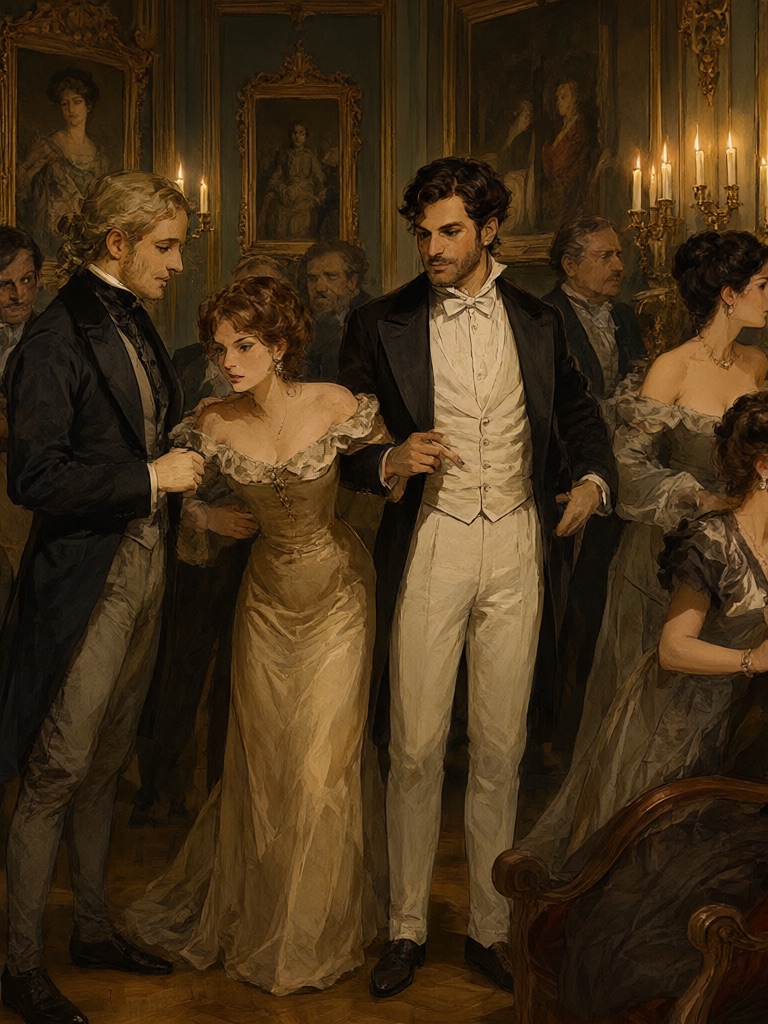
There was a certain student from Shuntian whose family was poor; in a year of famine he went with his father to Luoyang. He was slow by nature: at seventeen he could barely put a composition together. But he was handsome and graceful, witty in an elegant way, and a fine letter-writer, so that people who met him never guessed how empty he was inside. Before long his parents died one after the other, and, left all alone, he taught village children their first letters on the banks of the Luo. In the village at that time there was an orphaned girl of the Yan family, descended from a well-known scholar. She had been clever from childhood. While her father was alive he taught her to read, and anything she read once she never forgot. At ten or so she was learning to write poems from him. Her father would say, "We have a lady scholar in our house — a pity she can't wear a man's cap." He adored her and hoped to choose a distinguished husband for her. After he died her mother held to his wish, but in three years nothing came of it, and then her mother died too. Someone advised her to marry a man of talent; she agreed, but no match had yet been made.
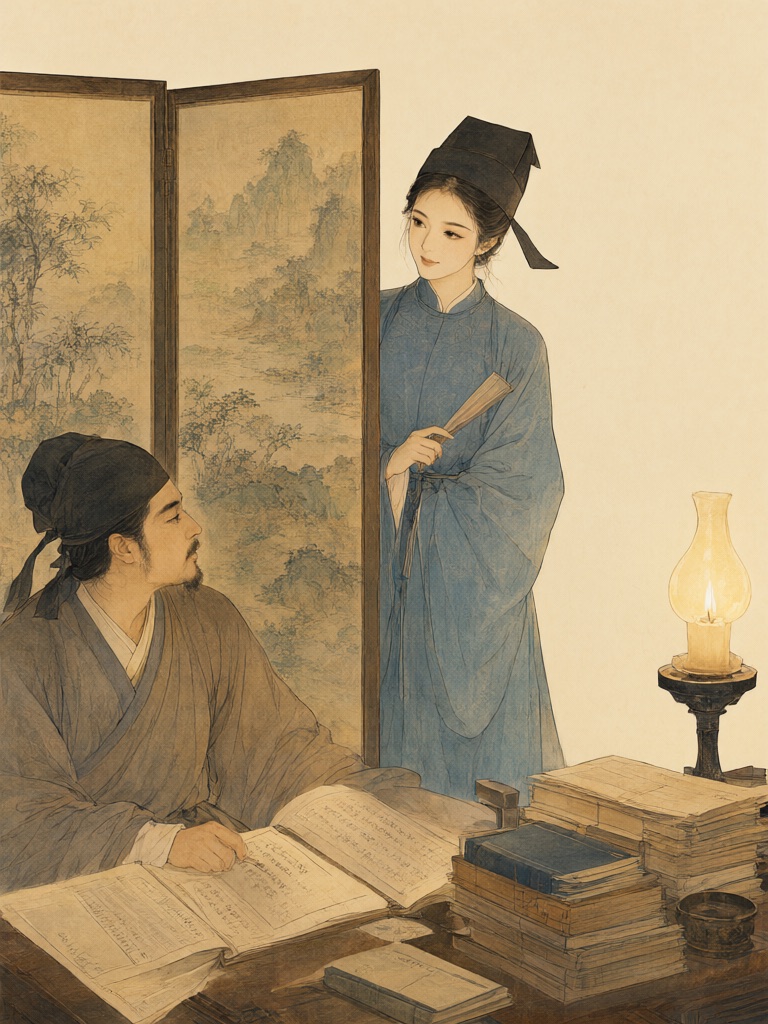
It happened that a neighbour woman climbed over the wall to chat with her. She had some embroidery thread wrapped in a sheet of paper with writing on it; the girl unwrapped it and found it was a letter in the student's own hand, written to the neighbour's husband. She read it over and over and liked it very much. The neighbour woman saw what was on her mind and whispered, "He's a dashing, handsome young man, an orphan just like you, and about your age. If you're interested, I'll have my husband bring you together." The girl gazed at her and said nothing. The neighbour woman went home and passed the idea on to her husband. He was already a good friend of the student, and when he told him, the student was overjoyed. He had a pair of gold crow-shaped earrings left to him by his mother, and asked the neighbour to deliver them as a betrothal gift. A day was fixed, the wedding was held, and the two got on like fish and water. But when she saw her husband's writing, she laughed: "Your writing and you seem like two different people. At this rate, when will you ever pass?" Morning and evening she urged him to study, as strict as a teacher and friend. At dusk she would be first to trim the candle and sit down at the desk reciting aloud, to set him an example, and only stopped when the water clock struck the third watch. After a year or so of this the student had become quite proficient at examination essays; but he sat twice and failed twice, getting nowhere and making no name for himself, without even enough to eat. Desolate and miserable, he wailed and wept.
She scolded him: "You're no man — you don't deserve that cap! If I could trade my hair-knot for a cap, I'd treat the purple and blue robes of high office like blades of grass!" The student, already in despair, glared at her angrily. "You women in your chambers have never set foot in an examination hall, so you think rank and riches are as easy as drawing water and boiling rice gruel in your kitchen. Put a cap on your head and I daresay you'd do no better than anyone else!" She laughed. "Don't be angry. When the examination comes round, let me change into men's clothes and go in your place. If I end up as hopeless as you, I'll never look down on the scholars of the world again." The student laughed too. "You don't know how bitter cork-tree bark is — you really should have a taste of it. Only I'm afraid you'd be found out, and the neighbours would laugh at us." She said, "I'm not joking. You've told me you still have the old family house up in Yan. Let me go back there with you dressed as a man and pass as your younger brother. You left there in swaddling clothes — who could tell I'm not?" The student agreed. She went into her room and came out in a man's cap and gown. "Look — can I pass for a man?" He looked: she was every inch a handsome young man fit to admire his own reflection.
The student was delighted, and took leave of everyone in the village. Friends gave them small parting gifts, and he bought a scrawny donkey and took his wife home on it. His cousin was still living there, and when he saw his two young kinsmen, both handsome as jade, he was overjoyed and looked after them morning and night. And when he saw them toiling at their books day and night, he loved and respected them all the more. He hired a little servant boy with cropped hair to run errands for them; after dark they always sent him away. When there were weddings or funerals in the district, the elder brother went out to deal with them; the younger brother simply stayed behind the curtain and read. In half a year hardly anyone had seen his face. When visitors asked to meet him, the elder brother always made excuses for him. Those who read his writing stared in astonishment. Some pushed through the door to force a meeting, but he would give a single bow and vanish. Having glimpsed his fine looks, the visitors were all the more taken with him. His fame spread far and wide, and great families vied to have him as a son-in-law. When the cousin raised the matter with him, he only smiled. Pressed again, he said, "I have set my heart on rising high. Until I pass, I will not marry."
Then the provincial director of education came to hold the examinations, and both of them sat. The elder brother failed again. The younger brother, placed first, went on to the provincial examination and came fourth in Shuntian; the next year he became a metropolitan graduate and was appointed magistrate of Tongcheng, where he governed with distinction. Soon he was promoted to seal-holding censor for the Henan circuit, with wealth to rival a prince. Then, pleading illness, he begged leave to retire, and was granted permission to return home. Guests crowded his gate, but he turned them all away. Moreover, from his days as a student right up to high office he had never once spoken of marrying, and there was no one who did not find it strange.
After coming home, he gradually acquired some maidservants. Some suspected him of carrying on with them, but his sister-in-law watched closely and found nothing improper at all. Before long the Ming dynasty fell and the empire was thrown into chaos. Then he said to his sister-in-law, "I'll tell you the truth: I am your younger brother-in-law's wife. My husband was so useless he couldn't make his own way, so in a fit of pique I did it myself. I was terrified it would get out and the Emperor would summon me for questioning, and I'd be the laughing-stock of the whole country." The sister-in-law didn't believe it. She pulled off her boots to show her feet, and only then was the sister-in-law astounded; looking inside the boots, she found them stuffed full of old cotton wadding. And so she had her husband take over her title, while she herself shut the door and went back to living quietly as a woman. But she never bore a child, so she paid out money to buy her husband a concubine. She said to him, "When most men rise to high office, they buy concubines to wait on them. I was an official for ten years and stayed on my own the whole time. What great good fortune have you got, to sit back and enjoy a beauty?" The student said, "Thirty handsome male favourites — please, go and get them for yourself." The story was repeated everywhere as a joke. By this time the student's parents had several times received honours from the throne. Gentlemen of the district came to call and treated him with the ceremony due to a censor. But the student was ashamed to bear the title his wife had won; he contented himself with being a plain licentiate, and never once in his life rode in an official's sedan chair.