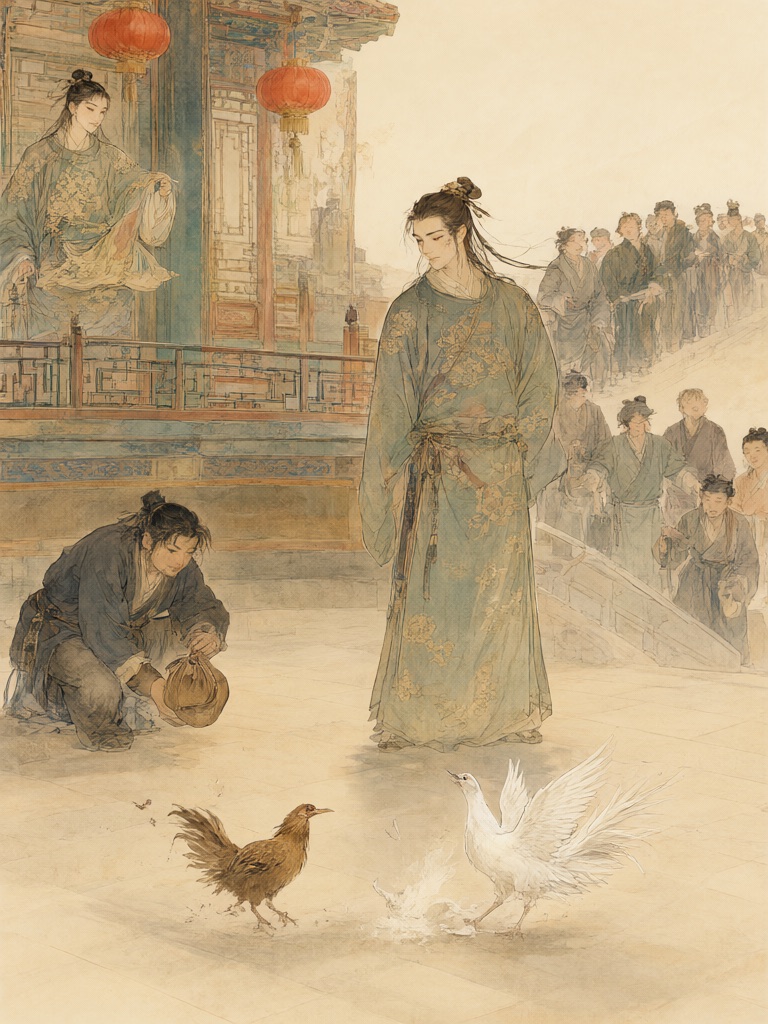
Wang, later a minister of the Court of Imperial Sacrifices, was a native of Yue. When he was a small boy, he was lying on his bed one afternoon when the sky suddenly darkened and a tremendous clap of thunder broke. A creature somewhat bigger than a cat came and crouched beneath him, twisting and turning and refusing to leave. After a while the sky cleared and the creature went straight out. Only when he looked did he see it was no cat, and he took fright and called to his elder brother in the next room. Hearing the story, his brother said happily, "You're sure to rise high. That was a fox hiding from its tribulation of thunder." Sure enough, he passed the highest examination while still young and rose from county magistrate to censor at court. He had a son named Yuanfeng who was utterly simple-minded: at sixteen he could not tell male from female, and so no family in the district would marry a daughter to him.
Wang worried over this. Then one day a woman came to the door with a young girl, offering her as a bride. The girl had a lovely smile; she was truly a fairy. Delighted, they asked their names. The woman said, "Our name is Yu. My daughter is Xiaocui; she's sixteen." They began to discuss a betrothal gift. She said, "With me she can't even get her fill of husks and chaff. If she can live in a great house, with maids and servants to order about and rich food till she's sick of it, and she's happy, then I'm content. Am I selling vegetables, to haggle over a price?" The lady of the house was delighted and treated them generously. The woman at once had her daughter bow to Wang and his wife, and told her, "These are your father- and mother-in-law. Serve them carefully. I'm very busy, so I'll go for now and come back in three or four days." Wang ordered servants and a horse to see her home, but she said, "My lane isn't far. Don't trouble yourselves." And she went out the gate.
Xiaocui showed no sadness at all at the parting, and went straight to rummaging in her dowry box for embroidery patterns. The lady of the house grew fond of her too. Several days passed and the woman did not come back. When they asked Xiaocui where she lived, she only looked blank and could not tell them the way. So they made ready a separate courtyard and had the young couple married. When the relatives heard that the Wangs had picked up a poor family's girl as a bride, they all laughed and sneered; but every one of them was astonished on seeing her, and the gossip died down. Xiaocui was also very clever and could read her in-laws' moods. Wang and his wife doted on her beyond the usual, yet they lived in dread that she would despise their son for his simpleness. But she was always cheerful and showed no dislike of him. Only she loved to play pranks. She stitched cloth into a ball and kicked it about for fun. In her little leather boots she would kick it dozens of paces away and trick the young master into running to fetch it, and he and the maids were forever chasing it in a sweat, one after another.
One day Wang happened to pass by, and the ball came flying and struck him full in the face. Xiaocui and the maids all slipped away, but the young master went on leaping and running after it. Wang, furious, threw a stone at him, and only then did he drop down and cry. Wang told his wife; she went to scold Xiaocui, who hung her head with a little smile and picked at the edge of the bed with her finger. As soon as the lady left, she was romping just as before, and painted the young master's face with rouge and powder until he looked like a demon. When the lady saw it she was beside herself and called Xiaocui in for a tongue-lashing. Xiaocui leaned on a side table toying with her sash, neither afraid nor saying a word. The lady could do nothing with her, so she beat her son instead. Yuanfeng howled, and only then did Xiaocui's face change; she fell to her knees and begged for mercy. The lady's anger melted at once; she dropped the stick and went away. Xiaocui, laughing, pulled the young master into their room, brushed the dust off his clothes, wiped his tears, rubbed the welts, and fed him dates and chestnuts. Then he stopped crying and was happy. Xiaocui shut the courtyard gate and dressed him up again as the Hegemon King of Chu, or as a man of the desert, while she herself put on gorgeous clothes, cinched her slender waist, and danced like the beauty in the king's tent; or she stuck pheasant plumes in her hair and plucked the pipa, plink-plunk, filling the room with noise and laughter. It was like that every day.
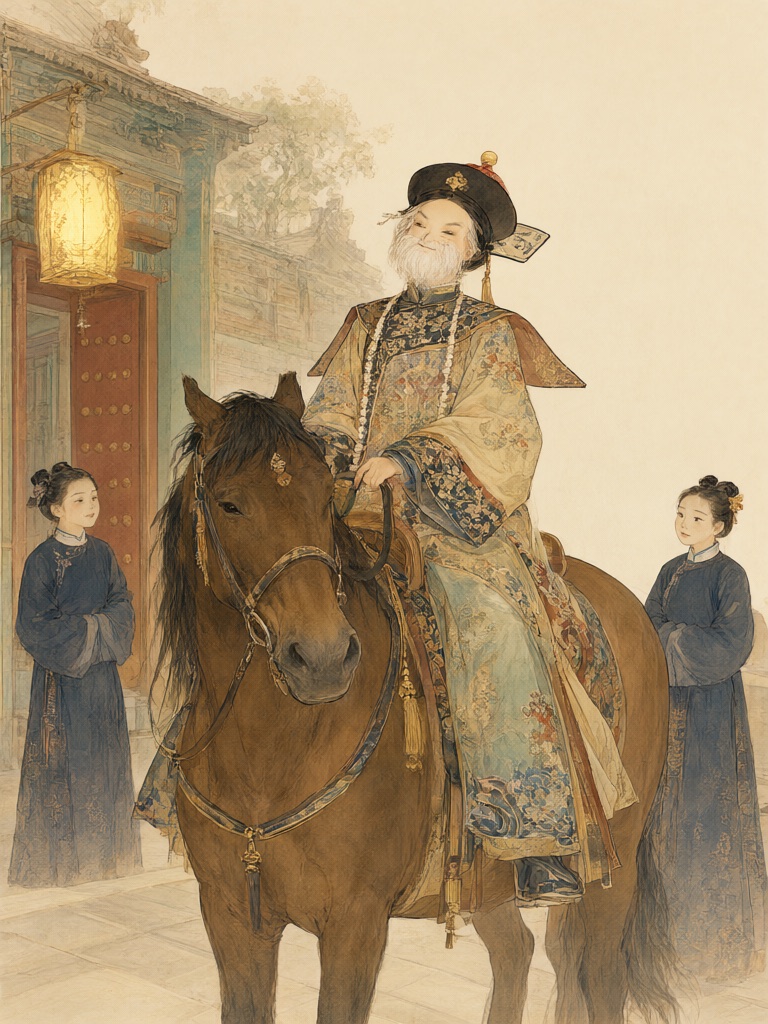
Because his son was simple, Wang could not bring himself to be too hard on his daughter-in-law; even when he caught wind of things, he let them pass. In the same lane, a dozen-odd doors away, lived Supervising Secretary Wang, who had never got along with him. It was the year of the triennial review of officials, and the Secretary, jealous that Wang held the seal of the Henan Circuit, was plotting to bring him down. Wang knew of the scheme and was sick with worry, with no idea what to do. One evening, after he had gone to bed early, Xiaocui put on an official's cap and sash and got herself up as the Minister of Personnel, with white silk thread trimmed into a thick beard, and dressed two maids in dark clothes as her attendants. Then she slipped out on a horse from the stable, joking, "I'm off to call on Mr. Wang." She rode up to the Secretary's gate, then lashed her attendants with her whip and said loudly, "It's Censor Wang I've come to see. Why would I call on Supervising Secretary Wang?" And she turned her horse and rode home. When she reached the gate, the gatekeeper took her for the real minister and ran to tell Wang. Wang hurried out to welcome the visitor and discovered it was his daughter-in-law's prank. Furious, he said to his wife, "The man is just looking for a flaw in me, and she goes and carries the scandal of our inner chambers to his very door! Disaster is not far off!" His wife, enraged, rushed into Xiaocui's room and berated her. Xiaocui only giggled and said not a word in her defense. To beat her, they hadn't the heart; to send her away, she had no home to go to. Husband and wife fretted and fumed and lay awake all night.
At that time a certain lord was Minister of Personnel and enormously powerful, and his bearing, dress and retinue were no different from Xiaocui's disguise, so the Supervising Secretary too took it for the real thing. He sent men again and again to watch Wang's gate, and when the visitor had still not come out by midnight, he suspected the minister and Wang of plotting something together. At court the next morning he met Wang and asked, "Did His Excellency visit your house last night?" Wang thought he was mocking him, and only mumbled assent, red-faced, without really answering. The Secretary grew more suspicious than ever, dropped his scheme, and from then on courted Wang's friendship all the more. When Wang found out why, he was secretly pleased, but he still quietly told his wife to urge Xiaocui to mend her ways. Xiaocui laughingly agreed.
A year later the chief minister was dismissed, and a private letter meant for Wang happened to be delivered to the Supervising Secretary by mistake. Delighted, the Secretary first sent a friend of Wang's to ask him for a loan of ten thousand taels, and Wang refused. So the Secretary came to Wang's house himself. Wang searched for his cap and robe and could not find them anywhere; the Secretary waited a long time, grew angry at the slight, and was about to storm off when he suddenly saw the young master in the imperial dragon robe and crown, pushed out of a door by a young woman. He was aghast; then, smiling, he patted the boy, took off the robe and crown, and carried them away. Wang hurried out, but his visitor was already far off. When he heard what had happened, his face went the color of earth, and he wailed, "She's a curse on this house! Any day now our whole clan will be wiped out!" He and his wife took up sticks and went after her. Xiaocui already knew; she bolted her door and let them rage. Wang, furious, took an axe to the door. From inside, Xiaocui said with a laugh in her voice, "Don't trouble yourself with anger, father! While your daughter-in-law is here, saw, axe or blade, I'll take it myself; I'll never let harm come to you two. If you go on like this, it's as if you want to kill me to keep me quiet." At that Wang stopped.
Back home, the Secretary did indeed submit a memorial accusing Wang of treason, with the robe and crown as evidence. The emperor, alarmed, examined them himself: the crown was made of sorghum-stalk pith, and the robe was a worn-out yellow wrapping cloth. The emperor was angry at the false accusation. He also summoned Yuanfeng, and seeing how endearingly simple he was, laughed: "Could this one be an emperor?" So he handed the Secretary over to the judiciary. The Secretary then charged that there was a sorceress in Wang's house, but when the court questioned the household servants sternly, they all said there was nothing of the kind, only a mad wife and a simple son who spent their days in play; and the neighbors said the same. So the case was closed, and the Secretary was banished to serve in the army in Yunnan. From then on Wang thought Xiaocui remarkable. And because her mother had never come back, he suspected she was not human. He had his wife sound her out, but Xiaocui only laughed and said nothing. When pressed again, she covered her mouth and said, "I'm the daughter of the Jade Emperor. Didn't you know, mother?"
Before long Wang was promoted to a minister's post in the capital. He was past fifty and often fretted that he had no grandson. Xiaocui had been in the house three years, yet every night she and the young master slept in separate beds, and it seemed they had never been intimate. The lady had one of the beds carried away and told her son to sleep with his wife. A few days later the young master said to his mother, "You borrowed my bed and you won't give it back! Every night Xiaocui puts her legs across my belly so I can't breathe, and she's always pinching the inside of my thigh." Every maid and old nurse burst out laughing. The lady scolded him, gave him a pat, and sent him off.
One day Xiaocui was bathing in her room. The young master saw her and wanted to bathe with her; she laughed and stopped him, telling him to wait a little. When she came out, she poured fresh scalding water into the big jar, stripped off his robe and trousers, and with a maid's help lifted him in. Feeling stifled by the steam, he shouted to get out. Xiaocui ignored him and covered him over with a quilt. After a while there was no sound; they uncovered him and found he had stopped breathing. Xiaocui laughed calmly, not the least alarmed, dragged him onto the bed, dried him off, and covered him with a double quilt. Hearing of it, the lady came in weeping and cursed her: "Mad girl, why have you killed my son?" Xiaocui smiled and said, "A son as simple as that, better not to have one at all." The lady, more furious than ever, butted at Xiaocui with her head, and the maids rushed to pull her away and calm her. In the midst of the uproar a maid called out, "The young master is moaning!" The lady stopped weeping and felt him: he was breathing faintly and sweating heavily, soaking the bedding. After about the time it takes to eat a meal, the sweating stopped. Suddenly he opened his eyes and looked around, peering at each of the household as if he did not know them, and said, "Now when I think back on the past, it all seems like a dream. Why is that?" The lady, finding that he no longer talked like a simpleton, was amazed. She took him to his father, who tested him again and again: he was simple no longer. They were overjoyed, as if they had found a rare treasure. That evening they put the second bed back where it had been and laid out quilts and pillows on it, to see what would happen. The young master went into the room and sent all the maids away. When they peeked in early the next morning, the second bed had not been slept in. From then on there was no more simpleness or madness, and the couple lived in perfect harmony, inseparable as body and shadow.
A year or so later, Wang was impeached by the Supervising Secretary's allies and dismissed from office, with some minor charges against him besides. He had a jade vase, a gift from the Governor of Guangxi, worth thousands of taels, which he meant to use to bribe those in power. Xiaocui loved it and was turning it in her hands when it slipped and smashed. Ashamed, she went and confessed. Wang and his wife, already upset at his dismissal, flew into a rage when they heard and both railed at her. Xiaocui stormed out and said to the young master, "I've saved far more than a vase in your family. Why can't they leave me even a little dignity? I'll tell you the truth: I am not human. When my mother faced her tribulation of thunder, your father sheltered her, and we owe him deeply; and you and I were fated to have five years together. So I was sent to repay that old kindness and fulfill our destiny. I've been spat on and cursed more times than there are hairs on my head. The only reason I didn't leave at once was that our five years of love weren't yet complete. How can I stay a moment longer now?" She swept out in a fury, and when they ran after her she was already gone. Wang was stunned, and his regret came too late.
The young master went into their room, saw the powder she had left and her little shoes, and wept as if he would die. He could neither eat nor sleep, and wasted away day by day. Wang, greatly worried, hastened to find him a new wife to ease his grief, but the young master took no pleasure in it. All he wanted was to have a skilled painter make a small portrait of Xiaocui, and day and night he poured libations and prayed before it, for nearly two years. Once, coming home on some business from another village, when the bright moon had already risen, he rode past the outside wall of a garden pavilion the family owned beyond the village. Hearing laughter and voices, he reined in, had the groom hold the bridle, stood up on the saddle and looked over: two young women were playing inside.
Clouds dimmed the moon and he could not make them out clearly. He only heard one in green say, "You hussy, you ought to be thrown out!" One in red said, "You're in my family's garden, and you want to throw out whom?" The one in green said, "Shameless girl! You couldn't manage being a wife, you got driven out, and you still lay claim to the property?" The one in red said, "Still better than an old maid nobody will have!" The voice was just like Xiaocui's, and he called to her eagerly. The one in green walked off, saying, "I won't argue with you for now. Your man is here." Then the one in red came over, and it was indeed Xiaocui. He was overjoyed. She had him climb onto the wall and helped him down, saying, "Two years apart, and you're nothing but a handful of bones!" He clasped her hands in tears and told her all his longing. She said, "I know. But I couldn't face your family again. Today I was out playing with my eldest sister, and here we meet again: proof enough that what is fated can't be escaped." He begged her to come home with him; she refused. He begged her to stay in the garden; she agreed.
The young master sent a servant running to tell his mother. She rose in astonishment, had herself carried there in a sedan chair, unlocked the pavilion and went in. Xiaocui hurried down to greet her with a bow. The lady seized her arm in tears, owning all her past wrongs, so ashamed she hardly knew where to put herself, and said, "If you don't hold the old quarrel too much against me, please come home with me and comfort my old age." Xiaocui firmly refused. The lady, worried that the pavilion out in the countryside was lonely and desolate, proposed sending plenty of servants. Xiaocui said, "I don't want to see any of them, except the two maids who used to wait on me morning and evening; I can't help being fond of them. Apart from that, just one old servant to keep the gate. I need nothing else." The lady did exactly as she asked. They gave out that the young master was convalescing in the garden, and simply sent food and supplies every day.
Xiaocui often urged him to marry again, but he would not. A year or so later, her eyes, brows and voice were gradually changing from what they had been; when he brought out the portrait to compare, she looked like a different person. He was greatly puzzled. She said, "Looking at me today, am I as beautiful as before?" He said, "You're beautiful now, but compared with before, you seem not quite as lovely." She said, "I must be getting old!" He said, "You're only twenty-odd. How could you age so fast?" Laughing, she burned the portrait, and when he tried to save it, it was already ashes.
One day she said to him, "Back when I lived in your house, your father said I would never bear a child to save my life. Now your parents are old and you are their only son, and I truly cannot have children. I'm afraid I'll cut off your family line. Please marry a wife at home to wait on your parents morning and evening; you can come and go between the two places, and it will be no trouble." He agreed and sent betrothal gifts to the family of Academician Zhong. As the wedding day drew near, Xiaocui made clothes and shoes for the bride and sent them all to his mother. When the bride arrived, her speech, looks and manner were not a hair's breadth different from Xiaocui's, and he was amazed. He went to the garden pavilion, but Xiaocui was nowhere to be found. He asked the maid, who brought out a red kerchief and said, "My lady has gone home to visit her family for a while. She left this for you, young master." He unfolded the kerchief: tied in it was a jade jue, an open ring, and he knew she would not return. So he took the maids and went home. Though he never forgot Xiaocui for a moment, by good fortune, facing his new bride was like seeing his old love again. Only then did he understand that Xiaocui had known of the Zhong marriage beforehand, and had changed her looks ahead of time to console his longing in the days to come.