Wang Cheng came of an old family of Pingyuan, and he was the laziest of men. His fortunes sank day by day until nothing was left but a few tumbledown rooms, where he and his wife slept under a cattle blanket and nagged at each other unbearably. It was the height of a sweltering summer. Outside the village there was an old garden that had belonged to the Zhou family; its walls and buildings had all collapsed, and only a pavilion was left standing. Many villagers spent the nights there, Wang among them. At daybreak the sleepers all left, but Wang did not get up until the sun was high, and then he dawdled about before heading home. In the grass he spotted a gold hairpin, picked it up and looked: it was engraved in tiny characters, "Made for the House of the Prince's Consort." Wang's grandfather had been consort to a daughter of the Prince of Heng, and many of the family's old things were made in just this style, so he stood holding the pin, hesitating. Suddenly an old woman came looking for it. Poor though he was, Wang was an upright man, and he handed it over at once. The old woman was delighted and praised his virtue warmly, saying, "The pin isn't worth much, but it was left to me by my late husband." He asked, "Who was your husband?" She answered, "The late consort Wang Jianzhi." Wang said in astonishment, "He was my grandfather! How do we come to meet?" The old woman was astonished too: "You are Wang Jianzhi's grandson? I am a fox immortal. A hundred years ago your grandfather and I were lovers. When he died, I withdrew from the world. I dropped my pin passing by here, and it fell right into your hands — isn't that fate!"
Wang had heard that his grandfather had a fox wife, so he believed her and invited her home. The old woman went with him. Wang called his wife out to meet her; she was wrapped in tattered cotton wadding, her face sallow with hunger. The old woman sighed, "Ah! That Wang Jianzhi's grandson should have come to such poverty!" Looking at the broken stove with no smoke rising from it, she said, "With the household like this, how do you get by?" The wife told her in detail how poor they were, sobbing as she spoke. The old woman gave the hairpin to the wife and told her to pawn it for now to buy rice, saying she would come back to see them in three days. Wang begged her to stay. The old woman said, "You can't even keep one wife alive; if I stay, I'll only sit staring at the rafters with you — what good would that do?" And she left directly. Wang explained everything to his wife, who was terrified. Wang praised the old woman's goodness and told his wife to serve her as she would her own mother-in-law, and the wife agreed. Three days later, the old woman came as promised. She brought out a few taels of silver and bought a picul each of millet and wheat. At night she shared the narrow bed with Wang's wife. The wife was afraid of her at first, but seeing how truly kind she was, she stopped doubting her.
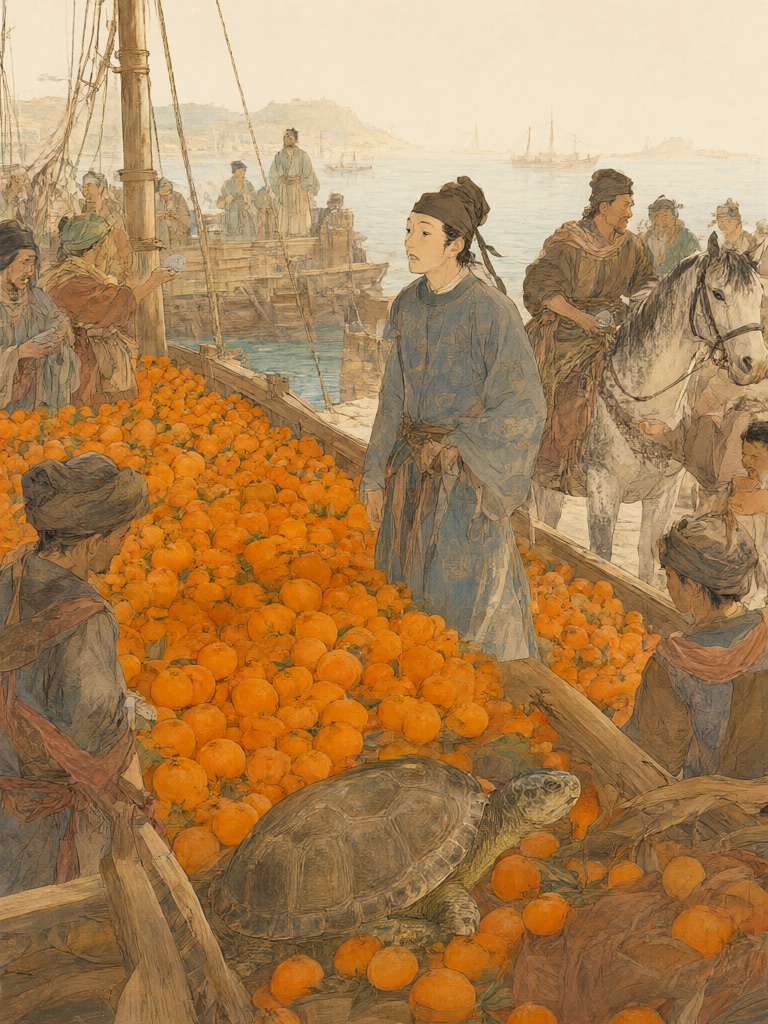
The next day the old woman said to Wang, "Grandson, you mustn't be idle. You ought to take up a small trade — how long can you go on eating without earning?" Wang told her he had no capital. She said, "When your grandfather was alive, I could take as much gold and silk as I liked; but being outside the world of men, I had no need of such things, so I never took much. I saved forty taels of pin money for rouge and powder, and I still have it. Hoarding it does no good; take it all, buy summer cloth, and hurry to the capital — you'll make a small profit." Wang did as she said and came back with more than fifty bolts of cloth. The old woman told him to pack quickly; she reckoned he could reach the capital in six or seven days. She warned him, "Be diligent, not lazy; be quick, not slow. Arrive a day late, and you'll regret it too late." Wang respectfully agreed, packed up the goods and set off. Halfway there he ran into rain, and his clothes and shoes were soaked through. Never in his life had he known hardship, and he was so worn out that he stopped at an inn to rest a while. To his dismay the rain pattered on till dark, pouring off the eaves in ropes. By the next morning the mud was worse still. Seeing travelers sinking to their shins in the muck, he shrank from the hardship. By noon the road was just beginning to dry when the clouds gathered again and the rain came pelting down once more. Only after two nights did he set off.
As he neared the capital, he heard that the price of summer cloth had soared, and he was secretly pleased. He entered the city and unpacked at an inn, but the innkeeper was very sorry he had come so late. As it turned out, the southern roads had only just reopened, so very little cloth had arrived. A prince's household had been buying it urgently, and the price had shot up to about three times the usual. They had finished buying only the day before, and everyone who came after was disappointed. The innkeeper explained all this to Wang. Wang was downcast. The next day more cloth arrived, and the price dropped further. Since there was no profit to be had, Wang refused to sell. After waiting more than ten days, he reckoned how much he was spending on food and board and grew more anxious than ever. The innkeeper advised him to sell cheaply and try something else. He did so. Losing more than ten taels of his capital, he sold off every bolt. Rising early to start for home, he opened his bag and found the silver gone. In alarm he told the innkeeper. The innkeeper could think of nothing to do. Someone advised him to go to the magistrate and make the innkeeper pay. Wang sighed and said, "This is my fate — how is the innkeeper to blame?" Hearing this, the innkeeper was grateful and gave him five taels of silver, consoling him and sending him on his way home. But Wang felt he could not face his grandmother, and he paced in and out, not knowing whether to go forward or back.
Just then he saw some people fighting quails, betting several thousand cash on a single bout; a single quail often cost more than a hundred cash. An idea suddenly struck him. Counting the money in his bag, he found it was just enough to deal in quails, and he talked it over with the innkeeper. The innkeeper urged him on eagerly and offered him lodging and meals free of charge. Wang was delighted and set off. He bought a full carrying-pole load of quails and returned to the capital. The innkeeper was pleased and congratulated him on a quick sale to come. That night it rained heavily until dawn. In the morning the streets ran like rivers, and still the rain kept dripping down. Wang stayed in, waiting for the weather to clear, but the rain went on for days without stopping. When he got up and looked into the cages, the quails were dying one by one. Wang was terrified and did not know what to do. The next day more had died; only a few were left, and he put them all in one cage to feed them. When he looked the following morning, only a single quail was alive. He told the innkeeper, and tears fell before he knew it. The innkeeper, too, wrung his hands in sympathy. Wang, judging that his money was gone and he could not go home, wanted only to die, but the innkeeper comforted him. They went together to look at the quail, and after studying it carefully the innkeeper said, "This looks like an exceptional bird. The other quails may well have died because it fought them to death. You've nothing to do anyway, so train it; if it's really good, you can make a living by fighting it." Wang did as he advised. Once the bird was trained, the innkeeper had him take it into the street and bet for food and wine. The quail was very strong and won every time. The innkeeper was pleased and gave Wang money to bet against the young gentlemen of wealthy families; he fought three times and won three times. In about half a year he had saved twenty taels. His heart grew lighter and lighter, and he treasured the quail as his own life.
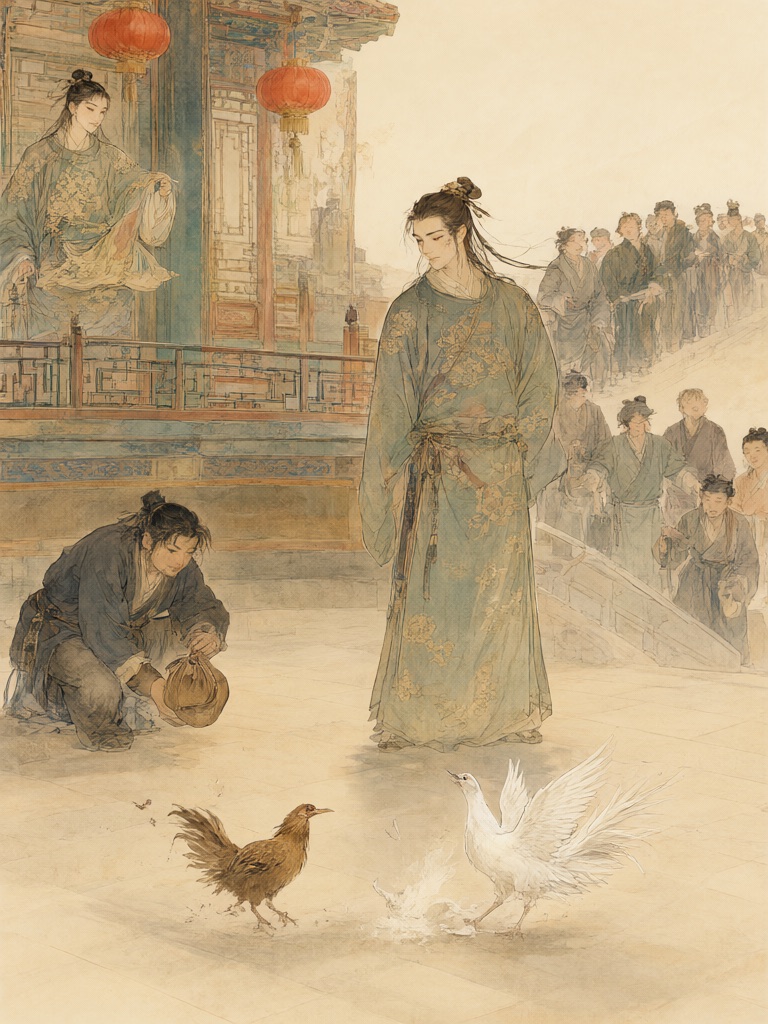
Now, a certain great prince was fond of quails, and every year at the Lantern Festival he let the quail-keepers among the common people into his palace to fight their birds. The innkeeper said to Wang, "Now a great fortune can be had at once; whether it comes to you depends on your fate." He explained the custom to Wang and took him along. He warned him, "If your bird loses, just slink out with your head down. But if, by one chance in ten thousand, your quail wins, the prince is sure to want to buy it. Don't agree; if he insists, watch me, and agree only when I nod." Wang said, "All right." At the palace, quail-keepers were packed shoulder to shoulder below the steps. Before long the prince came out and took his seat in the hall. His attendants announced, "Anyone who wishes to fight, come up!" At once a man holding a quail hurried forward. The prince ordered his own quail let loose, and the visitor released his; after a single leap, the visitor's quail was beaten. The prince laughed loudly. In a little while several men had gone up and lost. The innkeeper said, "Now's the time." And together they climbed the steps.
The prince looked Wang's quail over and said, "Its eyes are shot with angry veins. This is a fierce bird; we mustn't take it lightly." He ordered his iron-beaked quail brought out to face it. After a leap or two, the prince's quail was beaten, its feathers ruffled. He chose a better one, and then another, and both lost. The prince hastily ordered the jade quail brought from the inner palace. In a moment it was carried out — white-feathered as an egret, magnificent and extraordinary. Wang lost his nerve, knelt and begged to stop, saying, "Your Highness's quail is a divine creature. I'm afraid it will hurt my bird and ruin my livelihood." The prince laughed: "Let it go. If it dies fighting, I'll pay you handsomely." So Wang released his bird. The jade quail charged straight at it. As the jade quail came on, Wang's bird crouched like an angry cock and waited; when the jade quail struck hard, it rose like a soaring crane to hit back. Advancing and retreating, swooping up and down, they fought on for a long while. Gradually the jade quail began to tire, while the other grew fiercer and fought harder. Before long the jade quail's snowy feathers were falling, and it fled with drooping wings. Of the thousand onlookers, there was not one who did not gasp in admiration.
The prince then asked for the bird and held it himself, examining it carefully from beak to claw, and asked Wang, "Will you sell this quail?" He answered, "I have no steady property, sir; this bird and I depend on each other for our lives. I don't wish to sell it." The prince said, "I'll give you a handsome price, enough to set you up with a middling family's estate. Wouldn't you like that?" Wang bowed his head and thought for a long time, then said, "I really wouldn't like to part with it. But since Your Highness is so fond of it, if it gives me a way to keep myself fed and clothed, what more could I ask?" The prince asked his price, and he answered a thousand taels. The prince laughed: "Foolish fellow! What kind of treasure is this, to be worth a thousand taels?" Wang said, "Your Highness may not think it a treasure, but to me even a jade worth a string of cities is no better." The prince said, "How so?" He said, "I take it to the market and win a few taels a day, which I trade for pecks of grain; my family of more than ten mouths never goes cold or hungry. What treasure could compare with that?"
The prince said, "I won't cheat you; I'll give you two hundred taels." Wang shook his head. The prince added a hundred more. Wang glanced at the innkeeper, whose face did not move. So he said, "At Your Highness's command, I'll take a hundred off the price." The prince said, "Forget it! Who would trade nine hundred taels for one quail?" Wang put the quail in its bag and turned to go. The prince called out, "Quail man, come back, come back! I'll give you six hundred, flat. Take it and it's sold; if not, that's that." Wang looked at the innkeeper again, but the innkeeper was as calm as before. Wang's wishes were more than satisfied, and fearing to miss his chance, he said, "Selling at this price leaves me truly unhappy. But if the deal falls through, I'll be in even worse trouble for offending you. There's nothing else for it — I'll do as Your Highness commands." The prince was pleased and had the silver weighed out and paid at once. Wang bagged the silver, bowed his thanks and went out. The innkeeper said reproachfully, "What did I tell you? Why were you in such a hurry to sell? If you'd held out a little longer, you'd have had eight hundred taels in your hand." Back at the inn, Wang threw the silver on the table and asked the innkeeper to take what he liked, but the innkeeper refused. Only when Wang pressed him again and again did he reckon up the cost of Wang's meals and take that.
Wang packed up and went home. When he arrived he told everything he had done, and they brought out the silver and celebrated. The old woman had him buy three hundred mu of good farmland, build a house and furnish it, until they were once again a family of standing. The old woman rose early every day and set Wang to oversee the plowing and his wife to oversee the weaving; at the slightest slacking, she scolded them. The couple lived in peace and dared not utter a word of complaint. After three years the family was richer still. The old woman announced that she wished to leave. The couple both begged her to stay, even weeping. And so she stayed. But when they went to greet her at dawn the next day, she had vanished without a trace.