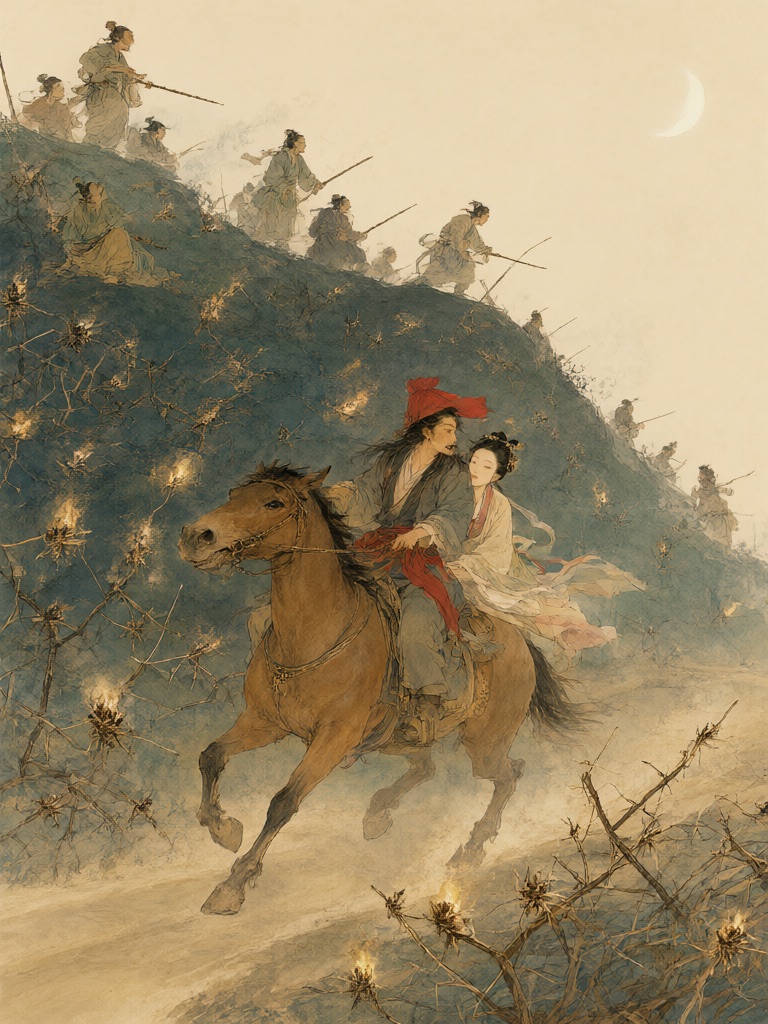
Wu Chengxiu was a man of Liaoyang. He loved making friends, and all his companions were men of reputation. One night he dreamed that someone told him, “You have friends all over the land, but they're all fair-weather friends. There is only one man who would share your troubles — how is it you don't even know him?” “Who is he?” Wu asked. “Is it not Tian Qilang?” He woke up and wondered at it. The next morning he asked everyone he met about Qilang. One of his guests knew him as a hunter from the East Village. Wu went respectfully to call at his home and knocked at the gate with his riding crop. Soon a man came out, a little over twenty, with the eyes of a wild cat and a waist as slim as a wasp's, wearing a greasy cap and a pair of black knee-length breeches patched with white all over. He raised his clasped hands to his forehead and asked where the visitor had come from. Wu gave his name, and pretended he was feeling unwell from the journey and would like to rest in his house. When he asked for Qilang, the man answered, “That's me.” So he invited the guest in. Wu saw a few beams of a tumbledown house, the walls propped up with forked branches. They went into a small room where tiger skins and wolf hides hung between the pillars, and there was not even a stool or bench to sit on. Qilang spread a tiger skin on the ground for him. As they talked, Wu found his speech plain and honest, and was greatly taken with him. He at once offered him silver to set himself up. Qilang would not accept it. Wu insisted. Qilang took it to tell his mother. A moment later he brought it back, firmly refusing. Wu pressed him again and again. Then Qilang's mother came tottering in and said sternly, “I have only this one son. I don't want him serving any fine gentleman!” Wu withdrew in embarrassment. All the way home he turned it over in his mind, unable to see what she meant. As it happened, one of his attendants had overheard what the mother said behind the house, and he told Wu.
When Qilang had taken the silver to his mother, she had said, “I've just seen that young gentleman. There are dark lines in his face — he is bound to meet some strange disaster. I have heard it said: one who is valued by another must share his sorrows; one who is helped by another must rush to his rescue. The rich repay with money; the poor repay with loyalty. To receive a rich gift for no reason is unlucky. I'm afraid he will one day take your life in repayment.” When Wu heard this, he marvelled at the mother's wisdom, but it only made him admire Qilang all the more. The next day he laid on a feast and invited Qilang, but Qilang declined to come. So Wu went to his house, sat down in his hall and asked for something to drink. Qilang poured the wine himself and set out dried venison, observing every courtesy. A day later Wu invited him over in return, and this time he came. They got on wonderfully. Wu gave him silver, and again he would not take it. Only when Wu said it was to buy tiger skins did he accept. Back home, Qilang looked over the skins he had stored and reckoned they were not worth the money, so he decided to hunt some more before bringing them. He spent three days in the mountains without catching anything. Then his wife fell ill, and he stayed by her side preparing her medicine, with no time for hunting. Within ten days she had suddenly died. The funeral and the rites for her soul slowly ate up the silver he had been given. Wu came in person to offer condolences and attend the burial, with the most generous gifts. After the funeral Qilang shouldered his crossbow and went into the woods, more determined than ever to find some way to repay Wu, but still he caught nothing. When Wu found out why, he kept urging him not to hurry. He longed for Qilang to come and visit, but Qilang, still troubled by his debt, would not come.
So Wu asked first for the skins Qilang already had, hoping to hurry his visit. Qilang went through his old pelts and found them moth-eaten and ruined, every hair gone, which only made him more miserable. When Wu heard, he rode to his yard and did everything he could to console him. Then, looking at the ruined skins, he said, “These are perfectly good too. It was never the fur I was after.” He rolled up the bald hides to take away, and invited Qilang to come along. Qilang would not, so Wu went home alone. Feeling that he still had not done enough to repay Wu, Qilang packed some provisions and went into the mountains, and after several nights he killed a tiger, which he brought to Wu whole. Wu was delighted, laid on a feast and begged him to stay three days. Qilang firmly declined. Wu locked the gates so he could not leave. His guests, seeing how rough and plain Qilang was, whispered that the young master was making friends recklessly. But Wu treated Qilang quite differently from all his other guests. He offered him new clothes, which Qilang refused; so Wu waited until he was asleep and secretly swapped them, and Qilang had no choice but to accept. After he left, his son came on his grandmother's orders to return the new clothes and ask for the old jacket. Wu laughed. “Go home and tell the old lady that the old jacket has already been taken apart for shoe linings.” From then on, Qilang sent him hares and deer every day, but when invited, he would no longer come.
One day Wu went to see Qilang, who happened to be out hunting. The old woman came out and, leaning on the doorframe, said, “Don't come luring my son away again. You mean him no good!” Wu bowed to her respectfully and withdrew, abashed. About half a year later, his servants suddenly told him, “Qilang got into a fight over a leopard he'd killed and beat a man to death. They've taken him off to the yamen.” Wu was horrified and rode to see him, but Qilang was already in shackles in prison. When he saw Wu he said nothing except, “From now on, please look after my old mother.” Wu came out heartsick, and at once bribed the magistrate heavily and gave a hundred taels to the dead man's family. Within a month or so the case was dropped and Qilang was released. His mother said with feeling, “Your very hair and skin are Young Master Wu's gift now; they are no longer mine to cherish. I only pray that the young master lives out his hundred years without harm or trouble — that will be your good fortune.” Qilang wanted to go and thank Wu. His mother said, “Go if you must, but don't thank him when you see him. A small kindness can be thanked; a great kindness cannot.” Qilang went to see Wu; Wu spoke to him warmly and comfortingly, and Qilang only murmured his assent. Wu's household all thought him cold; but Wu was pleased by his sincerity and treated him more generously than ever. From then on Qilang often stayed at the young master's house for several days at a time. When given gifts he accepted them without refusing, and said nothing about repaying them.
It was Wu's birthday, and there were so many guests and attendants that every room was full at night. Wu shared a tiny room with Qilang, and three servants slept on straw on the floor beneath the bed. The second watch of the night was nearly over, and the servants had all fallen asleep, but the two of them were still talking away. Qilang's sword was hanging on the wall; suddenly it leapt a few inches out of its scabbard of its own accord, ringing loudly and flashing like lightning. Wu sat up in alarm. Qilang got up too and asked, “Who's sleeping under the bed?” “Only servants,” said Wu. “There must be an evil man among them,” said Qilang. Wu asked why. “I bought this sword in a foreign land. It kills without wetting a single thread with blood. It has been worn by three generations of my family now. It has cut off heads by the thousand, and it's still as sharp as if fresh from the whetstone. When it sees an evil man it rings and leaps — that means a killing is not far off. You should keep close to good men and away from bad ones, sir; then you might, by some slim chance, escape it.” Wu nodded. Still Qilang was uneasy and tossed and turned on the bed. “Fortune and misfortune are fated,” said Wu. “Why worry so?” Qilang said, “I'm afraid of nothing — except that I have my old mother to think of.” “Surely it won't come to that!” said Wu. “If it doesn't, so much the better,” said Qilang. Now, the three under the bed were: Lin'er, an ageing catamite who had won his master's favour; a page of twelve or thirteen whom Wu often sent on errands; and Li Ying, the most stubborn and clumsy of them all, who often argued with the young master over trifles, glaring at him, so that Wu was always angry with him. That night Wu thought it over silently and suspected it must be this man. The next morning he called Li Ying in and dismissed him with kind words.
Wu's eldest son, Shen, had married a girl of the Wang family. One day, when Wu went out, he left Lin'er in charge of the house. The chrysanthemums in the study courtyard were in full bloom. Thinking that with her father-in-law away the study courtyard would be quiet, the young wife went over herself to pick some. Lin'er sprang out and made advances to her. She tried to run, but he dragged her into a room. She wept and fought him off until her face was white and her voice hoarse. When Shen rushed in, Lin'er finally let go and fled. When Wu came home and heard, he went in a rage to find Lin'er, but he had vanished without a trace. Two or three days later they learned he had taken refuge in the household of a certain censor. The censor held office in the capital and left all his household affairs to his younger brother. Wu, as one gentleman to another, wrote to demand Lin'er's return, but the brother simply ignored the letter. More furious than ever, Wu took the case to the county magistrate. A warrant was issued, but the runners made no arrest and the magistrate asked no questions. Wu was seething when Qilang happened to arrive. “Your words have come true,” said Wu, and told him the whole story. Qilang's face turned ghastly; he said not a single word and left at once. Wu told his most capable servants to keep watch for Lin'er.
Lin'er came back one night and was caught by the watchers, who brought him before Wu. Wu had him flogged. Lin'er answered with insults. Wu's uncle Heng, a mild and venerable old man, was afraid his nephew's fury would bring disaster, and advised him to let the law deal with the man instead. Wu agreed, and had Lin'er tied up and taken to court. But a calling card and letter from the censor's family arrived by post; the magistrate released Lin'er and handed him over to the censor's steward. Lin'er grew more brazen than ever, and announced in front of crowds that his master's daughter-in-law had been sleeping with him. Wu could do nothing about it, and was so choked with rage that he wanted to die. He rode to the censor's gate and stood there ranting and cursing. The neighbours calmed him down and persuaded him to go home. The next night, a servant suddenly reported, “Lin'er has been hacked to pieces, and his body's been thrown out in the wilds.” Wu was startled and delighted, and felt some of his pent-up rage released.
Soon afterwards they heard that the censor's family was suing uncle and nephew, so Wu went with his uncle to answer the charge. The magistrate would not let them argue their case, and was about to have Heng flogged. Wu protested loudly, “The murder is a baseless charge! As for insulting a gentleman's family, that was me, and it has nothing to do with my uncle.” The magistrate pretended not to hear. Wu, eyes blazing fit to burst, tried to rush forward, but a pack of runners seized him and held him down. The runners wielding the rods were all lackeys of the gentry family, and Heng was old and frail; before half the strokes had been counted out, he was dead. Seeing Wu's uncle dying, the magistrate pursued the matter no further. Wu wailed and cursed, and the magistrate acted as if he heard nothing. So Wu carried his uncle home. Grief-stricken and enraged, he could think of nothing to do. He wanted to consult Qilang, but Qilang had not even come once to offer condolences. Wu thought to himself: I have not treated Qilang badly — why has he suddenly become like a stranger in the street? He also suspected that Qilang must have killed Lin'er. But then he thought: if so, why would he not have told me? So he sent someone to Qilang's house to find out, and found the doors locked and silent; even the neighbours had no news.
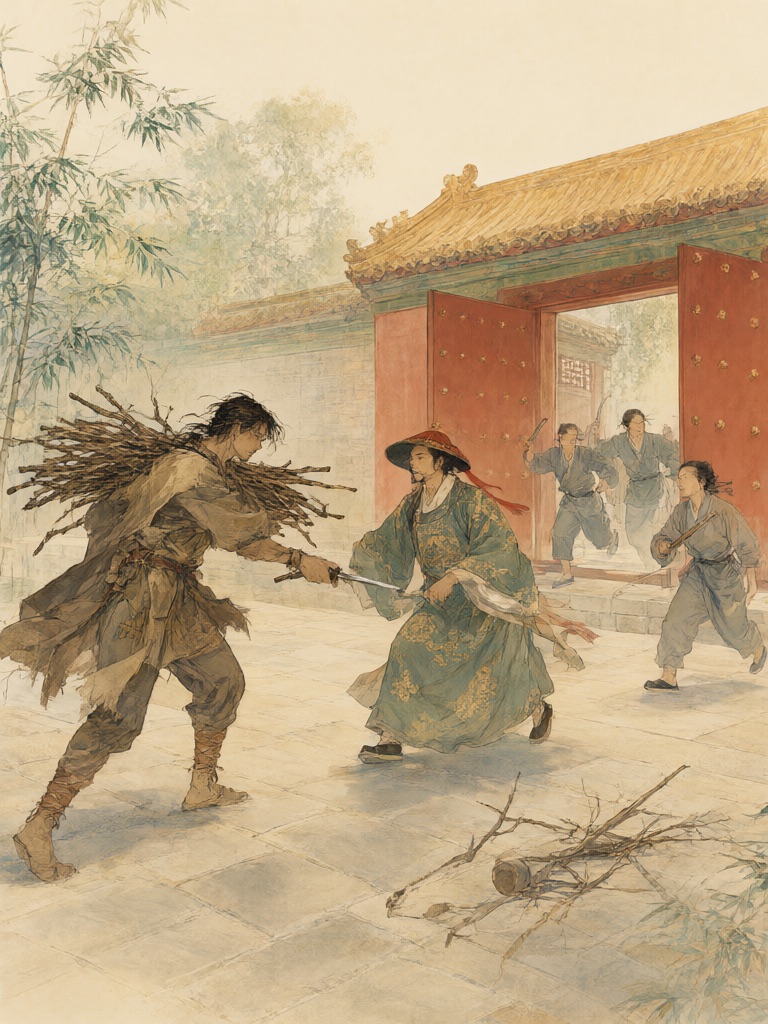
One day the censor's brother was in the inner offices of the yamen, putting in a word with the magistrate. It was the hour when firewood and water were delivered in the morning, and suddenly a woodcutter came up to him, put down his load, drew a sharp blade and charged straight at him. The man, panic-stricken, put up his hand to block the blade; it came down and severed his wrist; with a second stroke the woodcutter cut off his head. The magistrate, horrified, fled. The woodcutter was still glancing wildly about. The clerks and runners hurried to shut the yamen gates and, seizing their staves, raised a great shout. At that the woodcutter cut his own throat and died. People crowded round to identify him, and those who knew him saw it was Tian Qilang. When the magistrate had recovered from his fright, he came out to examine the body. Qilang lay stiff in a pool of blood, his hand still gripping the blade. As the magistrate stopped and bent over to look closely, the corpse suddenly sprang upright and cut off the magistrate's head; then it fell back down. The yamen officials went to arrest Qilang's mother and son, but they had already been gone for several days. When Wu heard that Qilang was dead, he rode there and wept in utter grief. Everyone said he had put Qilang up to it. Wu spent his whole fortune bribing those in power and only so escaped punishment. Qilang's body lay out in the wilds for more than thirty days, with birds and dogs keeping watch around it. Wu took it and gave it a lavish burial. Qilang's son drifted to Dengzhou and changed his surname to Tong. He rose through the ranks and, for his merits, became a deputy general. When he returned to Liaoyang, Wu was over eighty, and he showed him where his father was buried.