Cui Meng, courtesy name Wumeng, was the son of an old established family of Jianchang. He was hard and unbending by nature. As a boy at school, if any of the other children crossed him in the slightest, he would set about them with his fists, and no amount of warnings from the teacher could change him; both his name, Meng — “Fierce” — and his courtesy name, Wumeng — “Be Not Fierce” — were given him by his teacher. By sixteen or seventeen he was strong and martial beyond compare. He could even vault onto the roof of a great house with a long pole. He loved to right wrongs, and so the people of the district all looked up to him; those who came to lay complaints before him crowded his steps and filled his rooms. Cui put down the strong and helped the weak, never minding whose enmity he earned; anyone who defied him even a little was set upon with stones and clubs until he was crippled. When he was in a towering rage, no one dared to reason with him. Only to his mother was he dutiful: when she came, his anger melted. She would scold him thoroughly, and he would meekly promise to obey — and forget it all as soon as he was out the door.
Next door lived a vicious wife who abused her mother-in-law every day. The old woman was starving almost to death, and her son secretly brought her food; when the wife found out, she heaped every kind of abuse on them, so loudly it could be heard on all sides. Cui, enraged, leapt over the wall and cut off her nose, ears, lips and tongue, and she died on the spot. His mother was appalled when she heard. She called in the neighbour's son, comforted him with every possible kindness and gave him a young maid as a wife, and so the matter was hushed up. But she wept with anger and refused to eat. Cui was frightened, knelt and begged her to beat him, and told her he was sorry. His mother only wept and would not look at him. Cui's wife, Zhou, knelt beside him. Then his mother beat her son with a stick, and pricked a cross into his arm with a needle and rubbed it with vermilion so that it would never fade. Cui submitted to all of it, and only then would his mother eat.
Cui's mother liked to feed Buddhist monks and Taoist priests, and often sent them away well fed. One day a Taoist was at the gate as Cui went by. The Taoist looked him over and said, “Young sir, there is a great deal of violence in you. I fear you will not come to a good end. A house that has stored up good deeds should not have this.” Cui, fresh from his mother's admonishment, answered respectfully, “I know it myself. But whenever I see injustice, I simply can't hold myself back. If I try hard to change, might I escape?” The Taoist smiled. “Don't ask yet whether you can escape; ask yourself first whether you can change. Only restrain yourself with all your might; if there is one chance in ten thousand, I'll tell you a way to escape death.” Cui had never in his life believed in charms and exorcisms; he smiled and said nothing. The Taoist said, “I knew you wouldn't believe me. But what I have to say isn't like the business of witches and shamans; following it would be a great virtue in itself, and even if it doesn't work, it can do no harm.”
Cui asked for his advice, and the Taoist said, “There's a youth outside the gate just now. You should befriend him generously; even if you commit a capital crime, he will be able to save your life.” He called Cui outside and pointed the person out. It was a boy of the Zhao family named Sengge. The Zhaos came from Nanchang, and because of a famine year they were living as sojourners in Jianchang. From then on Cui made close friends with them, invited the Zhaos to lodge in his house and provided for them handsomely. Sengge, who was twelve, came into the hall to bow to Cui's mother, and he and Cui swore to be brothers. The next year, when spring ploughing began, Zhao took his family away, and nothing more was heard of them.
Ever since the death of the neighbour's wife, Cui's mother had been stricter than ever with her son, and anyone who came to lay a complaint before him was turned away. One day her younger brother died, and Cui went with his mother to the funeral. On the way they met a group of men leading a man bound with rope, cursing him, pushing him along and beating him. Onlookers choked the road so that the sedan chair could not get through. Cui asked what was going on. People who knew him crowded round to tell him. There was a certain son of a great gentry family, call him Jia, who lorded it over the district; he had his eye on Li Shen's pretty wife and wanted to take her, but had no pretext. So he had his servants lure Li Shen into gambling, lending him money at heavy interest on condition that he wrote his wife into the bond as security, and lending him more when the money was gone. In one night Li Shen ran up debts of several thousand cash; in half a year, with interest, the total came to more than thirty thousand. When Li Shen could not repay, Jia sent a gang of men to seize his wife. Li Shen went weeping to Jia's gate. Jia, furious, had him dragged off, tied to a tree, flogged and stabbed with awls, and forced him to sign a pledge “never to go back on the deal.”
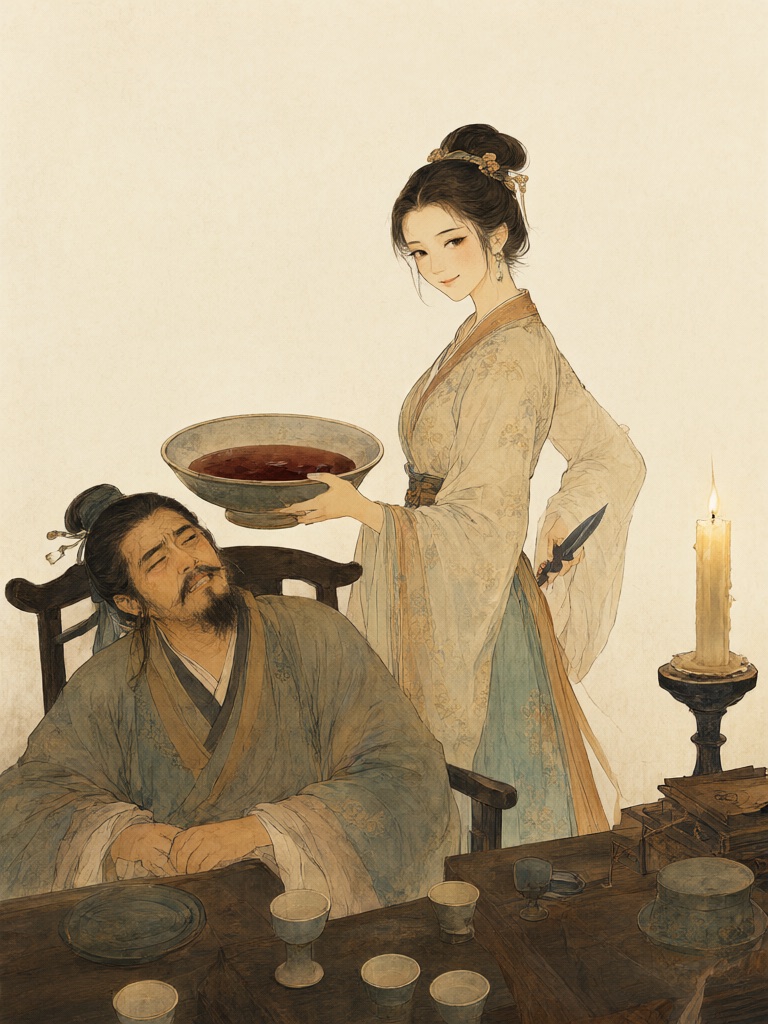
When Cui heard this, rage surged up in him like a mountain; he whipped his horse forward, ready to fight. His mother pulled back the curtain of her chair and cried, “Tsk! At it again?” And Cui stopped. When they came home from the funeral, he neither spoke nor ate, but sat bolt upright staring straight ahead, as if angry at someone. His wife asked what was wrong; he did not answer. That night he lay on the bed fully dressed, tossing and turning till dawn, and the next night was the same. Suddenly he opened the door and went out, then came straight back and lay down. This happened three or four times; his wife did not dare ask, only held her breath and listened. Then he was gone for a long time before he came back, shut the door and fell fast asleep. That night someone killed Jia in his bed, ripping open his belly so that his guts spilled out; Li Shen's wife too lay dead and naked beneath the bed. The authorities suspected Li Shen, arrested him and put him to the question. He was cruelly tortured in shackles until his ankle bones showed, but he made no confession. After more than a year he could bear the torture no longer and falsely confessed, and was sentenced to death.
Then Cui's mother died. After the funeral, Cui told his wife, “It was I who killed Jia. I didn't dare reveal it only because my old mother was alive. Now that the great matter of her burial is done, how can I let another man suffer for my crime? I'm going to the authorities to die!” His wife clutched at him in alarm, but he tore his robe free and left, and confessed in the courtroom. The magistrate, astonished, had him shackled and sent to prison, and released Li Shen. Li Shen would not go, and insisted he had done it himself. Unable to decide, the magistrate kept both in custody. Li Shen's relatives all reproached him. He said, “What the young master did is what I wanted to do and could not. He did it for me — how could I bear to sit by and watch him die? Let's just say today that the young master never came forward.” He held firmly to his story and kept disputing the guilt with Cui.
In time everyone in the yamen knew the truth of it; they forced Li Shen out, and Cui was to pay for the crime, his execution close at hand. It happened that Zhao, an official of the Board of Punishments sent to review capital cases, came to inspect the prisoners; when he reached Cui's name, he sent everyone else away and called him in. Cui entered and, looking up at the bench, saw that it was Sengge. With mingled grief and joy he told him the whole truth. Zhao paced back and forth for a long time; then he had Cui sent back to prison, telling the jailers to treat him well. Soon, because he had given himself up, his sentence was reduced by a degree to military exile in Yunnan, and Li Shen went with him as his servant. Within a year he was pardoned in an amnesty and came home: all this was Zhao's doing.
Once they were home, Li Shen stayed by Cui and would not leave him, managing his estate for him. When Cui offered him money, he would not take it. He took a keen interest in pole-climbing and the arts of combat. Cui treated him generously, bought him a wife and gave him land. From then on Cui worked hard to mend his old ways, and whenever he stroked the tattoo on his arm, tears would come to his eyes. So when there were disputes among the neighbours, Li Shen would settle them himself, pretending to act on Cui's orders, without telling him.
There was a certain Wang, a student of the Imperial Academy, whose family was rich and powerful; all sorts of villains and scoundrels from far and wide came and went through his gates. Many of the wealthy families in the county were robbed by them; and if anyone crossed Wang, he would send bandits to murder him on the road. His son was just as lecherous and violent. Wang had a widowed aunt, and father and son both slept with her. Wang's wife, née Qiu, repeatedly tried to stop him, so Wang strangled her. Her brothers took him to court, but Wang bribed and pulled strings, and the accusers were themselves convicted of false accusation. With no way to redress their grievance, the brothers came to Cui to plead their case. Li Shen turned them away.
A few days later a guest arrived, and as there happened to be no servant about, Cui told Li Shen to make tea. Li Shen went out without a word and told people, “Cui Meng and I are only friends. I followed him ten thousand li into exile — no one can say I fell short. Yet he's never paid me a penny, and he works me like a menial. I won't stand for it!” And he left in a huff. Someone told Cui. Cui was surprised at this change of heart, but did not think much more of it. Then Li Shen suddenly sued him, claiming Cui had not paid him wages for three years. Cui was astonished and went to answer the charge in person, while Li Shen argued angrily against him. The magistrate found against Li Shen, had him punished and driven out.
A few days later, Li Shen suddenly broke into the Wang house one night and killed father, son and the widowed aunt all together; he pasted a sheet of paper on the wall with his own name written on it; by the time they went after him, he had fled without a trace. The Wangs suspected Cui had put him up to it, but the authorities did not believe it. Only then did Cui realise that Li Shen's lawsuit had been meant to keep him from being implicated in the killing. Warrants went out to all the neighbouring prefectures and counties, and the hunt was urgent. Then the rebel Chuang bandits rose against the throne, and the matter was dropped.
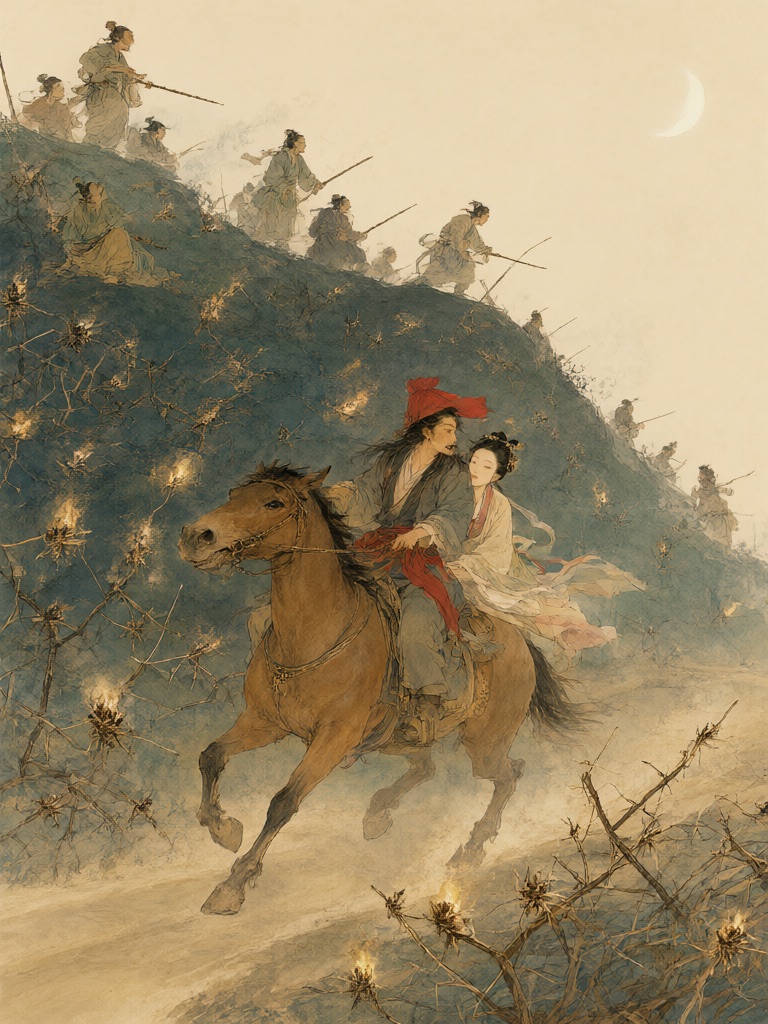
When the Ming fell and the dynasty changed, Li Shen brought his family home and was as good a friend to Cui as before. At that time local bandits were gathering in gangs. Wang had a nephew, Wang Deren, who assembled the scoundrels his uncle had gathered, seized a mountain stronghold and turned bandit, burning and plundering the villages. One night the whole gang descended on them, claiming to be avenging the family. Cui happened to be away; Li Shen only noticed when they broke down the door, and he slipped over the wall and hid in the dark. Unable to find Cui or Li, the bandits seized Cui's wife, ransacked the house and left. When Li Shen came back, only one servant was left. Beside himself with fury, he cut a rope into dozens of pieces, gave the short ones to the servant and tucked the long ones into his own coat. He told the servant to go past the bandits' den, climb halfway up the mountain, light the pieces of rope and hang them here and there on the thorn bushes, then come straight back without looking round. The servant agreed and went.
Li Shen had noticed that the bandits all wore red sashes round their waists and red silk tied to their caps, so he dressed himself the same way. There was an old mare that had just foaled, which the bandits had left outside the gate. Li Shen tied up the foal, mounted the mare, and with a gag between his teeth to keep silent, rode straight for the bandits' den. They were holding a large village; Li Shen tethered the horse outside it and climbed over the wall. He found the bandits milling about, still with weapons in hand. He quietly asked around among them and learned that Cui's wife was with Wang Deren. Soon an order went round for everyone to rest, and they roared their assent. Suddenly someone reported fires on the eastern hill, and all the bandits turned to look; at first there were only one or two points of light, but soon they were as many as the stars. Li Shen, panting as if out of breath, shouted that there was an alarm on the eastern hill. Wang was alarmed, buckled on his gear and led his men out. Li Shen took the chance to slip out on their right flank and doubled back inside. Seeing two bandits guarding the tent, he lied to them, “General Wang left his sword behind.” The two bandits scrambled to look for it. Li Shen cut one down from behind; the other turned round, and Li Shen killed him too. Then he carried Cui's wife on his back over the wall. He untied the horse and handed her the reins. “You don't know the way, madam — just give the horse its head.” The mare, longing for her foal, galloped off, and Li Shen followed. When they were through a narrow pass, Li Shen lit the rope pieces and hung them all about, and only then went home.
The next day Cui came home, and took it as a terrible humiliation. Beside himself, he wanted to ride out alone and wipe out the bandits. Li Shen talked him out of it. They called the villagers together to make a plan, but they were all too frightened to answer the call. After much explaining and persuading, they found twenty-odd men willing to go, but they had no weapons. It happened that two spies were caught in the house of one of Wang Deren's clansmen. Cui wanted to kill them, but Li Shen would not have it: he had the twenty men line up in front of the spies, each holding a plain wooden club, then cut off the spies' ears and let them go. Everyone complained, “With a force like ours, the last thing we want is for the bandits to know about it — and you've gone and shown them! If they come at us with their whole gang, the whole village is lost!” “I want them to come,” said Li Shen. He had the man who had harboured the bandits executed. He sent people out in all directions to borrow bows, arrows and firearms, and went to the county town to borrow two great cannon.
At dusk he led his fighters to the pass and set the cannon where they commanded the approach, with two men hidden by the fuses to fire as soon as they saw the bandits. Then he went to the eastern mouth of the valley and had trees felled and laid along the cliff edge. After that he and Cui each took ten-odd men and lay in ambush on either slope. Toward the end of the first watch they heard horses neighing in the distance: the bandits were coming in force, as expected, in an unbroken line. When they had all entered the valley, the felled trees were pushed down to block their retreat. Then the cannon roared, and the din of shouting and screaming shook the valley. The bandits fell back in a rush, trampling one another; at the eastern mouth they could not get out, and packed together with no room to move. Guns and arrows poured on them from both slopes like wind and rain, and men with heads blown off and legs shattered lay heaped in the gully. Twenty-odd survivors knelt and begged for their lives. They were sent back bound under guard. Pressing their advantage, the villagers went straight to the bandits' lair. Those guarding it fled at the news, and the villagers came home with all their stores and loot.
Cui was overjoyed and asked about the trick with the fires. Li Shen said, “I set the fires to the east for fear they'd chase us westward. The pieces were short so they'd burn out quickly, for fear the bandits would find out there was no one there. Then I set more at the mouth of the valley because it's so narrow that one man could hold it, and if they did come after us, the sight of fire there was sure to frighten them. They were all just desperate makeshifts of the moment.” When the captured bandits were questioned, it turned out they had indeed given chase into the valley and turned back in fright at the fires. All twenty-odd were let go after having their noses cut off and their feet hacked. From then on their fame spread far and wide; people fleeing the chaos flocked to them from near and far like a crowd to market, and they formed a militia of more than three hundred men. No bandit band anywhere dared to attack, and the whole region relied on them for its peace.