Jin Dayong came of an old family of the Central Plains. He was married to the daughter of Prefect You, whose name was Geng Niang; she was beautiful and wise, and the two were deeply devoted. When roving bandits rose in rebellion, families were scattered, and Jin fled south with his household. On the road they met a young man who was also fleeing with his wife; he said he was Wang the Eighteenth of Guangling and offered to lead the way. Jin was glad of it, and the two parties traveled and lodged together. When they reached the river, Geng Niang told her husband privately, "Don't share a boat with that young man. He keeps looking at me; his eyes shift and his face changes. There's no telling what's in his heart." Jin agreed. But Wang was most attentive; he found a big boat and carried Jin's baggage aboard, taking endless pains. Jin could not bring himself to refuse. Besides, he thought, a man traveling with a young wife was unlikely to mean any harm. Wang's wife shared quarters with Geng Niang, and her manner was gentle and mild. Wang sat at the bow talking softly with the boatmen, as if they were old friends or kin. Before long the sun set; the river stretched on and on, a vast expanse where north and south could not be told apart. Jin looked around at the dark, menacing surroundings and felt uneasy. Soon the bright moon rose, and there was nothing to be seen but reeds. Once they moored, Wang invited Jin and his father to step outside for some air. Then he seized the moment and shoved Jin into the water. Jin's father saw it and was about to cry out, but a boatman struck him with a pole, and he too went under. Jin's mother heard the noise and came out to look, and she too was struck into the water. Only then did Wang shout for help. When the mother went out, Geng Niang had been behind her and had seen it all. Hearing that the whole family had drowned, she showed no alarm. She only wept and said, "My father- and mother-in-law are both gone — where can I turn?" Wang came in to comfort her: "Don't worry, madam. Come with me to Jinling. My family has fields and houses enough to provide for you; you'll want for nothing." Geng Niang dried her tears and said, "If it can be so, I'll be content." Wang was overjoyed and waited on her with great attentiveness.
When night fell, he pulled at her, wanting to make love. She pleaded that it was her time of the month, so Wang went to sleep with his own wife. Toward the end of the first watch, the couple began quarreling, no one knew why. All that could be heard was the wife saying, "For what you've done, the thunder god will surely split your skull!" Wang hit her. She cried, "Then let me die! I'd sooner die than be a murderer's wife!" Wang roared with rage and dragged her outside. Then there was a loud splash, and he raised a shout that his wife had fallen into the river.
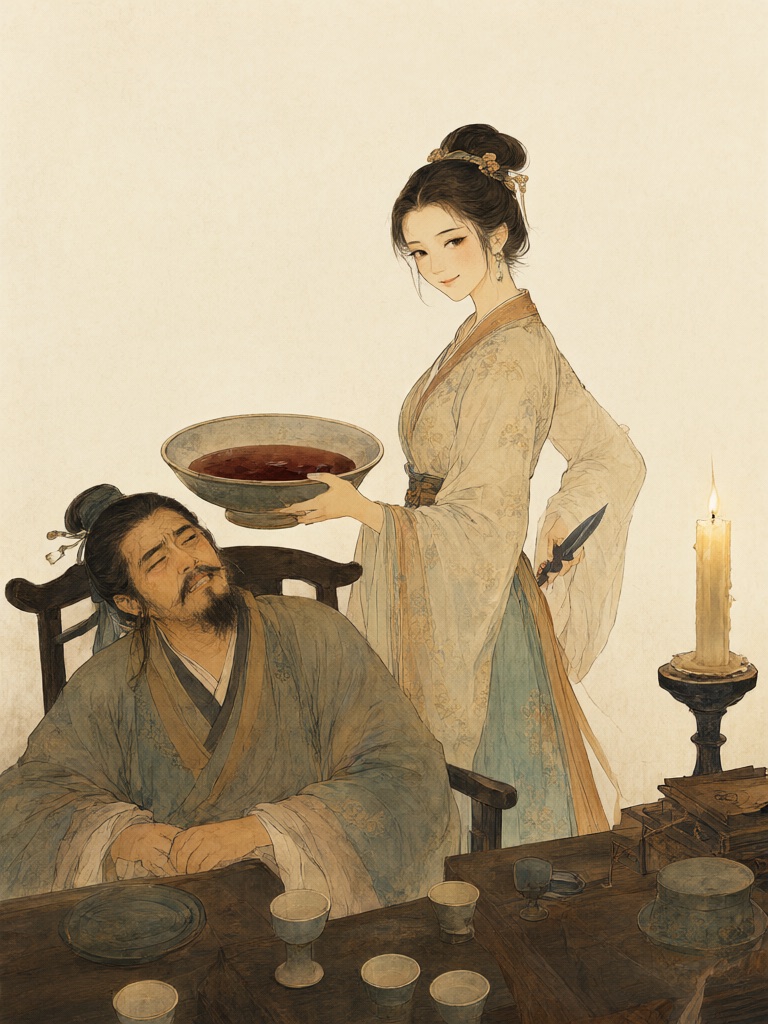
Before long they reached Jinling, and Wang brought Geng Niang home and took her into the hall to meet his mother. The old woman was surprised that she was not his former wife. Wang said, "My wife fell in the river and drowned; this is my new bride." Back in their room, he again tried to force himself on her. Geng Niang laughed and said, "A man of thirty or so, and you've never been with a woman? Even a market lad on his wedding night has a cup of thin wine to share; your family is so well off, that can't be hard to manage. Facing each other stone-sober — what kind of way is that?" Wang was pleased and set out wine for the two of them. Geng Niang held the cup and urged him to drink, warmly and persistently. Wang grew drunk and said he could drink no more. Geng Niang picked up a big bowl and coaxed him charmingly to drink it. Wang could not bear to refuse and drank again. Then, thoroughly drunk, he stripped and pressed her to come to bed. Geng Niang cleared away the dishes, blew out the candle and said she had to relieve herself. She left the room and came back with a knife. In the dark she felt for Wang's neck with her hand; Wang even caught her arm and murmured endearments. Geng Niang cut hard; he did not die, but rose up howling; she struck again, and he was dead. The old mother seemed to have heard something and hurried over to ask. Geng Niang killed her too. Wang's younger brother, the Nineteenth, woke to what was happening. Knowing she could not escape, Geng Niang quickly tried to cut her own throat. But the knife was blunt and nicked and would not go in, so she threw open the door and ran. The Nineteenth chased her, but she had already thrown herself into the pond. He called the neighbors, but when they pulled her out she was dead, her face as lovely as in life. Examining Wang's body together, they found a letter on the windowsill; opening it, they read Geng Niang's full account of the wrongs done to her. Everyone hailed her as a heroine of virtue and agreed to collect money for her funeral. When day broke, thousands gathered to see her; at the sight of her face they all bowed in homage. In a single day a hundred taels were collected, and she was buried in the southern outskirts. Admirers dressed her in a pearl headdress and fine robes, and a rich store of treasures was buried with her.
Now, when Jin was pushed into the river, he had floated on a plank and survived. Near dawn he drifted into the Huai River, where a small boat rescued him. The boat had been set up by a rich man, old Mr. Yin, expressly to save the drowning. Once Jin revived, he went to thank Mr. Yin. Mr. Yin treated him generously and kept him on to tutor his son. But Jin, not knowing what had become of his parents, wanted to go and search for them, so he could not decide. Soon someone reported, "We've pulled out a dead old man and an old woman." Jin suspected they were his parents, rushed to look, and so they were. Mr. Yin provided coffins for them. While Jin was still deep in mourning, someone reported again, "We've rescued a drowning woman who says Mr. Jin is her husband." Jin wiped his tears and hurried out in amazement, but the woman who arrived was not Geng Niang at all; it was Wang the Eighteenth's wife. She wept bitterly before Jin and begged him not to abandon her. Jin said, "My mind is in turmoil; how can I make plans for anyone else?" The woman grew even more distraught. When Mr. Yin learned the story, he was delighted, calling it Heaven's recompense, and urged Jin to take her as his wife. Jin declined on the grounds that he was in mourning, and that he meant to take revenge and feared a wife would be a burden. The woman said, "By that reasoning, if Geng Niang were still alive, would you put her aside for the sake of revenge and mourning?" Mr. Yin thought she spoke well and offered to take her in for the time being, and Jin agreed. When they chose a day to bury his parents, the woman wore sackcloth and wept as if mourning her own parents-in-law.
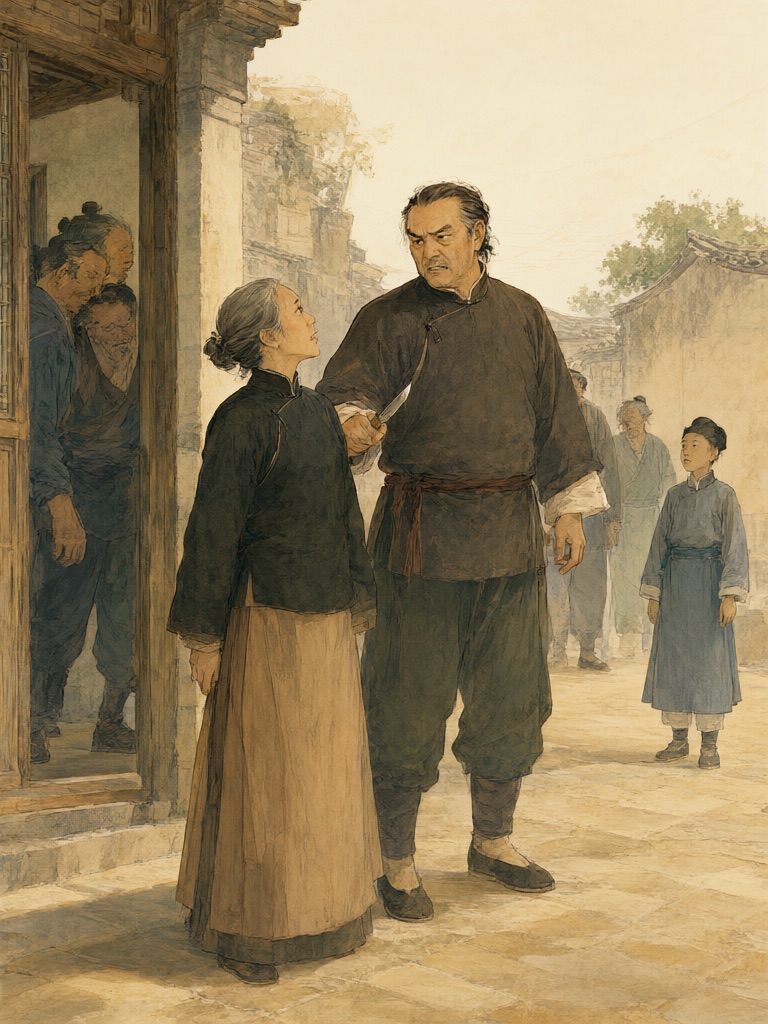
After the burial, Jin hid a blade in his clothes and, carrying a begging bowl, was about to set out for Guangling. The woman stopped him: "My name is Tang. My family has always lived in Jinling, the same place as that jackal. When he said he was from Guangling, it was a lie. Besides, half the river pirates are his cronies; you won't get your revenge, you'll only bring disaster on yourself." Jin wavered, not knowing what to do. Then, suddenly, news came of a woman who had killed her enemy; it spread all along the waterways, with her name in full. When Jin heard it, he felt a surge of satisfaction, but even greater grief. He told the woman he must decline her: "At least she was not dishonored. With so heroic a wife in my family, how could I betray her by marrying again?" But since there was already an agreement, the woman refused to part halfway and was willing to take the place of a concubine.
Now a deputy general named Yuan, an old friend of Mr. Yin's, happened to be setting out for the west and stopped at Mr. Yin's house. Meeting Jin, he took a great liking to him and asked him to serve as his secretary. Before long the bandits rose against the throne, and Yuan won great distinction; because Jin had taken part in military planning, he was rewarded for his services with the rank of a guerrilla commander and returned home. Only then did he and Tang hold a proper wedding. After a few days he took his wife to Jinling, intending to visit Geng Niang's grave. On the way, they stopped briefly at Zhenjiang, meaning to climb Golden Hill. As they rowed in midstream, a skiff suddenly passed with an old woman and a young woman aboard, and Jin was struck by how much the young woman looked like Geng Niang. The boat sped past, and the young woman peered at Jin through the window; her look was even more like Geng Niang's. Startled and unsure, Jin did not dare ask outright; he hastily called out, "Look, a flock of ducklings flying up to heaven!" The young woman heard and called back, "A greedy puppy wants a taste of kitten!" These had been their private jokes in the bedroom long ago. Jin was astounded; he turned his boat back and drew alongside — it really was Geng Niang. Her maids helped her across into his boat, and the two held each other and wept, moving the other travelers to tears. Tang greeted Geng Niang with the ceremony due to a principal wife. Geng Niang asked in surprise what this meant, and Jin told her the whole story. Geng Niang took Tang's hands and said, "What you said on that boat, I have never forgotten. Who would have thought that sworn enemies would become one family? You buried my father- and mother-in-law in my place; I should thank you first — why do you greet me with such ceremony?" Then they ranked themselves by age; Tang was a year younger than Geng Niang, so Geng Niang took her as a younger sister.
Before all this, after Geng Niang was buried, she herself did not know how many springs and autumns had passed. Suddenly someone called out, "Geng Niang, your husband is not dead; you will be reunited." At that she woke as if from a dream. She reached out and felt walls on all four sides, and only then realized that she had died and been buried. She felt stifled, but suffered no pain. Some young ruffians, eyeing the rich and splendid things buried with her, dug open the grave and broke the coffin. They were about to plunder it when they saw Geng Niang was alive, and they were all terrified. Afraid they would harm her, Geng Niang pleaded with them: "Thank heaven you came and let me see the light of day again. Take all the pins and earrings from my hair. I'd like you to sell me to a nunnery; you'll get a little more money that way. I won't tell anyone either." The robbers kowtowed and said, "Madam, your virtue and courage are revered by gods and men alike. We're only poor men at our wits' end, who did this wicked thing. If you'll just keep quiet about it, we'll count ourselves lucky — how would we dare sell you to a nunnery!" Geng Niang said, "It's what I myself would like." Another robber said, "Lady Geng of Zhenjiang is a childless widow. If she saw you, madam, she'd be delighted." Geng Niang thanked him. She pulled out her pearl ornaments herself and gave them all to the robbers. They did not dare accept them, but when she insisted, they all bowed and took them. Then they took her by boat to Lady Geng's house, explaining that their boat had been blown off course. Lady Geng was of a great family and lived alone as a widow. She was overjoyed to see Geng Niang and treated her as her own daughter. That day on the river, mother and daughter had just been returning from Golden Hill. Geng Niang told the whole story in detail. Jin then went aboard to pay his respects to Lady Geng, who received him like a son-in-law. She invited them to her home and kept them several days before they left. From then on the two families visited constantly.