Qiu Zhong was a man of Shanxi; which county he came from has been forgotten. During a time of great upheaval he was carried off by bandits. His two sons, Fu and Lu, were both small; his second wife, Lady Shao, raised the two boys alone, and the property he had left was enough to keep them fed and clothed. But year after year the harvests failed, and the local bullies preyed on them, until the family could barely keep body and soul together. Qiu Zhong's uncle, Shanglian, saw profit in marrying her off and kept urging her to remarry, but Lady Shao had sworn not to and would not budge. So Shanglian secretly signed an agreement with a wealthy family to have her taken by force; the deal was struck, and no one else knew of it. Now a villager named Wei Ming, a sly and crafty man, had long been at odds with the Qiu family and was always looking for ways to hurt them. Since Lady Shao was a widow, he invented rumours to disgrace her. When the wealthy family heard them, they were put off by her supposed misconduct and dropped the matter. In time Lady Shao came to hear of both Shanglian's plot and the gossip outside; the injustice knotted up inside her, she wept morning and night, her limbs gradually went numb, and she took to her bed.
When Fu was just sixteen, there was no one at home to do the sewing, so they hurried to marry him off. His bride, the daughter of a licentiate named Jiang Qizhan, was known for being both virtuous and capable, and the whole household came to depend on her management. Things grew easier from then on, and they were able to send Lu to study with a tutor. Wei was jealous, but he pretended to be friendly, often inviting Fu out to drink, and Fu came to regard him as his closest confidant. Wei seized a chance to tell him, “Your honoured mother is an invalid and can't manage the family's living; your brother eats without lifting a finger. Why should a fine couple like you and your wife slave away like oxen and horses? Besides, when your brother takes a wife, it'll cost a fortune. If I were you, I'd split the household early: then the poverty stays with your brother and the wealth stays with you.” Fu went home and raised it with his wife; she scolded him. But Wei kept dripping hints into his ear day after day, and Fu was taken in, until he put the idea bluntly to his mother. His mother flew into a rage and cursed him. Fu grew even more resentful and began to treat the family's money and grain as if they belonged to someone else, squandering them freely. Wei took the opportunity to lure him into gambling, and the granary slowly emptied; his wife knew but didn't dare speak. Only when the grain ran out and her mother-in-law demanded in alarm what had happened did she tell the truth. The mother was furious but helpless, and so she divided the household. Fortunately Jiang's daughter was a good woman: morning and evening she still cooked for her mother-in-law and served her just as before.
Once the household was split, Fu had nothing left to restrain him, and he threw himself into whoring and gambling. Within a few months all his land had gone to pay gambling debts, and neither his mother nor his wife knew anything about it. With his money gone and no way out, Fu thought of pledging his wife as security for a loan, but could find no one willing to take her. There was a man in the county known as Zhao the King of Hell, a notorious bandit who had slipped through the net and now ruled the district by force; he was not the least bit afraid of Fu going back on his word, and lent him the money generously. Fu took it away, and within days it was gone. He hesitated, wanting to break the contract. Zhao glared at him. Fu was terrified, tricked his wife into going, and handed her over. Wei was secretly delighted when he heard, and rushed off to tell the Jiang family, really intending to bring the Qius to ruin. Jiang was furious and took the matter to court. Fu was so frightened that he ran away.
Only when Jiang's daughter reached Zhao's house did she learn that her husband had sold her. She wept bitterly and wanted only to die. Zhao at first tried to soothe her, but she would not listen; then he tried threats, and she cursed him all the harder; finally, in a rage, he whipped her, but she still would not submit. She pulled the pin from her hair and stabbed herself in the throat; by the time they rushed to save her, it had pierced her gullet and blood was pouring out. Zhao hastily bound her neck with silk, still hoping to wear her down in time. The next day the warrant for his arrest arrived, and Zhao swaggered in without a care. The magistrate examined the woman's grave wound and ordered Zhao flogged, but the runners only looked at one another, none daring to lay a hand on him. The magistrate had long heard of the man's violence, and now he believed it all the more; in a fury he called out his own household servants, and they beat Zhao to death on the spot. The Jiangs then carried their daughter home. It was the lawsuit that first told Lady Shao the full extent of Fu's wickedness; she let out a single wail and nearly expired, sinking into a stupor at death's door. Lu, fifteen at the time, was all alone with no idea what to do.
Now, Qiu Zhong had a daughter by his first wife, called Danniang, who had married into a distant prefecture. She had a fierce, unbending temper; whenever she visited home and the gifts she was given fell short of what she wanted, she would quarrel with her parents and often storm off in anger, so that Qiu Zhong came to resent her; and since the road was long, years had gone by without a word between them. With Lady Shao near death, Wei wanted to summon Danniang so as to stir up a fight over the property. It happened that a travelling trader came from the same place as Danniang, so Wei had him carry a message to her, tempting her with the hint that the family's estate was there for the taking. A few days later, Danniang duly arrived with her younger son. As she came through the door and saw her little brother tending their sick mother, the whole wretched scene, she could not help feeling a pang. She asked about her brother Fu, and Lu told her everything. When Danniang heard it, rage choked her throat. “With no grown man in the house, they let people trample us like this! Our family's land — what right had those thieves to swindle it away!” She went into the kitchen, lit the fire and cooked gruel, served her mother first, then called her brother and son to eat with her. When they had eaten she stormed out to the county yamen and filed a complaint against the gamblers. They took fright and pooled money to bribe her. Danniang took their money and went on suing them anyway. The county magistrate had the gamblers arrested one by one and caned, but did nothing at all about the land. Still seething, Danniang took her son to the prefecture. The prefect hated gamblers above all else. Danniang laid out forcefully how the orphans and widow had suffered and how the villains had rigged their swindle, speaking with passion. The prefect was moved, and ruled that the county magistrate must recover the land for its owners, and also punish Qiu Fu as a warning to wastrels. Once she was home, the magistrate, under orders, pressed the culprits hard, and all the old property was returned.
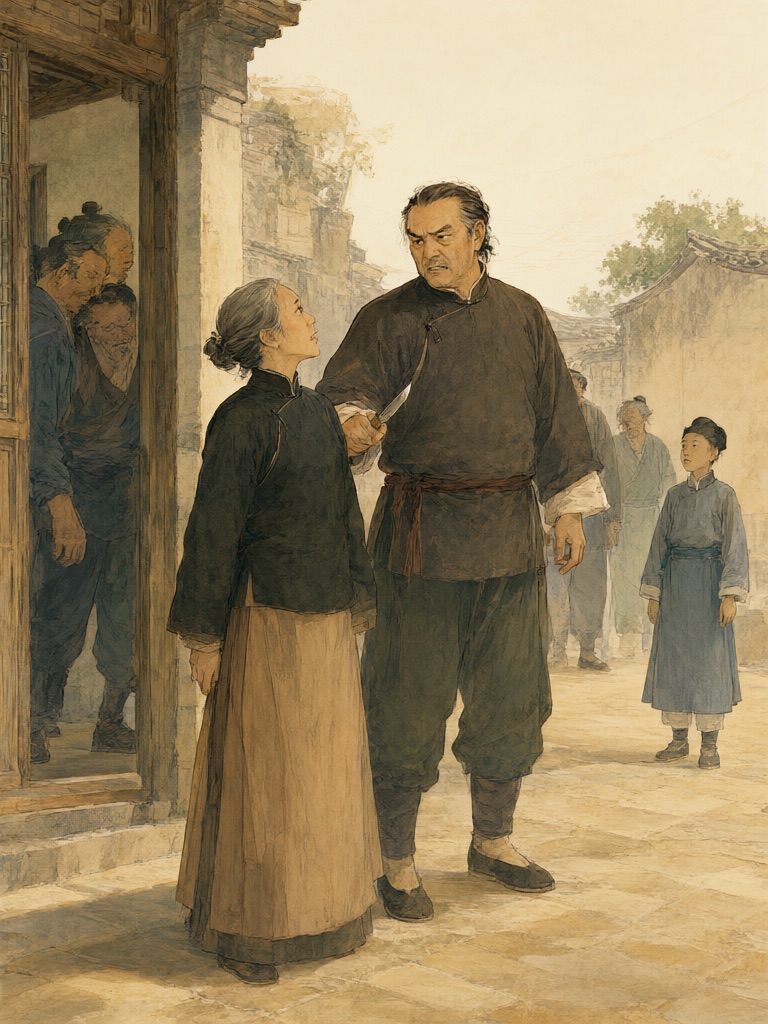
Danniang had long been a widow by then, so she sent her younger son home, telling him to work hard alongside his elder cousin and not to come back. From then on she stayed in her mother's house, caring for her mother and teaching her brother, and everything inside and outside the home ran in good order. Her mother was greatly comforted, her illness slowly mended, and she handed all the household affairs over to Danniang. If any of the local bullies tried even a little intimidation, Danniang would take a knife in hand and turn up at their door, arguing her case boldly, and not one of them failed to back down. After a year or so, the family's land was growing by the day. She often bought medicines and delicacies to send to Jiang's daughter. And seeing Lu growing up, she kept asking matchmakers to find him a bride. Wei told people, “The whole Qiu estate belongs to Danniang now. I doubt it'll ever go back to the family.” Everyone believed him, so no one was willing to discuss a match.
There was a young gentleman named Fan Ziwen whose family garden was the most famous in Shanxi. Rare flowers lined its paths all the way to the inner apartments. Once a man had wandered in by mistake just as the young master was holding a private party; Fan, furious, seized him as a thief and had him beaten nearly to death. At the Qingming festival, Lu came home from school, and Wei took him out on an outing that led them to the garden. Wei was an old acquaintance of the gardener, who let them in, and they toured all the pavilions and terraces. Presently they came to a spot where a stream rushed past, and a painted bridge with vermilion railings led to a lacquered gate; through it, in the distance, flowers bloomed like brocade — this was in fact the young master's private quarters. Wei tricked him: “You go on in first. I just need to relieve myself.” Lu believed him, followed the bridge through the gate and came into a courtyard, where he heard women laughing. As he stopped short, a maid came out, caught sight of him, and turned right back. Only then did Lu take fright and run. Before long the young master came out and shouted for his servants to take ropes and chase him. Cornered, Lu threw himself into the stream. The young master's anger turned to laughter, and he had his servants pull the boy out. Seeing how refined the boy looked and dressed, he had his clothes and shoes changed, drew him into a pavilion and asked his name. His manner was gracious and his words gentle, as if they were old friends. Soon he hurried into the inner rooms; then he came back out, smiling, took Lu by the hand, crossed the bridge, and led him back toward the very place he had come from. Lu, not understanding what he meant by this, hung back and dared not go in. The young master pulled him in by force, and Lu glimpsed beauties peeping at him from behind the flowering hedge.
Once they were seated, a troop of maids poured wine. Lu excused himself: “I'm only an ignorant boy who blundered into the women's quarters. To be pardoned at all is more than I could hope for. I ask only that you let me go home soon, and I'll be deeply grateful.” The young master would not hear of it. Soon dishes of roast meat came crowding in. Lu rose again, protesting that he had eaten and drunk his fill, but the young master pushed him back into his seat and said with a laugh, “I have the name of a tune. If you can match it with a couplet, I'll let you go.” Lu meekly asked him to name it. “The tune is called ‘Hunbusi — Like Nothing at All.’” Lu thought in silence for a long time, then answered: “Silver cast as ‘Meinaihe — Nothing to Be Done.’” The young master roared with laughter: “A true Shi Chong!” Lu had no idea what he meant.
As it happened, the young master had a daughter named Huiniang, beautiful and well read, who had been choosing a worthy husband for some time. One night she dreamed that someone told her, “Shi Chong is to be your husband.” “Where is he?” she asked. “Tomorrow he will fall into the water.” In the morning she told her parents, and they all thought it strange. Lu happened to fit the dream exactly, which was why he had been invited into the inner quarters, so that the lady of the house and the girls could all have a look at him. Pleased with the couplet, the young master said, “The tune name was set by my daughter. She tried again and again but could never find a match for it; now that you have, there must be a heavenly bond. I would like to give you my daughter as your wife. My humble home has no lack of rooms, so you won't even need to trouble yourself with fetching the bride.” Lu nervously declined, pleading that his mother was ill and that he could not marry into another family's house. The young master told him to go home and think it over for now, and sent a groom carrying his wet clothes to see him home on horseback.
When he got home and told his mother, she was alarmed and thought it a bad omen. Only now did they understand how treacherous Wei was; but since ill had turned to good, they did not hold it against him, and she merely warned her son to cut him off completely. A few days later the young master sent someone to put the proposal to the mother, and still she did not dare accept. Danniang accepted on her behalf, and at once engaged two matchmakers to deliver the betrothal gifts. Before long Lu went to live in the young master's house as a son-in-law. A year or so later he passed the county examination, and his talent became widely known. As his wife's younger brother grew up, he treated Lu with less respect; Lu took offence and brought his wife home. By then his mother could walk with a stick. Thanks to Danniang's management over the years, the house too was in fine repair. Once the new bride arrived, with maids and servants thick as clouds, the place had all the air of a great family.
Now that Wei had been shut out again, his envy ran deeper than ever, and he chafed at having no flaw to exploit. So he got a runaway from one of the Banners to falsely accuse Lu of hiding money for him. The laws were at their harshest in the early years of the dynasty, and Lu was exiled beyond the Great Wall as the law required. Young Master Fan bribed everyone high and low, but could only spare Huiniang from going with him; all of Lu's land was confiscated. Fortunately Danniang held the deed of household division and boldly went to argue the case: the good fields acquired since then were all registered in Fu's name, and so mother and daughter were able to keep their home.
Expecting never to return, Lu wrote out a letter of divorce, left it with his wife's family, and set off alone and forlorn. After several days on the road he reached the country north of the capital and stopped to eat at an inn. A beggar was hovering anxiously outside the door who looked exactly like his elder brother; Lu went up to question him, and it was indeed Fu. Lu told his own story, and the two brothers grieved together. Lu undid his padded coat, gave his brother a few taels of silver from it, and told him to go home. Fu wept as he took it, and they parted.
Beyond the Wall, Lu became a slave in a general's camp. Because Lu was a frail scholar, he was put in charge of the accounts and lodged with the other servants. They asked him about his family, and he told them everything. One of them cried out in astonishment, “This is my son!” For Qiu Zhong had at first been made to herd horses for the bandits; later, when they surrendered to the government, they sold him into the Banners, and at that time he was stationed beyond the Wall with his master. As he told Lu his story in detail, they realised they truly were father and son, and they wept in each other's arms, so that everyone in the room was moved. Then Qiu Zhong said angrily, “What sort of creature is this runaway, to frame my son!” and he went in tears to tell the general. The general at once made Lu his acting secretary, and wrote a letter to an imperial prince, sending Qiu Zhong to the capital with it. Qiu Zhong waited for the emperor's carriage to come out and was the first to present a petition of grievance. The prince interceded on his behalf, the injustice was redressed, and the local officials were ordered to buy back the property and return it to the Qius. When Qiu Zhong came back, father and son rejoiced. Lu asked carefully about his father's household, meaning to buy his freedom. He learned that since entering the Banners his father had twice been given a wife, had had no children by either, and was now a widower. So Lu packed his bags and headed home.
Meanwhile, after parting from his brother, Fu had come home and thrown himself on the ground to confess. Danniang sat their mother in the main hall and, stick in hand, questioned him: “If you're willing to take a beating, you may stay for now. If not — your land is all gone, and there's no rice bowl here for you, so kindly leave again.” Fu lay weeping on the floor and said he would take the beating. Danniang threw down the stick. “A man who sells his wife isn't even worth punishing. But your old case is still on the books; do it again and I'll simply turn you in to the magistrate.” Then she sent someone to tell the Jiangs. Jiang's daughter snapped back, “What am I to the Qiu family, that you send me news?” Danniang repeated this to Fu again and again to mock him, and Fu was too ashamed even to breathe.
Half a year passed. Danniang provided for Fu fully, but worked him like a servant. Fu did whatever he was told without a word of complaint, and when money was entrusted to him he never cut a corner. When Danniang was sure he meant no more harm, she went to her mother and asked to bring Jiang's daughter back. Her mother thought it could never be mended. “Not so,” said Danniang. “If she were willing to serve a second master, why would she have put herself through such torment? It's only that she can't help feeling this anger.” So she took her brother to beg forgiveness in person. Jiang's parents reproached them bitterly. Danniang ordered Fu to kneel and stay kneeling, then asked to see Jiang's daughter. She asked again and again, but the young woman firmly kept out of sight, until Danniang searched her out and hauled her into the room. Then the young woman pointed at Fu and spat curses at him, and Fu, drenched in the sweat of shame, wished the ground would swallow him. Only then did Jiang's mother pull him to his feet. Danniang asked when she would come home. The young woman said, “I have received so much kindness from you, sister, that when you ask, how could I say otherwise? I'm only afraid there's no guarantee he won't sell me again! Besides, all bonds of love and duty between us are broken; how could I bear to live with that black-hearted scoundrel? Please set aside a separate room, and I will come and serve our old mother. Anything better than shaving my head as a nun is enough for me.” Danniang spoke up for Fu's repentance, arranged to fetch her the next day, and took her leave.
The next morning they sent a sedan chair to bring her back, and her mother-in-law met her at the gate and knelt to her. The young woman threw herself on the ground, sobbing. Danniang calmed them, set out wine to celebrate, had Fu sit at the side of the table, and then raised her cup and said, “I fought so hard, but not for my own gain. Now that my brother has mended his ways and his faithful wife has come home, let me hand over the account books. I came here with nothing but myself, and with nothing but myself I'll go.” Husband and wife both rose from their seats, their faces changed, and they knelt around her weeping and pleading, until at last Danniang gave in.
Not long after, the order of exoneration came down, and within a few days all the fields and houses were restored to their rightful owners. Wei was astounded, unable to see how it had happened, and cursed himself for having no more tricks to play. It happened that a fire broke out at the neighbour's house to the west; Wei went over on the pretext of helping to put it out and secretly set Lu's house alight with a bundle of thatch. Then a fierce wind sprang up, and almost everything burned; only the two or three rooms where Fu lived were left, and the whole family crowded into them. Soon afterwards Lu arrived home, and their meeting was half grief, half joy.
Earlier, when Young Master Fan received the letter of divorce, he had taken it to Huiniang to discuss. Huiniang wept bitterly, tore it to pieces and threw it on the floor. Her father respected her wishes and pressed her no further. When Lu came home and heard that she had not remarried, he went joyfully to his father-in-law's house. Knowing of the fire, the young master wanted him to stay; Lu would not, and took his leave. Luckily Danniang had some money hidden away, and she brought it out to repair the ruined walls. As Fu shouldered a spade to do the building, he dug up a buried hoard of silver; that night he and his brother opened it up, and found a stone pit ten feet across, filled to the brim with the great silver ingots called “Immovables.” With that they hired craftsmen and built on a grand scale, towers and halls rising one after another, as splendid as any old noble house. Grateful for the general's kindness, Lu prepared a thousand taels to go and ransom his father. Fu asked to be the one to go, so they sent him off with some sturdy servants to help. Lu then brought Huiniang home. Not long after, father and elder brother came home together, and the whole family was overjoyed.
All the while she had lived in her mother's house, Danniang had forbidden her sons to visit, for fear people would say she was feathering her own nest. Once her father was home, she insisted on leaving. Her brothers could not bear to let her go. So their father divided the property in three: two shares to the sons, one to the daughter. Danniang firmly refused. Both brothers wept and said, “If not for you, sister, where would we be today?” So at last Danniang accepted. She sent for her sons and moved her family in to live with them all. Someone asked her, “They're only your half-brothers — why do you care for them so much?” Danniang said, “To know one's mother but not one's father — only beasts are like that. Should a human being imitate them?” When Fu and Lu heard this, they both wept. They had workmen build her a house just as fine as their own.
Wei reckoned that for more than ten years he had tried to ruin the Qius, and every time he had only made them more fortunate; he was deeply ashamed and sorry. He also coveted their wealth and wanted to get into their good graces, so he used a visit to congratulate Qiu Zhong as his stepping stone, and came bearing gifts. Fu wanted to turn them away, but Qiu Zhong could not bear to snub him, and accepted a chicken and some wine. The chicken's feet were tied with a strip of cloth; it got loose and ran into the stove, where the fire caught the cloth, and then it went to roost on the woodpile. The servants saw it but paid no attention. Presently the woodpile caught fire and spread to the house, and the whole family was thrown into panic. Fortunately there were plenty of hands, and it was put out in no time, but everything in the kitchen was lost. The brothers both said Wei's gifts were unlucky.
Later, on their father's birthday, Wei brought them a sheep on a lead. They could not refuse it, so they tied it to a tree in the courtyard. That night a servant boy who had been beaten by one of the other servants stormed out to the tree in a rage, untied the sheep's rope and hanged himself with it. The brothers sighed, “His blessings do us worse than his curses!” From then on, however attentive Wei was, they dared not accept so much as a thread from him, preferring to reward him handsomely instead. Later, when Wei was old, he fell into poverty and became a beggar, and the Qius often helped him with cloth and grain, repaying his wrongs with kindness.