The road ahead lies dark as lacquer, hard to know; autumn moons and spring flowers each keep their season. Listen quietly to what Heaven decrees— why toil and rush about in the dead of night? Our story is set in the first year of the Zhenguan reign of the great Tang, when Emperor Taizong was humane, wise and righteous, and trusted worthy ministers. For letters he had his Eighteen Scholars; for arms, his eighteen Commanders-General. Truly it was: The ranks at court stood thick and stately, row on orderly row. Every man of talent and wit in the empire had been recommended to office and allowed to give full play to his ambitions. And so the realm was at peace and the people content. Among them all, let us speak of one man alone: his surname was Ma, his given name Zhou, his courtesy name Binwang, and he came from Chiping in Bozhou. Both his parents were dead and he was as poor as if he had been washed clean. Past thirty and still unmarried, he had nobody in the world but himself. From boyhood he had mastered the classics and histories; his learning was broad, and in spirit and strategy he outdid others in every respect. But being poor and alone, with no one to back him, he had nobody to recommend him—plainly a divine dragon stuck in the mud, unable to take flight. He watched men with a ten-thousandth of his learning rise one after another to high rank and fat salaries, while he alone stayed unrecognized. Every day he sighed in gloom: “It's the times, it's luck, it's fate.” In his life he had earned himself a great capacity for drink, and when he was low he simply drank until he was drunk. Whether he ate one meal or none he never cared, but he could not do without his cup. When he had no money for wine he would find out which neighbor had some and go and swill it there. Yet he behaved grandly and carelessly, and once drunk he would rant and shout and curse everyone at the table. The neighbors on every side grew sick of his racket, and not one of them could stand him. Behind his back they called him “Poor Ma Zhou,” and “the Drunkard.” Ma Zhou knew it and did not care in the least. Truly it was: Until the dragon meets the tiger, let them call him horse or ox.
Now, the prefect of Bozhou, a man named Daxi, had long heard that Ma Zhou was learned in the classics, and engaged him as assistant instructor at the prefectural school. On the day he took up the post, the students brought wine to congratulate him, and before he knew it he was blind drunk. The next day the prefect came in person to the school to consult him, and Ma Zhou, still sodden with wine, could not get out of bed. The prefect left in a fury. When Ma Zhou woke and learned the prefect had called, he went to the yamen expressly to apologize, and received a long lecture. Ma Zhou said “Yes, yes,” but could not mend his ways. Whenever a student came with a text to ask about a difficult passage, he kept him to drink. All his salary went to the wine shops, and when that was not enough he went on drinking at his students' homes. One day, drunk, he was coming home propped up by two students, singing all the way, when he ran into the prefect's outriders, who shouted at him to stand aside. Ma Zhou would not give an inch; he glared and started cursing them, and the prefect gave him another dressing-down right there in the street. Ma Zhou was too drunk to know it at the time; when he woke the next day, his students came again to urge him to go and apologize. Ma Zhou sighed and said, “I bent my will to other men only because I was poor and alone, with no one to back me, and wanted some step to climb by. Now, over the wine, the prefect has scolded and shamed me again and again. How can I face bowing and scraping for his pity once more? The ancients would not bend their backs for five pecks of rice, and this little instructor's post is no place for me to spend my life.” He handed his official robe to a student, told him to return it to the prefect, threw back his head with a great laugh, and walked out the door. Truly it was: From here on he would rely on his three-inch tongue; had he come back, the post would not be worth a cash.
As the old saying goes, “Water does not leap unless it is stirred; a man does not rise unless he is provoked.” Ma Zhou, unable to bear the prefect's rebukes over his drinking, sighed and walked out the door, went to a certain place, met a certain man who lifted him up, and rose all the way to Minister of Personnel. But that comes later. Where was he heading now? He thought, “Knocking about from prefecture to prefecture, I'll never meet a great chance. Only in the imperial capital, Chang'an, among the dukes, lords and ministers, might there be some Xiao He who can recommend a man, some Wei Wuzhi who can spot talent. There I could find my day to rise and fulfil my life's wish.” So he wandered westward, and before many days he came to Xinfeng. Now Xinfeng had been built by the founding emperor of Han. Gaozu was born in the village of Feng; later he raised an army, overthrew Qin and destroyed Xiang Yu, became Son of Heaven of the great Han, and honoured his father as Grand Emperor Emeritus. Living in Chang'an, the old man pined for the sights of his home village. So Gaozu ordered skilled craftsmen to build this town exactly like the old Feng, and moved the people of Feng to live in it. Streets, markets and houses were laid out exactly as in Feng. When the Zhangs' chickens and the Lis' dogs were let loose in the street, even they knew their own gates and went home. The Grand Emperor Emeritus was delighted and named the town New Feng—Xinfeng. Now the great Tang still had its capital at Chang'an, and Xinfeng, lying within the Pass, was a dense and bustling market town. Of inns for travelling merchants alone there were countless.
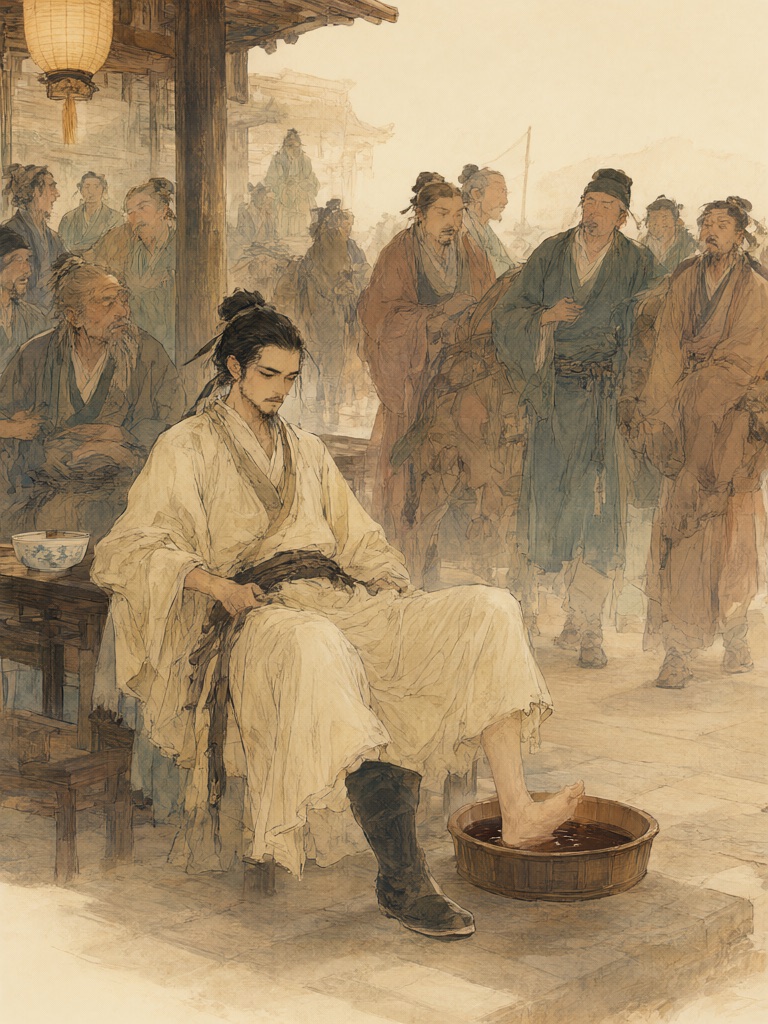
Ma Zhou reached the Xinfeng market as night was falling, picked out a large inn, and strolled in. All around was swirling dust and a press of carts and horses; crowds of merchants and travellers with loaded pack animals were pouring in by threes and fives to put up for the night. Old Wang, the innkeeper, greeted them and hurried about assigning rooms and stacking baggage. The guests formed into their parties, each claimed a table, and called for soup and wine. The waiter could not carry fast enough and spun about like a revolving lantern. Ma Zhou sat off to one side, alone and ignored; not a soul paid him any attention. Indignant, he slapped the table and shouted, “Innkeeper, you're a bully! Am I the only one who's not a guest, that you won't look after me? What kind of way is this?” Hearing him flare up, Old Wang came over to smooth things down: “Don't be angry, sir. They're a big crowd over there, so I had to settle them first; you're only one, and easy to serve. Whatever you want to eat or drink, just tell me.” Ma Zhou said, “I've been walking all day and haven't washed my feet. First bring me some clean hot water.” Old Wang said, “The pot's not free; you'll have to wait a while for hot water.” “In that case,” said Ma Zhou, “bring the wine first.” “How much wine?” asked Old Wang. Ma Zhou pointed at a party of guests at the big table opposite and said, “However much they're having, I'll have the same.” “Those five gentlemen,” said Old Wang, “are having a peck of good wine each.” Ma Zhou said, “Strictly speaking that wouldn't get me half drunk, but I go easy on the road, so five pecks will do. And bring on whatever good dishes you've got.” Old Wang passed the order to the waiter. Five pecks of wine were warmed one after another and set on the table, with a big porcelain bowl and a few dishes of meat and vegetables. Ma Zhou raised the bowl and drank alone, as if no one else were there.
When he had drunk a little over three pecks, he called for a foot basin, poured all the remaining wine into it, kicked off his boots, and put his feet in to wash them. Every guest who saw it was astonished. Old Wang marvelled to himself and knew this was no ordinary man. Cen Wenben, who lived at the same time, painted a picture called Ma Zhou Washing His Feet, and later an Old Fisherman of the Misty Waves inscribed a eulogy on it, which said: The world exalts the mouth; I alone honour the feet. The mouth easily stirs up waves; the feet can cross the land. They stand below without toppling and can chase a thousand miles. Their toil is heavy, their reward slight; silently they bear the shame. I repay you with wine to comfort you for your weary miles. Today you forget your cares—better than filling my own belly. Ah, Binwang, your vision rose above the common herd.
The night passed without incident. Next morning Old Wang rose early to settle the bills and send the travellers on their way. Ma Zhou had no money on him; thinking the weather was turning warm, he took off his fox-fur coat and offered it to Old Wang for the wine. Old Wang, seeing he was a generous-spirited man and feeling the coat was worth far too much, refused again and again. Ma Zhou asked for a brush and wrote a poem on the wall. It said: The ancients, moved by a single meal, tossed away a thousand in gold like old sandals; how could chopsticks and spoon be worth repaying? What matters is a friend who understands. I drank the wine of Xinfeng, and need not pawn my fox fur for it; worthy indeed is my host, whose generous spirit sways the whole village!
After it he wrote: “Inscribed by Ma Zhou of Chiping.” Seeing how fine both the poem and the calligraphy were, Old Wang felt deep respect for him and asked, “Where are you headed now, Master Ma?” “To Chang'an, to seek a name,” said Ma Zhou. “Do you know anyone there to lodge with?” “No,” Ma Zhou replied. Old Wang said, “A man of your great talent will surely become rich and honoured there. But in Chang'an rice is as dear as pearls and firewood as dear as cassia, and your purse is empty—how will you get by? I have a niece who married into the family of Zhao Sanlang, a cake-seller on Wanshou Street there. I'll write a letter and send you to lodge with her; it will be less trouble than anywhere else. And here's an ounce of silver to help with the journey—don't think it too little.” Moved by his kindness, Ma Zhou had to accept. When Old Wang had finished the letter, he handed it to Ma Zhou. Ma Zhou said, “If one day I get the smallest advancement, I will never forget you.” He thanked him and took his leave.
When he reached Chang'an, it was indeed a world of flowers and brocade, quite different again from the Xinfeng market. Ma Zhou asked his way straight to the Zhao cake shop on Wanshou Street and handed over Old Wang's letter. The Zhao family, it turned out, had made their living for generations selling these rice-flour cakes; Zhao Sanlang had died two years before, and his wife, left a widow, had taken over the shop. She was the niece of Old Wang of the Xinfeng inn. Though past thirty, she was still full-figured and more beautiful than most. The people of the capital all called her, as it tripped off the tongue, “the Cake Granny.” The northern word ao, “granny,” was just like the southern word ma, “mother.” When Granny Wang first began selling cakes in the shop, the great physiognomist Yuan Tiangang was astounded at the sight of her and sighed, “This woman's face is like the full moon, her lips like red lotus, her voice resonant and her spirit clear, and the bridge of her nose unbroken. That is the face of great nobility; one day she will surely be a lady of the first rank. How can she be stuck in a place like this?” He happened to mention this to Chang He, a Leader of Court Gentlemen. Chang He believed Yuan Tiangang's words completely, and told his old steward to go to her shop every day on the pretext of buying cakes, chat with her, and talk her into remarrying, for he wanted to take her as a concubine. Granny Wang only gave a dry laugh and would not commit herself at all. Truly it was: A marriage is fixed in a former life; if it is not your match, do not force it.
Now, the night before, Granny Wang had had a strange dream. She dreamed that a white horse came from the east into her shop and ate up all her rice cakes in one gulp. She seized a whip to chase it off and, without knowing how, found herself leaping onto its back. The horse turned into a fiery dragon and soared up into the sky. She woke up hot all over and thought the dream most unusual. And that very day she received a letter from her uncle, Old Wang, sending her a guest named Ma—and Ma Zhou was dressed in white. Granny Wang's suspicions were strongly roused, and she let him lodge at the shop. Three meals a day she served him attentively. Ma Zhou took it all as a matter of course, without the least show of modesty, and Granny Wang for her part never slackened. But, confound it, there was a gang of idle young rakes in the neighbourhood who, seeing that Granny Wang was a pretty widow, were forever lounging against her doorway, behaving improperly and trying to provoke her with cheap, flirtatious talk. Granny Wang never gave them any encouragement, and people said she was a decent woman. Now, seeing her keep a single man from far away in her house, they could not help wagging their tongues and inventing all sorts of gossip. Granny Wang was a shrewd woman and had already heard it all. She said to Ma Zhou, “I would gladly keep you here, sir, but in a widow's house, people's talk is not pretty. You have a great future ahead of you; you should choose a higher branch to perch on so that you can rise. To bury your great talent here would be a sad waste.” Ma Zhou said, “I would gladly serve as a tutor or secretary in some household; I just have nowhere to go.”
Before the words were out of his mouth, in came Chang He's old steward again to buy cakes. Granny Wang reflected that Chang He was a military officer and was bound to need a literary man's help, so she asked the steward, “I have a distant relative, a Scholar Ma, a very learned man, who is looking for a post here. Could your master use him?” “Very much so,” answered the steward. It so happened that there was a drought just then, and Emperor Taizong had issued an edict that all officials of the fifth rank and above should rack their brains and speak frankly on the successes and failures of government, so that he might adopt their advice. By his rank Chang He too ought to submit a memorial, and he was just looking for a learned man to write it for him. Granny Wang's mention of Scholar Ma was plainly food to the hungry and drink to the thirsty—it scratched exactly where it itched. The steward went back and reported to Chang He, who was delighted and at once sent men with a horse to fetch him. Ma Zhou took leave of Granny Wang and came to Chang He's house. Chang He, seeing that Ma Zhou had an uncommon bearing, treated him with great respect. That day he set out wine to entertain him, had his study swept, and kept Ma Zhou to stay.
The next day Chang He took twenty ounces of silver and ten lengths of coloured silk and delivered them in person to the study as a token gift for his teacher. Then he discussed with Ma Zhou the matter of the imperial edict asking for counsel. Ma Zhou called for brush and inkstone, spread out a sheet of plain paper, and with his hand never stopping, dashed off twenty proposals. Chang He sighed in admiration and had them neatly copied out that very night, and at the morning audience next day presented them for the emperor's perusal. When Emperor Taizong had read them, he praised every one, and asked Chang He, “Insight and argument like this are beyond you. Where did you get them?” Chang He prostrated himself on the ground and said, “I deserve death! Your foolish servant could never have put forward these twenty proposals. They are the work of Ma Zhou, a guest in my house.” Emperor Taizong said, “Where is Ma Zhou? Summon him to see Us at once.” A palace eunuch took the imperial order straight to Chang He's house to summon Ma Zhou. But Ma Zhou had had his morning wine and was snoring away, and no amount of calling would wake him. Another edict came down to hurry him, and by the third, Chang He came home himself. This shows how extremely Emperor Taizong valued talent. A court historian wrote a poem about it: Three summonses came hard on each other's heels: the Zhenguan emperor cherished talent. If every court loved scholars thus, how could heroes languish in the wilds?
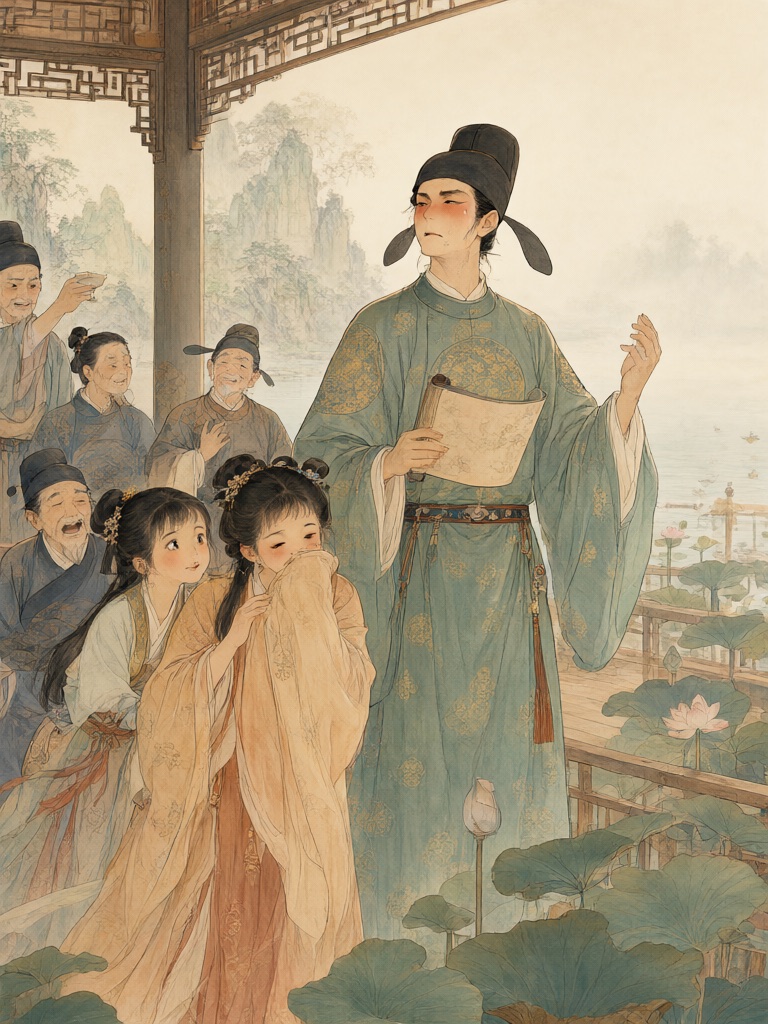
Chang He went to the study himself, had the page boy prop Ma Zhou up, and sprayed cold water in his face, and only then did Ma Zhou come to. Hearing of the imperial summons, he hurried onto a horse. Chang He led him to the Golden Bell Hall to see the emperor, and when he had finished his obeisances, Taizong asked in his jade voice, “Where are you from? Have you held office?” Ma Zhou replied, “Your servant is from Chiping county and was once assistant instructor at Bozhou. Not being able to fulfil my aims there, I gave up the post and came to the capital. To be granted sight of Your Majesty's face today is my great good fortune.” Taizong was delighted and that same day appointed him Investigating Censor, bestowing on him the robe, tablet and belt of office. Ma Zhou put them on, gave thanks and withdrew, then went back to Chang He's house to thank him for the recommendation. Chang He laid out another feast and raised his cup in congratulation.
When the party broke up that evening, Chang He did not like to keep Ma Zhou in the humble study any longer and wanted to have a sedan chair and horses made ready to take him home to his relative Granny Wang. Ma Zhou said, “Granny Wang is not really a relative; I was only lodging at her house.” Chang He was astonished and asked, “Does Your Honour the Censor have a family?” Ma Zhou said, “I'm ashamed to say that I've been too poor to marry.” Chang He said, “Master Yuan Tiangang once read Granny Wang's face and said she was destined to be a lady of the first rank. I was afraid she was your relative, which would have stood in the way; but since you met by chance like duckweed on the water, it is a match made by Heaven. If Your Honour does not find her unworthy, I will act as go-between.” Ma Zhou, grateful for Granny Wang's kindness, had the same idea himself and said, “If you, my senior, will bring it about, I shall be deeply indebted to you.” That night Ma Zhou again stayed at Chang He's house.
Early the next morning Ma Zhou again went with Chang He to see the emperor. At that time the Turks had rebelled, and Emperor Taizong was sending four Commanders-General out to crush them; he ordered Ma Zhou to present a plan for pacifying the barbarians. Ma Zhou recited his answer before the throne as fluently as flowing water, and every phrase suited the imperial mind. He was promoted to Supervising Secretary. Chang He, for his merit in recommending a worthy man, was granted a hundred bolts of silk. When he had given thanks and left the court, he ordered that he be taken straight to the cake shop, where he would ask to see Granny Wang. Granny Wang, still thinking that Chang He had come to force her to marry him, hurried off to hide and would not come out for anything. Chang He sat down in the shop and sent his steward to find an elderly neighbour woman to carry a message: “Leader of Court Gentlemen Chang has come here today for no other reason than to ask for your hand on behalf of Supervising Secretary Ma.” When Granny Wang asked what it was all about, she learned that Supervising Secretary Ma was Ma Zhou. The dream of the white horse turning into a dragon had now come true. This was a match given by Heaven and could not be refused. When Chang He saw that Granny Wang had consented, he used the silk the emperor had bestowed on him as Ma Zhou's betrothal gifts, and rented an empty house for Ma Zhou to live in. An auspicious day was chosen, Ma Zhou married Granny Wang, and all the officials of the court came to offer congratulations. Truly it was: Plainly a poor scholar with a beggar's face, suddenly made an honoured guest of the court. When Granny Wang married Ma Zhou, she moved her whole household over to the Ma home. Everyone in the neighbourhood envied her—but no more of that.
From the time Ma Zhou met Emperor Taizong, everything he said was heeded and every remonstrance he made was followed. In less than three years he rose all the way to Minister of Personnel, and Granny Wang was given the title of Lady. Old Wang, the innkeeper of Xinfeng, learning that Ma Zhou had risen to wealth and glory, made a special trip to Chang'an to see him, meaning to call on his niece first. But when he reached Wanshou Street, the cake shop was gone, and he supposed she had moved. Only after questioning the neighbours did he learn that his niece, widowed, had later married none other than Minister Ma—and Old Wang's joy was beyond measure. He asked his way to the Minister's mansion and met Ma Zhou and his wife, and they talked over old times. After staying more than a month, he wanted to say goodbye and go home. Ma Zhou presented him with a thousand in gold, which Old Wang flatly refused. Ma Zhou said, “The lines of the poem are still on your wall: a single meal is worth a thousand in gold. How could I forget?” Only then did Old Wang accept it; he thanked him and went home, and became a rich man of Xinfeng. This was a case of being given a melon and repaying with jade, of kindness repaid with kindness—but no more of that.
As for Prefect Daxi: he had gone home to observe mourning for a parent, and when the mourning period was over he came to the capital. Hearing that Ma Zhou was now Minister of Personnel, and knowing he had offended him, he was so anxious and frightened that he did not dare apply for a new post. When Ma Zhou heard of this, he invited him again and again to come and see him. Daxi threw himself on the ground, crying, “I had eyes but did not recognize Mount Tai. I beg you to forgive my offence.” Ma Zhou hastily raised him up and said, “A prefect who trains students ought to choose upright, careful men. Drinking to excess and shouting wildly—that was Ma Zhou's fault, not the fault of a worthy prefect.” That very day he recommended Daxi to be Governor of the Capital. The officials of the capital, seeing how broad-minded and generous Ma Zhou was, all admired him. Ma Zhou lived in wealth and honour all his days and grew old together with Granny Wang. A later poet wrote this lament: A famous minister of his age was a drinking man, and Granny Wang the cake-seller was a rare one too. The people of the time lacked a Persian jeweller's eye, and let these bright pearls lie mixed in common dust.