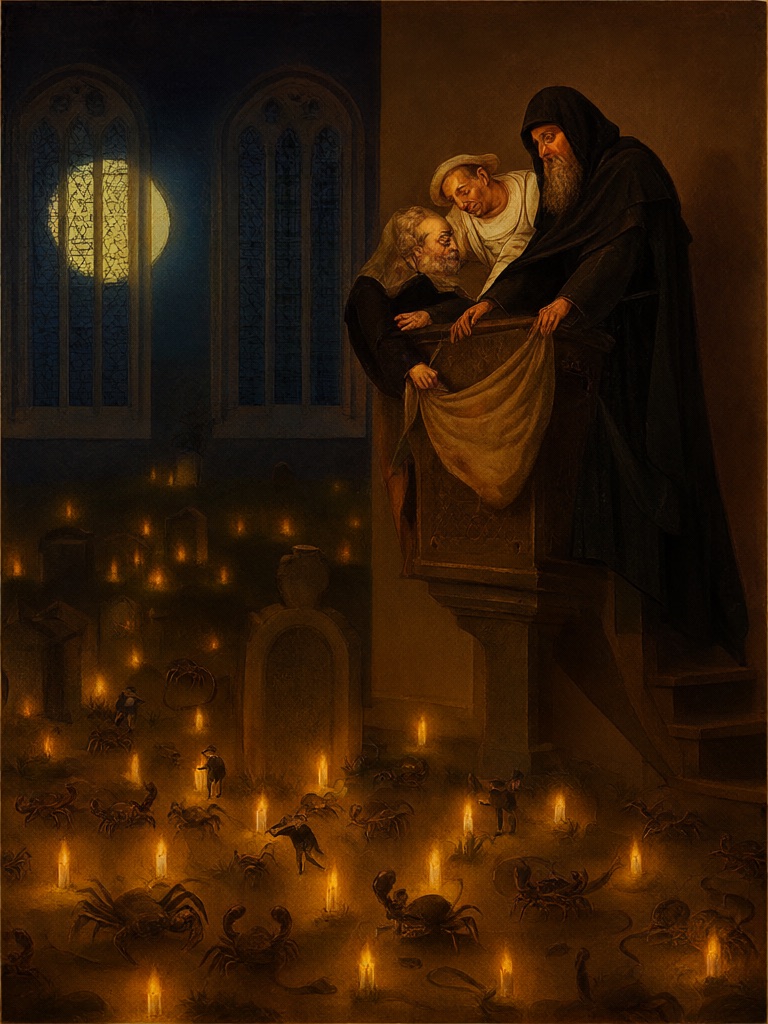
Wang Mian, styled Mianzhai, was a man of Lingshan. He was talented and had often come first in the examinations, but he was very proud and loved to mock and abuse others, and many people suffered his scorn. One day he happened to meet a Daoist, who studied him and said, "Your face shows the makings of great rank, but the karma of your sharp tongue has almost used it all up. Clever as you are, if you turned around and cultivated the Way, you could still be enrolled among the immortals." Wang sneered: "Good fortune is unknowable, true, but there are no immortals in this world!" The Daoist said, "How narrow your vision is! You needn't look elsewhere: I myself am an immortal." Wang laughed even harder at such nonsense. The Daoist said, "I'm nothing remarkable. If you'll come with me, you can see dozens of true immortals at once." "Where?" Wang asked. "Close at hand." The Daoist then gripped his staff between his thighs, handed the other end to Wang, and told him to do the same. He told him to close his eyes and shouted, "Rise!" Wang felt the staff swell as thick as a five-peck sack and fly up into the air; feeling it stealthily, he found it covered with rows of scales. Terrified, he dared not move again. After a while the Daoist shouted again, "Stop!" and pulled the staff away, and they landed in a great mansion of towering halls and long galleries, like an emperor's palace. There was a terrace more than ten feet high, and on it a hall eleven bays wide, magnificent beyond compare.
The Daoist led his guest up and at once told a boy to lay out a banquet and summon the guests. Dozens of tables were set out in the hall, dazzling in their splendor. The Daoist changed into formal robes and waited. Soon the guests began arriving through the air, riding dragons, tigers, or phoenixes, each one different, and all bringing musical instruments. There were women and men, and some went barefoot. Among them was one beauty alone who rode a many-colored phoenix and was dressed like a lady of the palace; a maid carried her instrument for her, about five feet long, neither a qin nor a se, and no one knew its name. When the wine went round, rare dishes were served in profusion, sweet and fragrant in the mouth and unlike any ordinary delicacy. Wang sat in silence, his eyes fixed on the beauty. He was smitten with her, and longed to hear her play, but secretly feared she would never play at all.
As the feast drew to a close, an old man proposed, "Thanks to Master Cui's kind invitation, today is truly a grand gathering, and we should enjoy ourselves to the full. Let those with the same kind of instrument form a group and play together." So they all paired off into ensembles, and the sound of strings and pipes rang up to the Milky Way. Only the lady on the phoenix had no partner for her instrument. When the music died away, her maid opened the embroidered bag and laid the instrument across a low table. The lady stretched out her jade-white wrists and plucked it like a zither. Its sound was several times brighter than a qin; at its fiercest it could throw the heart wide open, at its softest it could sway the soul. She played for about as long as it takes to cook half a meal, and the whole hall fell silent; no one so much as coughed. At the close came a single ringing note like the striking of a clear stone chime. Everyone exclaimed together, "Lady Yunhe's art is peerless!" Then all rose to say goodbye, and amid the cries of cranes and the song of dragons they scattered at once.
The Daoist prepared a jeweled couch with brocade quilts for Wang to sleep on. From the moment he first saw the beauty, Wang's heart had been stirred; after hearing her play, his longing grew even more tormenting. He thought that with his talents he could pick up high office as easily as picking up a blade of grass, and once rich and noble, what could he not have? In an instant a hundred thoughts tangled in his mind like a mess of hemp. The Daoist seemed to know, and said, "In a former life you studied the Way alongside me, but because your will was not firm you fell into the net of the dusty world. I don't treat you as a stranger; I truly wanted to pull you out of that filth. But your delusion runs so deep you're in a daze and can't be woken. Now I must send you on your way. We may meet again someday, but you will have to pass through another cycle of trials before you can become a heavenly immortal." He pointed to a long stone below the steps, told Wang to sit on it with his eyes closed, and warned him firmly not to look. Then he drove the stone with a whip. It flew up, the wind roaring in Wang's ears, and he had no idea how far they went.
Suddenly Wang wondered what the world below looked like, and he secretly opened his eyes a crack. All he saw was the vast sea, stretching without end. Terrified, he shut them again at once, but his body was already falling with the stone, and with a loud splash he went under like a gull. Luckily he had always lived near the sea and could swim a little. He heard someone clap and say, "What a lovely tumble!" Just as he was in real danger, a girl pulled him up into her boat, saying, "Lucky, lucky! The scholar has passed—into the water!" He looked at her: she was about sixteen or seventeen and strikingly beautiful. Coming out of the water, Wang was shivering with cold and asked for a fire to warm himself. The girl said, "Come home with me, and we'll take care of you. If you're pleased, don't forget me." Wang said, "What are you saying! I'm a man of talent from the Central Plains who happens to be in a sorry state. Afterward I intend to repay you with my very self, not merely remember you!"
The girl plied her oar and the boat flew like wind and rain; in a moment they were near the shore. She took a handful of the lotus flowers she had picked from the cabin and led him away with her. After about half a li they entered a village and came to a red gate facing south. They passed through several courtyards, and the girl ran in ahead. Soon a man of about forty came out, bowed to Wang, invited him up the steps, and told his attendants to bring a cap, robe, socks and shoes for Wang to change into. When he had changed, the man asked about his home and family. Wang said, "I won't lie to you: my name as a man of letters is fairly well known. Master Cui was so eager to have me that he summoned me up to the heavenly palace. But I reckoned that fame and office would be mine for the taking, so I wasn't willing to live as a recluse." The man rose respectfully and said, "This is called Immortals' Island, far from the world of men. My name is Wenruo, my surname Huan. My family has lived here in seclusion for generations; how fortunate to be near a man of renown!" He set out wine with great warmth. Then he said at his ease, "I have two daughters. The elder, Fangyun, is sixteen and has not yet met a fitting match. I'd like her to serve a man of your distinction. What do you say?" Wang was sure it must be the lotus-picking girl, and rose from his seat to thank him. Huan sent for two or three elders of age and virtue from among the neighbors, then turned to his attendants and had them call his daughter at once. Before long a rich, strange fragrance spread through the room, and ten or so lovely girls came out escorting Fangyun, radiant and bright as a lotus in the morning sun. After she had bowed she sat down, and the girls stood in a row to wait on her; the lotus-picking girl was among them.
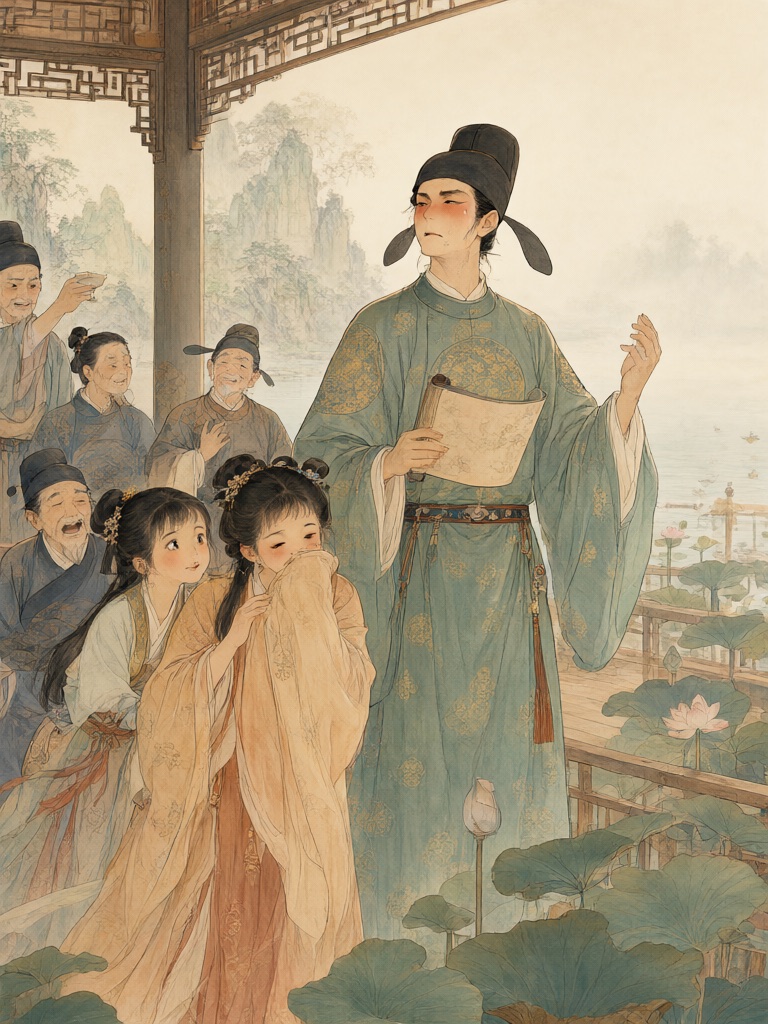
After a few rounds of wine, a little girl with her hair still hanging loose came out from inside. She was only ten or so, but graceful and lovely; smiling, she leaned in under Fangyun's arm, her bright eyes darting about. Huan said, "A girl should stay in her own rooms. What are you doing out here?" Turning to his guest, he said, "This is Lüyun, my younger daughter. She's quite clever and can recite the ancient classics." He had her recite poems for the guest. She chanted three bamboo-branch songs, sweet and charming to hear. He then told her to sit in the corner beside her sister. Huan said, "Master Wang, you are a genius; you must have many poems already composed. Might I have the benefit of hearing one?" Wang at once grandly recited a poem in regulated verse, looking around with great self-satisfaction. Its middle couplet went: "Of my whole body, only beard and brows remain; / a little wine can melt away the lumps in my breast." A neighboring elder recited it over and over. Fangyun said softly, "The first line is Monkey Sun leaving the Fire Cloud Cave, and the second is Pigsy crossing the Mother-and-Child River." The whole table clapped and laughed. Huan asked for another. Wang recited his poem on water birds: "At the pool's head they cry 'ge-zhe'..." and suddenly forgot the next line. While he paused to think, Fangyun whispered something in her sister's ear, then covered her mouth and laughed. Lüyun told her father, "She's finished the line for her new husband. It goes: 'At the dog's rump it sounds peng-ba.'" The whole table roared. Wang looked ashamed. Huan turned and glared at Fangyun.
When Wang had recovered a little, Huan asked to hear his examination essays. Thinking that people outside the world could know nothing of the eight-legged essay, Wang showed off the piece that had won him first place. The topic was the two lines beginning "Filial indeed is Min Ziqian," and his opening went: "The Sage praises the filial piety of a great worthy..." Lüyun turned to her father: "The Sage never called his disciples by their courtesy names. That line 'Filial indeed...' is really what other people said." Hearing this, Wang lost all his zest. Huan laughed. "What does a child know! Never mind that; let's just judge the writing." So Wang went on reciting. Every few lines the sisters would whisper to each other, seemingly passing judgment, but too softly to make out. When Wang reached the best passages, he also quoted the examiner's comments, one of which said, "Every word painfully incisive." Lüyun told her father, "Sister says, 'Delete the word incisive.'" No one understood. Huan, afraid she meant something rude, dared not ask further. When Wang finished, he quoted the general comment too: "One stroke of the Jie drum, and ten thousand blossoms fall together." Fangyun again covered her mouth and whispered to her sister, and both laughed until they could not sit up. Lüyun reported again: "Sister says, 'The Jie drum should be struck four times.'" Again no one understood. Lüyun opened her mouth to explain, but Fangyun, stifling her laughter, scolded her: "If you dare say it, you little wretch, I'll beat you to death!" Everyone was more puzzled than ever, and guesses flew back and forth. Lüyun could not hold it in and said, "Take away 'incisive' and you're left with 'painful,' and where there's pain, things 'don't go through.' And a drum struck four times goes 'bu-tong, bu-tong'—'doesn't go through, and doesn't go through again.'" Everyone burst out laughing. Huan scolded her angrily, then rose himself, filled a cup, and apologized over and over.
Wang, who had prided himself on his talent and thought no one in a thousand ages his equal, was now utterly crestfallen and drenched in sweat. Huan flattered and consoled him: "I've just thought of a line; let the company match it: 'Beside the prince, Wang, not a single dot that is not like jade.'" Before anyone had thought of a reply, Lüyun answered at once: "On old Mian's head, add half an 'evening' and he becomes a turtle." Fangyun burst out laughing, blew on her hands, and pinched the flesh at her sister's waist several times. Lüyun wriggled free and ran off, looking back to say, "What business is it of yours? You've mocked him again and again and thought nothing of it. Is no one else allowed even one line?" Only when Huan shouted at her did she go off laughing.
The neighbors said goodbye. The maids led the couple to their inner chamber, where lamps, candles, screens and bed were all exquisitely arranged. In the bridal chamber the shelves were packed with books; there was nothing that was not there. Wang put a few difficult questions to Fangyun, and her answers flowed without end. Only now did Wang feel how small he was before such an ocean, and he was ashamed. When Fangyun called "Mingdang," the lotus-picking girl hurried in to answer, and so Wang learned her name. Having been mocked and humiliated so often, he feared he would not be respected in the women's quarters; fortunately, though Fangyun's tongue was cruel, within the bed curtains they still loved each other. Living at ease with nothing to do, Wang began composing poems again. Fangyun said, "I have a piece of good advice. I wonder if you'll take it?" "What is it?" he asked. "Stop writing poetry from now on. That too is one way of hiding your clumsiness." Wang was deeply ashamed and gave up writing altogether. In time he grew intimate with Mingdang. He said to Fangyun, "Mingdang saved my life. I hope you'll be a little kinder to her." Fangyun agreed at once. Whenever they amused themselves in the bedchamber, she called Mingdang to join them, and Wang and Mingdang grew ever more attached, often exchanging glances and signals with their hands. Fangyun noticed a little and reproached him repeatedly; Wang only chattered on, trying hard to talk his way out of it.
One evening, as they sat drinking together, Wang found it dull and urged Fangyun to call Mingdang. Fangyun refused. Wang said, "You've read every book. Don't you remember the lines about 'enjoying music alone'?" Fangyun said, "I said you don't make sense, and now it's proven again. Don't you even know where the pauses go? It reads: 'Wanting it alone, one would rather someone else want it; pleasure on the side—who wants that? Answer: no.'" She laughed, and that was the end of it. Then one day Fangyun and her sister went off to an engagement with a neighbor's daughters, and Wang seized his chance: he hurried to draw Mingdang to him and lavished every tenderness on her. That night he felt a slight pain in his lower belly; when the pain passed, his private parts were swollen all over. Terrified, he told Fangyun. She laughed: "That must be Mingdang repaying your kindness!" Wang dared not hide anything and confessed the truth. Fangyun said, "You brought this disaster on yourself; there's really nothing to be done. Since it neither hurts nor itches, just leave it be."
After several days it had not healed, and Wang was gloomy and miserable. Fangyun knew what was on his mind but did not ask; she only gazed at him, her eyes brimming like autumn water, bright as the morning star. Wang said, "This is what you would call 'When the heart is upright, the pupils are clear.'" Fangyun laughed: "And this is what you would call 'When the heart is not upright, the little thing goes mou.'" For the mo of "there is none" was popularly pronounced like mou, "pupil," and so she teased him with it. Wang laughed in spite of himself and begged her for a cure. She said, "You wouldn't listen to good advice, and before this you probably suspected I was just jealous. You didn't know that this maid was never to be touched. I truly cared for you before, but my words went past you like the east wind past a horse's ears, so I spurned you and stopped feeling sorry for you. Still, there's no help for it; I'll treat you. But a doctor must examine the affected part." She reached under his clothes and chanted a spell: "Yellow bird, yellow bird, do not alight on the thorn!" Wang could not help bursting out laughing, and when he stopped laughing he was cured.
Some months later, Wang, thinking of his aged parents and his young son, often longed for home. He told Fangyun how he felt. She said, "Going back is not hard, but there will be no day when we are together again." Tears streamed down his face as he begged her to go back with him, and after thinking it over again and again she agreed. Old Huan held a farewell banquet for them. Lüyun came in carrying a basket and said, "Sister is going far away, and I have nothing to give her. I was afraid that when you reach the southern sea you'd have no place to live, so I've worked day and night building you a palace. Don't mind that it's rough." Fangyun bowed and accepted it. Looking closely, they saw it was a set of towers and pavilions woven from fine grass, the big ones the size of citrons and the small ones the size of tangerines, more than twenty in all; in each, every beam, pillar and rafter end could be clearly counted, and the curtains and beds inside were the size of sesame seeds. Wang treated it as a child's toy, though privately he marveled at the workmanship. Fangyun said, "I'll tell you the truth: we are all earthbound immortals. Because of a bond from a former life, I was able to keep you company. I never meant to set foot in the dusty world, but since you have an old father, I can't bear to refuse you. When your father has lived out his years, I must come back here." Wang respectfully agreed.
Then Huan asked, "By land or by boat?" Wang, fearing the wind and waves, chose to go by land. When they went out, a carriage and horses were already waiting at the gate. They said goodbye and set off at a tremendous pace. Soon they reached the shore, and Wang worried that there was no road. Fangyun took out a bolt of white silk and flung it southward, and it turned into a long causeway more than ten feet wide. They raced across in an instant, and the causeway gradually rolled itself up behind them. They came to a place where the tide flowed through, with a vast empty view on all sides. Fangyun told them to stop, got down from the carriage, took the grass buildings from the basket, and with Mingdang and a few others arranged them according to the proper method; in the blink of an eye they turned into a great mansion. They all went in and unpacked, and it was not the least bit different from their home on the island; even the tables and beds in the bridal chamber were exactly the same. By then it was dusk, so they stayed the night there.
Early the next morning Fangyun told Wang to bring his parents to be cared for. Wang rode quickly to his old home, only to find that the house now belonged to another family. Asking the villagers, he learned that his mother and his wife had both died, and only his old father was still alive. His son was a gambler who had lost all their land, so grandfather and grandson had nowhere to live and were renting a place in West Village for the time being. When Wang first came back he had still harbored ambitions for office and could not let them go; but hearing all this, he was overcome with grief and thought that even if wealth and rank could be had, they would be no different from flowers in the air. He rode to West Village and found his father in filthy, ragged clothes, so old and frail it was pitiful to see. When they met, they both broke down weeping. When he asked about his worthless son, he was told he was out gambling and had not come back. So Wang took his father home in a carriage. After Fangyun had paid her respects to her father-in-law, she heated water for his bath, brought him brocade clothes, and gave him a fragrant room to sleep in. She also invited his old friends from afar to talk and dine with him, and he was cared for better than in any great family.
One day the son tracked them down. Wang disowned him and would not let him in, but gave him twenty taels and sent someone to tell him, "Use this to buy yourself a wife and make a living. If you come again, you'll be whipped to death on the spot!" The son went off in tears. After his return, Wang kept largely to himself and did not exchange social courtesies; yet when an old friend dropped by, he always welcomed him and kept him a long while, more humble than he had ever been. There was one, Huang Zijie, who had studied under the same teacher with him, also a man of letters whose luck had been poor; Wang kept him for a long stay, often talked with him in private, and gave him lavish gifts. After three or four years Wang's father died. Wang spent ten thousand cash choosing a burial site and conducted the funeral with full ceremony. By then his son had married, and his wife kept him on a tight rein, so his gambling had eased somewhat; on the day of the funeral she was at last able to pay her respects to her husband's father and stepmother. As soon as Fangyun saw her, she judged that she could manage a household and gave her three hundred taels to buy land. The next day, when Huang and the son went together to visit, the house and everything in it had vanished, and no one knew where they had gone.