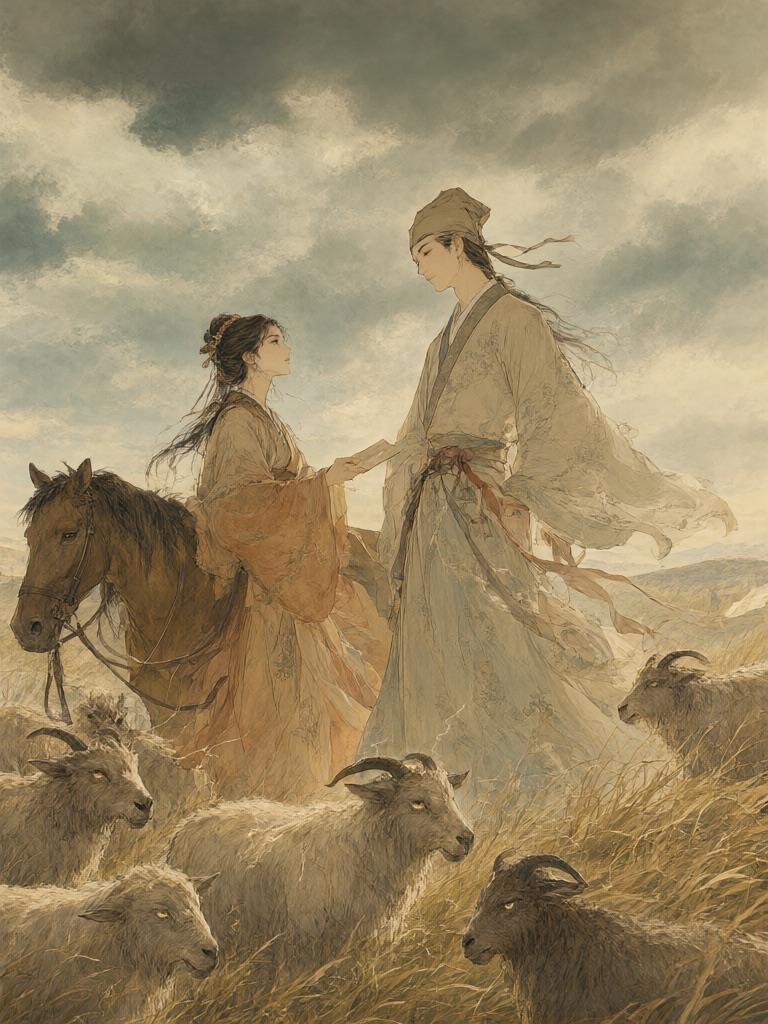
In the Yifeng reign there was a Confucian scholar named Liu Yi who sat the examinations, failed, and was about to go home to the banks of the Xiang. Remembering a fellow townsman living as a guest in Jingyang, he went to bid him farewell. Six or seven li along the road, birds burst up, his horse took fright and bolted off to the left of the road, and it was another six or seven li before it stopped. There he saw a woman herding sheep by the roadside. Liu looked at her curiously and found she was a rare beauty. Yet her delicate brows were knitted, her kerchief and sleeves were dull and lustreless, and she stood listening intently, as if waiting for something. Liu asked her, "What sorrow has brought you to such humiliation?" At first she looked pained and demurred, but at last she answered in tears: "I am unfortunate, and today an elder deigns to ask after me. But my grievance runs through my flesh and bones—how could shame make me hide it? Please hear me out. I am the youngest daughter of the Dragon Lord of Lake Dongting. My parents married me to the second son of the Lord of the Jing River, but my husband loves his pleasures and is led astray by maids and servants, and he grows colder to me day by day. When I went to complain to his parents, they doted on their son and could not restrain him. When I complained more often and more urgently, I offended them as well, and they cast me out and degraded me to this." Having spoken, she sobbed and wept, overcome with grief. Then she said, "How far is Dongting from here, I wonder? The sky stretches endlessly, and no word can pass. I have looked till my eyes and heart are worn out, and no one knows my sorrow. I hear you are going back to Wu, and Wu has ways through to Dongting. Might I entrust you with a short letter for my family's attendants? Would you be willing?"
Liu said, "I am a man of honour. Hearing your story, my blood is stirred; I only wish I had wings to fly there at once. Why speak of willing or not! But Dongting is deep water, and I walk the dusty world—how could I ever deliver a message? I fear that the paths of the seen and unseen do not meet, and I would fail your trust and disappoint your earnest hopes. Do you have some means to guide me?" Weeping, the woman thanked him: "That you would bear this charge means more than I can say. If I receive word back, I will repay you even if it costs my life. Before you agreed, how could I dare tell you? Now that you have agreed and ask, reaching Dongting is no harder than reaching the capital." Liu asked to hear how. She said, "On the south shore of Dongting there is a great orange tree, which the local people call the Shrine Orange. You must take off this sash and tie on something else in its place. Then knock on the tree three times, and someone will answer. Follow him, and nothing will stand in your way. I hope that besides what the letter says, you will pass on all the words of my heart—please, do not fail me." "I hear and obey," said Liu.
She then took the letter from inside her jacket, bowed twice and handed it to him, gazing east and weeping as if she could not bear it. Liu was deeply saddened for her. He put the letter in his bag and asked, "I don't understand what your herding sheep is for. Do the gods slaughter animals?" "These are not sheep," she said. "They are rain-workers." "What are rain-workers?" "Kin of thunder and lightning." He looked at them several times: they all held their heads high, glared and strode fiercely, and drank and grazed in a most unusual way. Yet in size, coat and horns they were no different from other sheep. Liu said, "Since I am your messenger, when you return to Dongting one day, I hope you won't avoid me." "Not merely not avoid you," she said, "I shall treat you as family." When they had finished speaking, he took his leave and headed east. Before he had gone a few dozen paces he looked back, and both the woman and the sheep had vanished.
That evening he reached the town and parted from his friend. A month or so later he got back home, and then went to Dongting to call on his friend. On the south shore of the lake there was indeed a Shrine Orange. So he changed his sash, faced the tree, knocked three times and stopped. Presently a warrior rose out of the waves, bowed twice and asked, "Honoured guest, where have you come from?" Liu did not tell the truth, but said, "I have come to pay my respects to the Great King." The warrior parted the water to show the way and led Liu in, saying, "Close your eyes and take a few breaths, and you'll be there." Liu did as he said and found himself at the palace. He saw terraces and pavilions facing one another, gates and doors by the thousand, and every kind of strange plant and precious tree. The warrior stopped him in a corner of a great hall and said, "Please wait here, sir." "What is this place?" asked Liu. "This is the Hall of Spiritual Void." Looking closely, Liu saw that all the treasures of the human world were gathered here. The pillars were white jade, the steps green jade, the couches coral, the curtains crystal; glazed glass was carved into the emerald lintels and amber adorned the rainbow beams. Its rare beauty and deep mystery were beyond words. But the king was a long time coming. Liu asked the warrior, "Where is the Lord of Dongting?" "Our lord is at the Black Pearl Pavilion, discussing the Fire Classic with the Taoist of the Sun. They will finish shortly."
"What is the Fire Classic?" asked Liu. The warrior said, "Our lord is a dragon. Dragons take water as their divine power—a single drop raised can engulf hills and valleys. The Taoist is a man. Men hold fire sacred—a single lamp can burn down the Epang Palace. Yet their powers serve different ends and their mysteries work differently. The Taoist of the Sun is versed in the principles of men, so our lord invited him to hear him speak." Just as he finished, the palace gates opened. Attendants gathered like shadows and clouds, and a figure appeared, clad in purple and holding green jade. The warrior leaped up: "That is our lord!" and went forward to announce Liu. The lord gazed at Liu and asked, "Are you not a man of the human world?" "I am," Liu replied. Liu then bowed, the lord bowed in return, and he bade Liu be seated in the Hall of Spiritual Void.
He said to Liu, "The water realm is deep and dim, and I am ignorant. You have come a thousand li, sir—what brings you?" Liu said, "I am a fellow countryman of Your Majesty's. I grew up in Chu and went to study in Qin. Having lately failed the examinations, I was riding idly along the right bank of the Jing River when I saw Your Majesty's beloved daughter herding sheep in the wilds, her hair tossed by wind and soaked by rain—a sight I could not bear to see. I asked what had happened. She told me: 'My husband scorns me and his parents have no care for me; that is how I came to this.' Her tears flowed freely; it truly wrung my heart. So she entrusted me with a letter. I promised her, and now I am here."
He took out the letter and presented it. When the Lord of Dongting had read it, he hid his face in his sleeve and wept: "The fault is mine, her old father's. I did not look or listen, and sat by as if deaf and blind, letting a frail girl from the inner chambers suffer harm far away. You, sir, are a stranger met on the road, yet you hastened to her aid. So long as I have teeth and hair, how could I fail your kindness!" When he had finished, he lamented for a long while. All his attendants wept. A eunuch who attended the lord closely was given the letter and told to take it into the palace. Moments later the whole palace was wailing. Alarmed, the lord said to his attendants, "Quickly, tell the palace to make no sound. I fear Qiantang will hear of it." "Who is Qiantang?" asked Liu. "My beloved younger brother. He was once lord of the Qiantang River, but has now retired." "Why must he not know?" "Because his valour exceeds all bounds. The nine years of flood in the days of Emperor Yao came from one fit of his anger. Recently he fell out with a heavenly general and blocked up the Five Mountains. Because I have some small merit, past and present, the Supreme Emperor pardoned my brother's crime. But he is still kept chained here, so the people of Qiantang wait for him day after day."
Before he had finished, a tremendous roar broke out; heaven split and earth cracked, the palace rocked and swayed, and clouds and smoke boiled up. In an instant there appeared a red dragon more than a thousand feet long, with lightning eyes and a blood-red tongue, scarlet scales and a fiery mane, dragging a golden chain from its neck, and the chain still fastened to a jade pillar. A thousand thunderclaps and ten thousand lightning bolts lashed around its body, and sleet, snow, rain and hail all fell at once. Then it split the blue sky and flew away. Liu was so terrified that he fell to the ground. The lord himself rose and helped him up. "Don't be afraid. There's no harm in it." Only after a long while did Liu calm down a little and collect himself. He then begged leave: "I'd like to go home alive, to be out of the way when he comes back." "It won't be like that," said the lord. "His going was like that; his coming back won't be. Please stay a little and let us show our goodwill." He ordered wine, and they raised cups to each other as host and guest.
Soon an auspicious wind and festive clouds came drifting, warm and joyous; banners and insignia glittered, and the music of flutes followed. Thousands of finely dressed women came laughing and chattering, and in their midst, toward the rear, was one with natural moth-wing brows, bright pearls all over her, and gauze and silk fluttering about her. Coming closer, Liu saw it was the very woman who had given him the letter. Yet she seemed both happy and sad, her tears falling like threads of silk. In a moment red mist veiled her left, purple vapour unfurled at her right, fragrance swirled about, and she went into the palace. The lord smiled and said to Liu, "The prisoner of the Jing River has arrived." He then excused himself and went into the palace. Soon they heard laments and complaints that went on and on. After a while the lord came out again and ate and drank with Liu.
Another figure appeared, clad in purple and holding green jade, imposing in looks and brimming with spirit, and stood at the lord's left. "This is Qiantang," the lord said to Liu. Liu rose and hurried forward to bow. Qiantang returned the courtesy in full and said to Liu, "My niece had the misfortune to be abused by a worthless brat. It is thanks to your shining good faith, sir, that her grievance reached us from afar. Otherwise she would have become dust in the Jing hills. I feast on your kindness and cherish your favour beyond what words can say." Liu modestly declined, bowing and murmuring. Qiantang then turned to his brother and reported: "Just now I set out from the Hall of Spiritual Void at the hour of the dragon, reached Jingyang at the hour of the snake, fought there at the hour of the horse, and came back here at the hour of the goat. In between, I raced up to the Ninth Heaven to report to the Supreme Emperor. The Emperor knew of the wrong and forgave my offence; the punishment laid on me before has been lifted as well. But my hot temper flared, I had no time to take leave, I alarmed the palace and offended your guest. I am ashamed and fearful, and do not know what to do." He stepped back and bowed again. "How many did you kill?" asked the lord. "Six hundred thousand." "Did you damage crops?" "Eight hundred li." "And the heartless husband?" "I ate him." The lord said ruefully, "That brat's heart was truly intolerable. But you were too rash. It is lucky the Supreme Emperor was wise and saw how grave the wrong was; otherwise, what excuse could I have offered? From now on, never do this again." Qiantang bowed twice more.
That night Liu was lodged in the Hall of Congealed Light. The next day he was feasted again in the Palace of Congealed Jade. Friends and kin were gathered, a grand band played, fine wines were set out and delicacies laid in rows. First, with reed pipes, horns and war drums, banners, swords and halberds, ten thousand men danced on the right. One of them stepped forward and announced: "This is 'Qiantang Breaks the Enemy Lines.'" The banners blazed with heroic spirit, the dancers wheeled and charged with fierce, fearsome vigour, and the guests' hair stood on end as they watched. Next, to bells, chimes, strings and flutes, a thousand women in silks and gauze, pearls and kingfisher ornaments, danced on the left. One of them came forward and said: "This is 'The Princess Returns to the Palace.'" The clear music rose and fell as if pleading and yearning, and the guests, listening, wept before they knew it. When the two dances were over, the Dragon Lord was delighted and bestowed fine silks on the dancers. Then the mats were drawn close and everyone sat side by side, drinking freely and enjoying themselves to the full.
When the wine was at its height, the Lord of Dongting beat time on his mat and sang: "Vast is the sky above, boundless the earth below. Each has his own heart's will—who can fathom it? Fox gods and rat sages cling to shrine and wall. Once the thunder strikes, who dares to stand against it? Thanks to a true man, whose faith runs long, my flesh and blood comes home again. With one voice we own our shame—when shall we forget!" When he finished, the Lord of Qiantang bowed twice and sang: "Heaven makes the matches; life and death have their paths. She should not have been his wife, nor he her husband. Heartsick and toiling by the bank of the Jing, wind and frost on her temples, rain, rain and snow on her silken jacket. Thanks to our noble guest who brought the plain letter, our flesh and blood's home is whole as before. Forever we say: treasure this, at every hour." When Qiantang's song was done, both lords rose and offered cups to Liu. Liu, abashed, accepted the goblet and drank, then offered two cups in return to the two lords, and sang: "Blue clouds drift on and on; the Jing flows east. I grieved for the lovely one, weeping in rain, a flower in sorrow. A short letter came from afar to ease your cares. The wrong is righted at last; she is home at peace. Grateful for your grace and your sweet fare, yet my mountain home is lonely, and I cannot linger long. About to take my leave, I am wrapped in sorrow."
When the song ended, all cried "Long life!" The Lord of Dongting then brought out a green jade casket holding a water-parting rhinoceros horn, and the Lord of Qiantang a red amber platter holding a pearl that shines by night; both rose and presented them to Liu. Liu declined and then accepted. Then everyone in the palace tossed silks, brocades, pearls and jade discs beside him, heaped up and dazzling, until in moments he was buried front and back. Liu laughed and looked about him, too busy bowing his embarrassed thanks to keep up. When the wine ran out and the joy was at its peak, Liu excused himself and again slept in the Hall of Congealed Light.
The next day Liu was feasted again in the Pavilion of Clear Light. Emboldened by wine, Qiantang put on a stern face and, squatting, said to Liu: "Have you not heard that a hard stone can be split but not rolled up, and a man of honour can be killed but not shamed? I have something on my mind I wish to put to you. If you agree, we shall both soar in the clouds; if not, we shall both be trampled into the dirt. What do you say?" "Please tell me," said Liu. Qiantang said, "The wife of the Jingyang prince is the beloved daughter of the Lord of Dongting. She is of gentle nature and fine quality, esteemed by all her kin. She had the misfortune to be shamed by a scoundrel, and now that marriage is over. We would entrust her to your high honour and become kin for generations. Then she who received your kindness would know where she belongs, and she who cherishes you would know to whom she is given. Is that not the way of a gentleman who sees things through from start to finish?"
Liu rose solemnly, then suddenly laughed: "I never knew the Lord of Qiantang was so mean-spirited! First I heard how you swept across the Nine Provinces and swallowed the Five Peaks to vent your rage; then I saw you snap your golden chain and wrench the jade pillar to rush to your kin's rescue. I thought no one could match you for resolve, candour and uprightness. To defy death against those who wrong you and spare not your life for those who move you—that is the true resolve of a man. How, then, while the flutes are in harmony and kin and guests in good cheer, can you cast principle aside and press a man by force? That is hardly what I expected of you! Had I met you amid the great waves or among the dark mountains, with your scales and whiskers bristling and cloud and rain about you, threatening me with death, I would have regarded you as a beast and died with no regrets. But now you are dressed in robes and cap, sitting and discussing propriety and righteousness; you have fulfilled the nature of the five virtues and grasped the subtle meaning of every conduct—even among the worthies of the human world there are some who fall short of you, let alone the spirits of rivers and lakes! And yet you would use your hulking body and savage temper, emboldened by drink, to coerce a man—how is that upright? My frame would not fill the space under one of your scales, Your Highness, but I dare to set my unbowed heart against your unprincipled bluster. Let Your Highness consider it!"
At this Qiantang drew back hesitantly and apologised: "I grew up in palace chambers and never heard upright counsel. Just now my words were wild and reckless and I offended a wise man. Reflecting on it, my fault admits no excuse. I hope, sir, you will not let this come between us." That evening there was another joyful feast, as merry as before, and Liu and Qiantang became bosom friends. The next day Liu took his leave. The Lady of Dongting gave him a farewell banquet in the Hall of Hidden Radiance, attended by all the menservants, maids and concubines. The lady said to Liu in tears, "My own flesh and blood received your great kindness, and to my regret we have not been able to show our gratitude before parting." She had the former wife of Jingyang bow to Liu at the table to thank him. Then she said, "Will there ever be a day when we meet again after this parting?" Though Liu had at first refused Qiantang's proposal, at this banquet he looked full of sighs and regret. When the feast was over and farewells were said, the whole palace was downcast. The treasures given him were too marvellous to describe. Liu then went back the way he came and emerged on the shore, where he found more than ten attendants carrying bags behind him; they saw him to his home and then took their leave.
Liu then went to the jewel shops of Guangling to sell what he had been given. Before he had sold one part in a hundred, his wealth already ran into millions, so that the rich families west of the Huai all considered themselves no match for him. He married a woman of the Zhang family, who died. He then married a woman of the Han family; within a few months, she too died. He moved his household to Jinling. Often lonely and melancholy as a widower, he thought of taking a new wife. A matchmaker told him, "There is a daughter of the Lu family, from Fanyang. Her father, Lu Hao, was once magistrate of Qingliu. In his later years he took to the Way and wandered alone among clouds and springs; no one knows where he is now. Her mother is of the Zheng family. Two years ago the daughter married into the Zhang family of Qinghe, but unfortunately her husband died young. Her mother pities her youth and treasures her intelligence and beauty, and wishes to choose a man of virtue for her. What do you think?" Liu chose an auspicious day for the wedding. Both families being great clans, the gifts prescribed by custom were as lavish as could be, and the gentry of Jinling all looked on in admiration.
After a month or so, coming into the room one evening and looking at his wife, Liu was struck by how much she resembled the Dragon Girl—only lovelier and more voluptuous still. So he told her of past events. His wife said, "Could such a thing really happen in the human world? But I am carrying your child." Liu cherished her all the more. A month after the birth, she put on rich ornaments and changed her dress, summoned Liu to the curtained chamber, and said to him with a smile, "Don't you remember me from long ago?" "We were never matched before," said Liu. "What should I remember?"
"I am the Lord of Dongting's daughter," she said. "You cleared my wrong at the Jing River. Grateful for your kindness, I vowed with all my heart to repay you. When my uncle Qiantang proposed the match and you refused, we were parted, each at a far end of the sky, with no way to ask after each other. My parents wanted to marry me to a young son of the Lord of the Zhuojin River, so I shut my door and cut off my hair to show I would have none of it. Though you had rejected me and by rights we would never meet again, my first resolve would not change till death. Later my parents, pitying my constancy, wanted to send word to you. But you were marrying one wife after another—first into the Zhang family, then into the Han. When the Zhang and Han wives had both died and you settled here, my parents were glad I could at last fulfil my wish to repay you. Now that I am able to serve you and we may spend our lives happily together, I can die without regret." Then she sobbed, tears streaming down her face. She went on: "I did not speak at first because I knew you did not prize beauty. I speak now because I know you have feeling for me. A woman's worth is slight, not enough to secure a lasting love, so I have used your love for our son to bind our lives together. I do not know how you feel, and I am so anxious and afraid I cannot set my mind at ease. On the day you took my letter, you smiled and said to me, 'When you go back to Dongting one day, don't avoid me.' I truly wonder—did you, even then, have today in mind? Afterwards, when my uncle proposed to you, you flatly refused. Did you truly think it impossible, or was it anger? Tell me!"
Liu said, "It seems it was fated. When I first met you by the Jing River, wronged and haggard, I truly felt indignant. But I held my heart in check: my only aim was to convey your grievance, and nothing more. When I said 'don't avoid me,' it was said by chance—what intent could there be! As for when Qiantang pressed me, it was only because the thing could not be justified that my anger was roused. Having set out to act from righteousness, how could I kill a woman's husband and then take her as my wife? That was the first impossibility. I have always held to integrity as my aim—how could I bend myself and submit against my heart? That was the second. Besides, I spoke my mind freely amid all the toasting, thinking only of what was right and with no thought of danger. Yet on the day of parting, when I saw the longing in your face, I regretted it deeply. In the end I was bound by the ways of the world and had no means to answer your feeling. Ah, but today you are a daughter of the Lu family and have made your home in the human world, so my first resolve was not mistaken after all. From now on we shall be happy together forever, without the slightest care."
His wife was deeply moved and wept tenderly for a long while. After a time she said, "Do not think that because I am of another kind I have no heart; I have always known I must repay you. A dragon lives ten thousand years, and now you will share that with me. On water or land, there is nowhere we cannot go. Don't take this for nonsense." Liu said admiringly, "I never knew that being a guest of your kingdom would also bring me the food of immortals." So together they went to pay their respects at Dongting. When they arrived, the ceremonies between hosts and guest were too grand to record in full. Afterwards they lived in Nanhai for nearly forty years, and their mansion, carriages and horses, delicacies, clothes and treasures could not be outdone even by the households of marquises and earls. Liu's whole clan shared in his bounty. Because his years kept piling up while his looks never faded, the people of Nanhai were all astonished. In the Kaiyuan era, the emperor took a keen interest in immortals and searched hard for Taoist arts. Liu could find no peace, so he and his wife went back to Dongting together. For more than ten years, no one knew where he was.
Toward the end of the Kaiyuan era, Liu's cousin Xue Gu, a magistrate in the capital district, was demoted to a post in the southeast. Crossing Dongting on a clear day, he was gazing into the distance when suddenly he saw a green mountain rise from the far-off waves. The boatmen all stood aside and said, "There was never a mountain here. It must be a water monster." Even as they pointed, the mountain bore down on the boat, and a painted boat came speeding from it to meet Xue and hail him. Someone in it called out, "Lord Liu awaits you." Suddenly Xue remembered, and hurried to the foot of the mountain, gathered up his robe and climbed quickly. On the mountain stood palaces like those of the human world, and he saw Liu standing in a hall, musicians arrayed before him and jewelled beauties ranged behind, the splendour of his possessions far surpassing anything among men. Liu's speech had grown more profound and his face younger than ever. He came first to meet Xue at the steps, took his hand and said, "It's been but a blink since we parted, and already your hair has turned yellow." Xue laughed: "You have become an immortal, brother, and I dry bones—it's fate." Liu then gave him fifty pills, saying, "Each pill adds a year of life. When the years are used up, come back; don't stay long in the world of men and make yourself suffer." When the feast was over, Xue took his leave. From then on, nothing more was ever heard of Liu. Xue often told people this story. Nearly forty-eight years later, Xue too vanished, no one knew where.
Li Chaowei of Longxi, having recorded this, remarks with a sigh: Among the five kinds of creatures, the chief must be the most spiritually gifted—and here the difference can be seen. Man, the naked creature, extended his good faith to the scaly ones. The Lord of Dongting was magnanimous and upright, the Lord of Qiantang swift and bold—it is fitting their virtues should be handed down. Xue Gu told the tale but never set it down, and he alone came near to that realm. I found it a story of righteousness, and so I wrote this piece.