Fan Xiaoshan, a resident of Qingzhou, made his living selling writing brushes and was away on a trading trip. In the fourth month his wife, née He, alone at home, was murdered one night by an intruder. It drizzled that night, and in the mud lay a fan inscribed with a poem—a gift from one Wang Sheng to Wu Feiqing. Who Wang Sheng was, nobody knew; Wu was a man of old family wealth in Yidu who lived in the same village as Fan and was known for rather loose and frivolous conduct, so the whole neighbourhood believed he had done it. The prefecture and county arrested and questioned him. He firmly refused to confess, was cruelly put in fetters and shackles, and the case was falsely fixed against him; it went back and forth on review through more than ten officials, and not one raised any objection. Wu himself reckoned he was sure to die, and told his wife to spend everything they owned relieving the poor and friendless. Anyone who chanted the Buddha's name a thousand times at his gate was given a pair of padded trousers; ten thousand times, a padded jacket. Beggars thronged his door like a market, and the chanting could be heard for more than ten li. The family quickly grew poor and had to sell off land day by day to meet the expenses. He secretly bribed the jailer to buy him poison. That night he dreamed that a god told him: "Do not die. Before, it was 'outside, ill-omened'; now it is 'inside, auspicious.'" He fell asleep again and heard the same words, and so he did not go through with it.
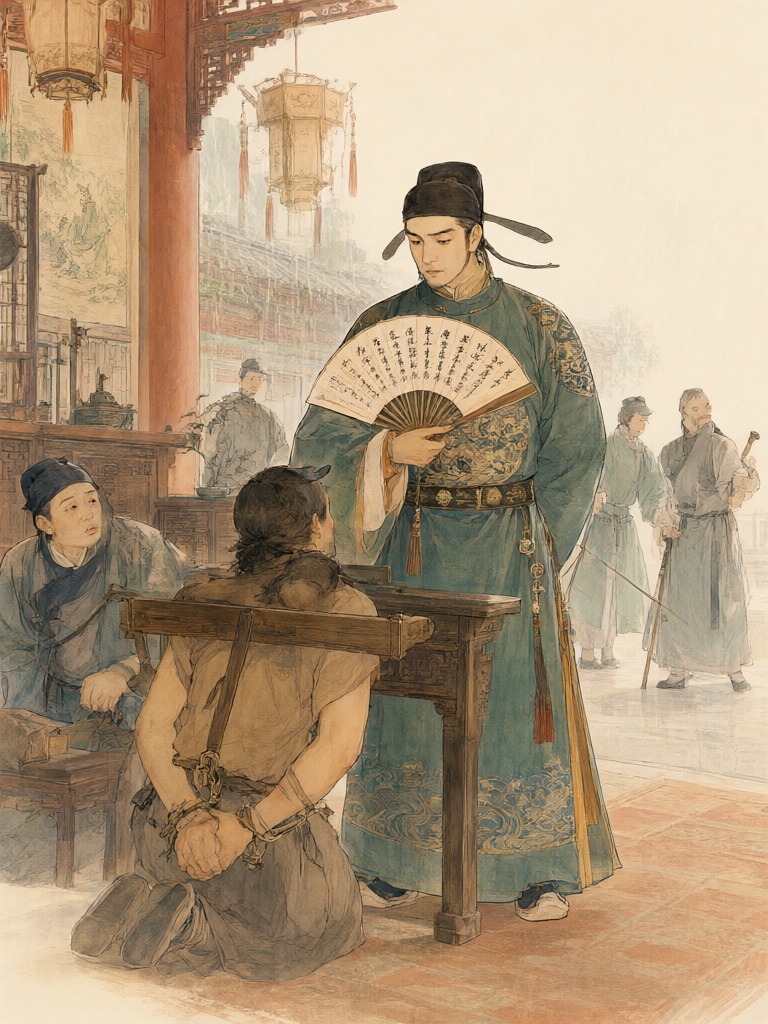
Before long, Mr. Zhou Yuanliang came to take charge of the circuit. Reviewing the prisoners' cases, he reached Wu's and seemed to be pondering something. "What firm evidence is there that this Wu killed anyone?" he asked. Fan answered with the fan. Mr. Zhou studied the fan closely and asked, "Who is Wang Sheng?" No one knew. He then read the case record carefully from start to finish, and at once ordered Wu's death-row shackles removed and had him moved from the prison to the granary lockup. Fan protested hard. Zhou said angrily, "Do you want to kill a man at random just to be done with it? Or will you be satisfied only when you have the real enemy?" Everyone suspected Mr. Zhou of favouring Wu, but no one dared say so.
Mr. Zhou issued a red-tabbed warrant and had the owner of a certain shop outside the south wall brought in at once. The shopkeeper was frightened and had no idea why. When he arrived, Zhou asked him, "On the wall of your shop is a poem by Li Xiu of Dongguan. When was it written there?" The man replied, "Last year, when the education commissioner came on his tour, two or three licentiates from Rizhao got drunk and left it there. I don't know where they live." So Zhou sent runners to Rizhao with orders to arrest Li Xiu by name. A few days later Li Xiu arrived. "You are a scholar," Zhou said angrily. "How could you plot a murder?" Li kowtowed, dumbfounded. "I did no such thing!" Zhou threw the fan down to him and told him to look for himself. "This is plainly your work. Why pass it off as Wang Sheng's?" Li studied it and said, "The poem is truly mine, but the handwriting really isn't." "If you know it is your poem," said Zhou, "the writer must be your friend. Who wrote it out?" "The hand looks like that of Wang Zuo of Yizhou," said Li. Zhou sent a dispatch and runners to arrest Wang Zuo. When Wang Zuo arrived, Zhou berated him just as he had Li. Wang Zuo testified: "Zhang Cheng, an iron merchant from Yidu, asked me to write it, saying Wang Sheng was his cousin." "Then here is our culprit," said Zhou. Zhang Cheng was seized and brought in, and at the first questioning he confessed.
It turned out that Zhang Cheng had been eyeing Mrs. He's beauty and meant to seduce her, but feared he would fail. He reckoned that if he used Wu's name everyone would believe it, so he forged a fan as Wu's and took it with him. If he succeeded he would own up himself; if not, he would pin the name on Wu—he never actually meant it to come to murder. He climbed over the wall and forced himself on her. Living alone, she always kept a knife for protection. When she woke she grabbed Zhang by his clothes and rose with the knife in her hand. Frightened, he wrested the knife away. She held on hard so that he could not break free, and screamed. More cornered than ever, he killed her, dropped the fan and fled.
A wrongful imprisonment of three years was cleared in a single morning, and everyone hailed Mr. Zhou as godlike. Only then did Wu realise that "inside, auspicious" stood for the character Zhou. Still, no one could work out how it had been done. Later a gentleman of the county found a chance to ask him. Zhou laughed: "Nothing could be easier. Reading the record carefully, I saw that Mrs. He was killed in the first ten days of the fourth month; that night was rainy and still cold, and a fan was the last thing anyone needed. Who, in the middle of a hurried, urgent business, would carry such a thing along just to burden himself? Clearly it was meant to shift the blame. Once, sheltering from the rain outside the south wall, I had seen the poem written on the wall, and it had the same turn of phrase as the one on the fan. So I ventured a guess at Mr. Li, and through him I did indeed catch the real culprit." All who heard it sighed in admiration.