The weak are mastered by the strong, but not by size, great or small. The centipede masters the great serpent with its pincers; when did it ever need a long beak?
The story goes that between heaven and earth, for every creature there is another that masters it; no one may boast of height or trust in strength. What is the 'centipede' this poem speaks of? It is the red-footed centipede, commonly called the 'hundred-legs,' or the hundred-footed creature. And what is the 'band'? It is the great serpent, so named because its shape is like a sash. In Lingnan there are many great serpents, dozens of yards long, that prey on people. The folk there all keep centipedes in their homes, some over a foot long, mostly placed beside or inside their pillows. When a snake comes, the centipede makes a clicking sound. Let it out, and it arches its back and springs with head and tail together, leaping ten feet high, and lands on the serpent's vital spot just below the head. It clamps on with its pair of pincers like iron hooks and sucks the snake's blood until it is dead. So a creature dozens of yards long and as thick as a bushel measure dies in the clutches of one a foot long and as thick as a finger. That is what the old saying 'the centipede clamps the band' means.
In the third year of the Yanhe reign of Emperor Wu of Han, the Yuezhi kingdom of the Western regions sent a fierce beast as tribute. It looked like a puppy fifty or sixty days old, no bigger than a wildcat, trailing a yellow tail. The envoy carried it in his arms into the palace to present it. Emperor Wu, seeing how puny it was, laughed: "How can such a little thing be called a fierce beast?" The envoy replied, "A creature whose might overawes all the birds and beasts need not be judged by its size. That is why the divine qilin is king of the great elephants, and the phoenix the master of the giant roc; it has nothing to do with size." The emperor did not believe him and said, "Let it make a sound for Us to hear." The envoy pointed at it, and the beast licked its lips and shook its head for a while, then suddenly let out a roar like a thunderclap on level ground, its two eyes flashing and shooting out two bolts of lightning. The emperor was jolted right out of his throne, clapped his hands over his ears, and could not stop trembling. The attendants around him, and the Imperial Guards and soldiers standing beneath the ceremonial banners, all had whatever they were holding shaken from their hands. Displeased, the emperor at once ordered the beast sent to the Shanglin Park to be eaten by the tigers. The keeper of the park obeyed. But when it was set down beside the tiger pen, the tigers, on seeing it, all huddled together in a heap and went down on their knees. When the keeper reported this, the emperor grew even angrier and wanted the beast killed. The next day both envoy and beast had vanished. Creatures as fierce as tigers and leopards were afraid of this little thing. So there is no limit to how strong or weak, how clever or dull a person may be. As the saying goes:
However strong you are, there is someone stronger; never boast in front of others.
In the Tang dynasty there was a candidate for the examinations whose name and home are not recorded. He was born with extraordinary strength and was outstanding in the martial arts. All his life he was gallant and loved justice, truly the kind who, seeing a wrong on the road, draws his sword to help. When he went to the capital for the examinations, he took no servants; trusting in his own skill, he saddled a fine horse, hung a bow, arrows and a short sword at his waist, and rode off alone. Along the way he hunted pheasants and hares, and when he stopped at an inn for the night he had them cooked to go with his wine.
One day on a road in Shandong, his horse ran too fast and carried him past the place where he should have stopped for the night. When he reached a village it was already pitch dark, and he judged he could go no farther. He saw one house with its gate open and lamplight streaming out. He got down from his horse and, leading it by the reins, went closer to look. Inside the gate was a large open yard with three or four Taihu rocks piled in it. In the middle stood three main rooms and two side rooms, and an old woman sat in the center twisting hemp. Hearing hooves in the courtyard, she stood up to ask who was there. The candidate called out, "Granny, I'm a scholar who has lost his way and would like to stay the night." The old woman said, "Sir, it isn't convenient. I'm not the one who decides here." There was something forlorn in the way she spoke.
The candidate grew suspicious and asked, "Granny, where have the men of your family gone? Why are you here all alone?" The old woman said, "I'm an old widow. My husband died years ago, and I have only one son, who is away trading." "Do you have a daughter-in-law?" he asked. The old woman knitted her brows. "I do have a daughter-in-law, worth more than any man; she earns the whole household's keep by herself. But she has enormous strength and is extraordinarily fierce. And she has a rough, hasty temper: say one wrong word, and you couldn't withstand a single finger of hers; one touch and you'd go down. I keep my voice low and my temper cool and watch her every look, yet she's often displeased, and I suffer her bullying. That's why I dare not decide whether you can stay, sir." With that, her tears fell like rain.
When the candidate heard this, his brows shot up and his eyes went wide. "Such injustice in the world! Where is this wicked woman? I'll get rid of her for you." He tied his horse to a Taihu rock in the courtyard and drew his sword. The old woman said, "Sir, don't go stirring up the earth over the head of the god of misfortune. My daughter-in-law is no one to trifle with. She doesn't do women's needlework. Every day after the midday meal she goes off empty-handed into the mountains and hunts a few river deer, deer or hares to bring home, salts and dries them, and sells them to traveling merchants for a few strings of cash. She often doesn't get back until the first or second watch of the night. Our daily needs depend entirely on what she brings in, so I dare not cross her."
The candidate lowered his sword and put it back in its scabbard. "All my life I've stood up to the strong and spared the weak, and lent my strength to others. How formidable can a woman be? Since you depend on her to live, Granny, I'll spare her life and not kill her; I'll just give her a sound beating and teach her a lesson so she mends her ways." The old woman said, "She'll be back any moment. I can only urge you, sir, not to stir up trouble." The candidate waited, fuming.
Then a great dark shape appeared at the gate. Someone walked in and flung down in the courtyard something carried on the shoulder like a forked sack, calling out, "Old woman, bring a light, quick, and see to the goods." Trembling, the old woman said, "What fine thing is it?" She held up the lamp and gave a start: it was a dead striped tiger. Quicker than it can be told, the candidate's horse caught sight of the dead tiger in the firelight and began rearing and plunging in fright. Seeing it, the newcomer asked, "Where did this horse come from?"
Watching from the shadows, the candidate saw a tall, dark woman. Seeing what she looked like, and that she had carried home a dead tiger on her back, he thought, "She's someone with real skill too," and was already a little afraid of her. He hurried over to lead his horse aside and tie it up, then stepped forward and said, "I'm a candidate who lost his way and went past my lodging for the night. By good fortune I came upon your farm, and seeing the gate still open, I made bold to ask for a night's shelter." The woman laughed. "The old woman has no sense! If you're a gentleman of rank, how could she leave you standing out in the open at this hour?" Pointing at the dead tiger, she said, "Today in the mountains I ran into this spotted brute, and it took me a long time wrestling with it before I finished it off. I'm back late and have failed in a host's courtesy. Please don't hold it against me, sir." Seeing how frank her speech was and how proper her manners, the candidate thought to himself, "She's not beyond being reasoned with," and said repeatedly, "Not at all, not at all."
The woman went into the hall and brought out a chair, saying to the candidate, "I ought to invite you into the hall to sit, but there are only the two of us here, mother-in-law and daughter-in-law, both women, and men and women should not mix. Please forgive me and sit out here in the gallery." Then she carried over a table, set it before him, and lit a lamp and placed it there. Next she went down into the courtyard, picked up the dead tiger with both hands, and carried it off to the kitchen. In no time she had heated a pot of wine and brought out a large tray holding a steaming dish of tiger meat, a dish of dried venison, and five or six small dishes of salted pheasant, hare and the like, saying, "Please don't mind the humble fare, sir." Seeing how attentive she was, the candidate took it and poured for himself and drank. Soon the wine and food were gone, and he raised his clasped hands: "Many thanks for your generous hospitality." "You embarrass me, you embarrass me," said the woman, and took up the tray to clear the bowls and cups from the table.
The candidate seized the moment and said, "Seeing how heroic you are, madam, and how wise in your conduct, why does it seem you fall a little short in the matter of respect for your elder?" The woman jabbed the tray down and, leaving the clearing undone, glared at him: "Has that old devil been telling you lies just now, sir?" The candidate said quickly, "No, she hasn't. It's only that I noticed in the way you address her and the look on your face that you seemed rather offhand and haughty, not the proper way between a daughter-in-law and her mother-in-law. Yet seeing how thoughtfully you treat a guest and how capable you are, you don't seem an unreasonable person, so I thought I'd ask you kindly."
Hearing this, the woman grabbed the candidate's sleeve and, holding the lamp in her other hand, walked over to the Taihu rock, saying, "This is a good chance to tell you all about it." The candidate could not pull free and thought, "If what she says turns out unreasonable, I'll figure out how to give her a beating." Leaning against the Taihu rock, the woman slapped her hand on it and said, "The other day there was this matter, so-and-so, such-and-such. Was I in the wrong, or was she?" Having said this, she drew a forefinger across the rock: "That's one." At that single stroke, the surface of the stone burst and crumbled, gouged out more than an inch deep. She counted off three matters one after another, drawing three strokes, and the Taihu rock looked as if an awl had chiseled the character chuan, 'river,' into it; seen at a slant it was the character san, 'three.' Every stroke was a full inch deep or more, as if carved with a graver. The candidate was so shaken that sweat poured from him and his whole face went red. "You were right in every case, madam," he said again and again. All his fierce resolve to settle right and wrong with her was like a bucket of snow water poured over his head; he did not even dare breathe hard.
When she had finished, the woman brought out a square bed for the candidate to sleep on by himself, and fed his horse for him. Then she went inside with the old woman, shut the door, put out the fire, and went to sleep. The candidate did not sleep a wink all night. He sighed, "To think there's someone in the world with such strength! It's lucky I never came to blows with her, or I'd have lost my life!" He waited impatiently for dawn, saddled his horse, thanked them, and without another word quietly left. After that he put away much of his swagger and never again meddled in other people's business, simply because he was afraid of running into someone as formidable as she was and coming off the worse.
Today I will tell of a man who relied on his skill and talked big, got a great fright, and became a byword for it. As the saying goes:
The tiger is lord of all beasts; every beast lies still before it. But let it meet the lion's roar, and the tiger is no use at all.
The story goes that in the Jiajing reign of our dynasty, in Jiaohe county, Hejian prefecture, Northern Zhili, there lived a man surnamed Liu, named Qin, known as Liu Dongshan, who served in Beijing as head of the constables in the police yamen. He was a man of great skill, at home with bow and horse, and never missed with an arrow, so people called him 'Chain-of-Pearls Arrow.' However savage the bandit, meeting him was like catching a turtle in a jar: he took them with ease. In this way he had saved up a fair amount of property. In his thirties he grew tired of that line of work, resigned, and went back to his home county to find another living.
One day at the very end of the year, he drove a dozen or more donkeys and horses to the capital to sell, and got a little over a hundred taels of silver for them. When the deal was done, he went to the Shuncheng Gate (that is, the Xuanwu Gate) to hire a mule for the journey home. At the mule-hirer's inn he ran into a neighbor, Zhang Erlang, who had come to the capital, and the two bought a meal together there. Erlang asked, "Dongshan, where are you off to?" Dongshan told him the whole story and said, "Now I'm hiring a mule here. I'll stay tonight and set out tomorrow." Erlang said, "The roads are bad lately. Around Liangxiang and Mozhou bandits come and go and rob people in broad daylight. Brother, you're carrying all this silver with no companion, traveling alone. I'm afraid you'll be caught out. Be careful!" Hearing this, Dongshan's beard and brows began to twitch and he bared his teeth. Clenching both hands into fists, he mimed drawing a bow and laughed aloud: "For twenty years I've drawn my bow to hunt men down, and never missed a shot or met my match. This is my last bit of business; I'm certainly not going to lose my capital on it." Everyone in the crowded inn heard him shouting and turned to look. Some even asked his name and said, "We've long heard of you, long heard of you." Erlang, feeling he had said the wrong thing, said goodbye and left the inn.
Dongshan slept until the fifth watch, got up, washed, combed his hair and dressed for the road. He bound the silver tightly in the pouch he wore against his belly and tied it at his waist, hung a bow over his shoulder, slung a sword outside his clothes, and hid twenty arrows below his knees. He picked out a tall, sturdy mule, sprang onto it, and with a crack of the whip set off. After thirty or forty li he reached Liangxiang, and saw someone galloping up behind him. Coming level with Dongshan's mule, the rider reined in a little. Dongshan looked him over: he was a handsome youth of about twenty, and very finely turned out. Behold:
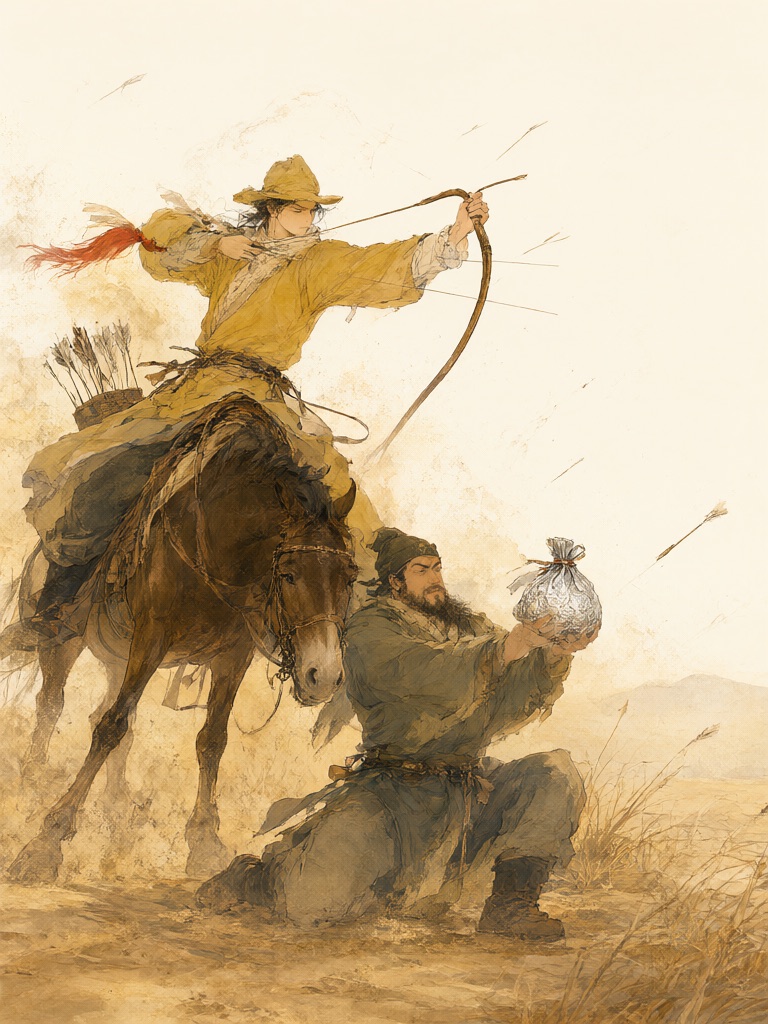
A yellow coat and felt hat, a short sword and a long bow. In his quiver, twenty-odd new arrows; on his horse's brow, a great tuft of red tassels. The trappings at his waist glittered: a fair-faced young gentleman. Keeping close, snorting and neighing: a splendid tall steed!
While Dongshan was still looking him over, the youth called from a distance, "Let's travel together." He saluted Dongshan with clasped hands and said, "Forgive my boldness on the road, but may I ask your honored name?" Dongshan replied, "My surname is Liu and my name Qin, and my sobriquet is Dongshan; people just call me Liu Dongshan." The youth said, "I've long heard your great name, sir; it's like thunder in my ears. I'm fortunate to meet you. Where are you headed now?" Dongshan said, "I'm going back to my home county of Jiaohe." The youth said, "Perfect, perfect. My family lives in Linzi; I'm the son of an old family too. As a boy I did some study, but because I loved bow and horse I threw my books aside. Three years ago I took some capital to the capital to trade and made a good profit. Now I'm going home to be married, so I can keep you company along the road and feel braver for it, all the way to the city of Hejian, where we'll part. What luck, what luck!" All along the way Dongshan noticed how heavy the youth's waist looked, how mild and careful his speech, how handsome his face and how slight his build, and he reckoned he was no villain. Besides, with a companion on the road he would not be lonely, so he was pleased and said, "I'd be glad of your company." That night they stopped at an inn together, ate and slept in the same place like brothers, and got on very well.
The next day they rode side by side out of Zhuozhou. The youth asked from his horse, "I've long heard that you're the best at catching thieves, sir. How many have you caught in your life? Have you ever met a real hero?" Dongshan had been itching to boast of his skill, and this question scratched just the right spot. Reckoning, too, that the youth was young and easy to impress, he bragged, "With my two hands and one bow I've caught every outlaw of the greenwood, more than I can count, and never met a match. Those rats aren't worth mentioning! Now that I'm middle-aged and lazy I've given up the trade. But if we run into any on the road ahead, I'll grab one or two for you, and you'll see what I can do!"
The youth only smiled faintly and coldly: "So that's how it is." He reached across from his horse and said, "Let me borrow the fine bow on your shoulder for a look." Dongshan handed it over from his mule. The youth gripped it with his left hand and with one easy pull of his right drew it to the full, drawing and releasing it again and again as if it were a soft silk sash. Dongshan went pale with shock and borrowed the youth's bow to look at in turn. The youth's bow weighed about twenty catties. Dongshan strained with every ounce of strength he had until his face and ears went red, but far from drawing it to the full, he could not even pull it into the half-moon of the eighth night of the month. Utterly mortified, Dongshan stuck out his tongue and said, "What a stiff bow you use!" Then he said to the youth, "Your strength is superhuman, little brother! How can it be so great? It's far beyond anything I could hope for." The youth said, "How can my strength be called superhuman? It's just that your bow is too soft, sir." Dongshan praised him again and again, and the youth was extremely modest and polite. That night they again stayed together.
The next day they set off together again, and toward sunset they passed Xiongxian. The youth gave his horse a slap, and it shot ahead as if riding the clouds. Dongshan looked, and the youth was gone. Having grown old among the haunts of thieves, how could he not panic at such behavior? He said to himself, "Heaven means me to take a fall this time! If he's a bad man, with strength like that, how could I stand against him? I'm as good as dead." His heart was like fifteen buckets drawing water at a well: seven up and eight down. With no choice, he plodded on. After a stage or two he saw the youth in the distance, a hundred paces off, bow raised and arrow nocked, drawn to the full moon, calling to Dongshan, "I've long heard you're unbeatable, sir. Today, kindly listen first to the wind of my arrows." Before he had finished speaking there was a whoosh, and past both of Dongshan's ears he heard a rustling like small birds as arrows flew by in front and behind, though not one touched him. The youth fitted another arrow and drew it full, aimed right at Dongshan's face, and laughed: "Dongshan, you're a sensible man. Hand over the money from your mules and horses at your waist, and spare us the trouble of a fight!"
Dongshan reckoned he was no match for him and had already lost his nerve. He could only jump down from the saddle, untie the silver pouch at his waist, and holding it in both hands, shuffle on his knees to the youth's horse and kowtow: "I respectfully offer the money, good sir. Take it, only spare my life!" The youth reached down from his horse, lifted the bag, and shouted, "What would I want your life for? Get going! Get going! Your old man has business here and can't travel on with his son." He wheeled his horse and dashed off northward in a streak of smoke, and all Dongshan could see was yellow dust rolling along the road; in an instant he was out of sight.
Dongshan stood dumbstruck for a long time, then beat his breast and stamped his feet: "Losing the money I could bear, but how am I to face people? My name as a hero all my life, ruined today. Even the Celestial Master Zhang has been bewitched by a ghost. Damn it! Damn it!" Head hanging and spirits crushed, he trudged back to Jiaohe empty-handed, one dragging step after another. At home he told his wife what had happened, and they both lamented over it. The couple talked it over, scraped together a little capital, and opened a wine shop on the edge of the village, making a living selling wine; he never again drew a bow or fitted an arrow. Afraid that people would find out and his reputation would be ruined, he dared not mention the matter to anyone and simply let it drop.
Three years passed. One day, in the depth of a bitter winter, as this lyric bears witness:
Frost on the paired mandarin-duck tiles, wind in the kingfisher curtain; this year the cold has come early and hard. Nail the bright windows low, open the red door only to the side, and let no one wander in. The heavy clouds have not cleared and the snow falls too; there's much to plan for. Hang the green bed-curtains and felt hangings tight, and draw the red drapes in snug and small. (To the tune 'Fragrance of Heaven, Former Part.')
Now, that winter, Dongshan and his wife were in the shop selling wine when a band of riders arrived at the door, eleven in all. Every one of them rode a tall, fine horse saddled with his own gear, the saddles and bridles gleaming. They all wore close-fitting short jackets and had bows, arrows, swords and knives at their belts. One after another they dismounted, came into the shop, and unloaded their saddles. Liu Dongshan went to meet them and drove their horses to the trough for them. His young helper went off to chop straw and boil beans; no need to say more of that. Among them was one who had not yet come of age and wore no cap of manhood, about fifteen or sixteen years old but eight feet tall, who alone did not dismount. He said to the others, "Little brother Eighteen will go and stay across the road by himself." They all answered together, "We'll rest here a little and then come wait on you." And he went off across the road on his own.
The ten sat down to drink, and the host prepared chicken, pork, beef and mutton to go with the wine. In no time they had wolfed it down like tigers; by his reckoning they ate a good sixty or seventy catties of meat and emptied six or seven jars of wine, and they also had the host take wine and food to the upstairs room across the road for the uncapped one. When they had eaten everything in the shop, they still cried that they had not had their fill, so they opened their leather bags and took out deer hooves, pheasants, roast hares and the like, and said with a laugh, "This is our treat. Call the host to drink with us."
Dongshan declined politely for a while before he came and sat down. He looked them over one by one, and when he came to the man on the left on the north side, the man's felt hat hung low, hiding his face so it could not be seen clearly. Suddenly the man raised his head; Dongshan looked closely and was frightened out of his wits, crying inwardly that he was done for. Who do you suppose it was? None other than the young traveling companion who had robbed him of his mule-and-horse money at Xiongxian. Dongshan thought, "This time I'm truly dead! How can my little livelihood stand up to his games? Back then I didn't dare face him alone, and now there are so many of them; they must all be heroes just like him. How will this end?" His heart thumped like a fawn butting about inside him. He kept his face to his wine cup and dared not make a sound.
The men rose one after another to toast their host. After they had settled down for a while, the youth seated on the left on the north side lifted the felt hat from his head and called to the host, "Dongshan, have you been well since we parted? I've thought ever since of how you took me along and looked after me on the road." Dongshan's face turned the color of earth, and before he knew it he was on his knees: "I beg you, good sir, forgive me!" The youth leapt from his seat, knelt down too, raised him up, and took his hand: "Don't do that! Don't do that! You'll shame me to death. That year we brothers were at the inn by the Shuncheng Gate and heard you boast that your skill had no equal under heaven. The others didn't think much of that, so they had me play this frivolous trick on you on the road, to have some fun at your expense. But I broke my promise and never reached Hejian with you. Even in my dreams I remember riding beside you on the Renqiu road. I'm grateful for your kindness, and now I'll repay you tenfold." With that he took a thousand taels of silver from his bag and set it on the table, saying to Dongshan, "Consider it a small token of respect since we parted. Please take it in."
Dongshan was as if drunk or dreaming. He sat stunned for a long while, afraid this was another joke, and for a moment dared not accept. Seeing him hesitate, the youth clapped his hands: "Would a real man ever deceive anyone? You're a hero too, Dongshan; how can you be so faint-hearted? Did you think we brothers would really take your silver? Hurry and put it away." Seeing how open-handedly he spoke, Liu Dongshan judged it was no trick. Only then did he come to his senses, like a drunk sobering up or a dreamer waking, and dared not refuse. He went inside and told his wife, and had her come out to help him carry it in.
When everything was put away, the two of them talked it over: "Such heroes, such kindness; we mustn't treat them lightly! We should slaughter animals and open more wine, and simply keep them here for the night and let them enjoy themselves for a few days." Dongshan came out to thank them and told the youth what they had in mind, and the youth told the others. They all said, "Since he's an old friend of this brother of ours, why not? Only we must go and ask Brother Eighteen." Together they crossed the road to speak to the uncapped one. Dongshan followed to watch; the men were extremely respectful toward the uncapped youth, and he treated them all with great dignity. They told him their host wanted them to stay the night and enjoy themselves. The uncapped one said, "Good, good, no harm in it. But when you're full of wine and food, don't sleep too soundly and fail the host's kindness. At the slightest stir, the two swords at my waist will have blood to drink." The men said in unison, "We brothers understand." Dongshan was more baffled than ever about what he meant.
The men went back to the shop and drank again to their hearts' content, and carried wine over to the room upstairs across the road. None of them dared keep him company; Brother Eighteen drank alone. By reckoning, he alone ate and drank as much as five people in the shop. When Brother Eighteen had finished, he took a strainer-ladle of pure silver from his bag, fanned up the charcoal fire, and made pancakes for himself. He ate more than a hundred of them one after another, then tidied up and strode out the door, no one knew where. He did not come back until nearly dark, and then he again stayed across the road and never once came to Liu Dongshan's house. The others ate and amused themselves at Dongshan's place. When they went across to see him, Brother Eighteen did not laugh or talk much with them either, but was very aloof.
Dongshan could not stop wondering. He pulled the youth who had traveled with him aside and asked, "This Brother Eighteen of yours, what sort of man is he?" The youth did not answer, but went and told the others, and they all burst out laughing. Without saying who he was, he chanted a poem aloud: "Willows and peach blossoms come out side by side; who can tell which one is the spring wind?" When he finished, he laughed loudly again.
After three days they all said goodbye, packed up, and mounted. The uncapped one rode in front and the rest behind, and off they went in a crowd.
Dongshan never did understand. But having suddenly come by a thousand-odd taels, he was comfortably off, and fearing other trouble might come of it, he moved into the city and took up another trade. Later, when he told people about it, someone who understood said, "If you work out those two lines of verse, they make the character Li. Besides, they called him Brother Eighteen, so the uncapped one must have been surnamed Li, and he must have been their chief. From what he said to the others, he was afraid of being ambushed, so he stayed across the road, the two places apart, so each could keep watch over the other. And he didn't eat and drink with the ten, which showed the difference in rank. As for going out alone at night, he must have been off on some job or other, but there's no way to find out for sure."
Liu Dongshan had been a hero all his life, but after this he never again dared say a single word about martial skill. He threw away his bow and broke his arrows, kept to an honest trade, and lived out his days to a peaceful end. So you see that in this life you must never trust in your own strength. Those who do have simply not yet met someone tougher. There is a poem about Liu Dongshan alone:
All his life he relied on the strength of bow and arrow, until at the end he met a great foe. Let no one in this world boast of his great skill; even the Hegemon King had his day of a mournful song.
And there is a poem about the youth:
Since ancient times heroes have thought little of tossing away a fortune; even robbers have their code, and it truly deserves telling. Laughing, he gave a thousand in gold to repay a hundred; the man he met on the road turned out to be a good friend.