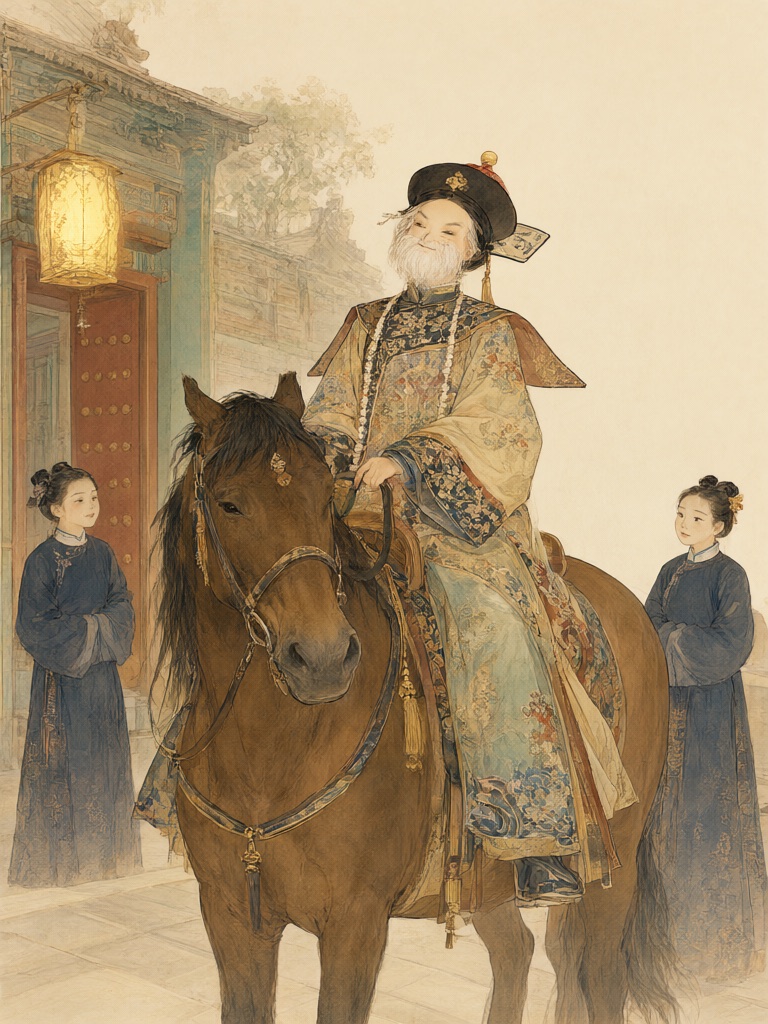
Lord Mao of Yexian, who rose to be Grand Secretary, came from a very humble family; his father made a living herding other people's cattle. In those days a great old clan of the county, the Zhangs, had laid out a new family burial ground on the sunny side of the East Hill. Someone passing by heard a voice inside the tomb bellow, "Clear out of here, all of you, and stop cluttering up a great man's house!" When Zhang heard about it he did not take it very seriously. But then he was warned again and again in dreams: "That grave plot of yours belongs by rights to Lord Mao. How long do you mean to borrow it?" After that the family's luck kept going wrong. A guest advised him that moving the graves would bring good fortune, so Zhang moved them.
One day Mao's father was out with the cattle when he came past the Zhangs' old grave. A sudden rain came on, and he took shelter in the abandoned grave pit. The rain grew heavier and heavier; floodwater rushed into the pit, the earth caved in, the water poured down, and he drowned. The future Grand Secretary was still a small child then. His mother went to Zhang herself and begged for a scrap of ground to bury her husband. Zhang asked her family name and was astonished. He went to look at the spot where the man had drowned, found it was exactly where the coffin had once lain, and was even more amazed; so he let her bury her husband in the old grave, and told her to bring her boy to him. When the burial was over, the mother and son came to thank him. Zhang took to the boy at first sight. He kept him in his household, had him taught to read, and treated him as one of the family's own sons. He even proposed to give the boy his eldest daughter in marriage. The mother declined, saying they would not dare, but Zhang's wife settled the match all the same.
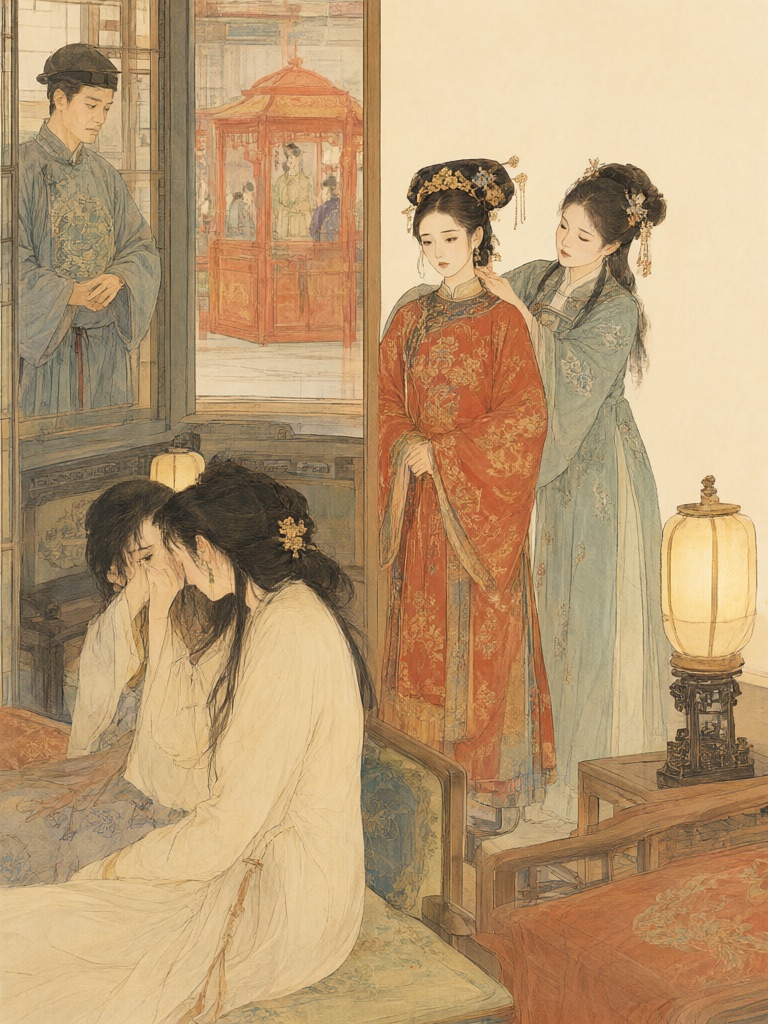
The daughter, however, despised the Mao family, and her resentment and shame kept showing in her face and in her words. "I'd rather die than marry a cowherd's brat!" she said. When the wedding day came, the groom went in to the feast and the bridal sedan stood decorated at the gate, but the bride sat in a corner with her sleeve over her face, weeping. They urged her to dress, and she would not; they reasoned with her, and she would not listen. Soon the groom announced he was ready to leave, and the drums and pipes struck up, but she still had tears streaming from her eyes and her hair all in a tangle. Her father went in to coax her; she ignored him. He lost his temper and tried to force her; she only wailed louder, and he was at his wits' end. A servant came to say the groom wanted to set off. Her father hurried out: "Her clothes and make-up aren't quite finished. Please be patient a little longer." Then he rushed back in to see his daughter. Back and forth he went several times, but she would not budge. Her father was frantic and ready to die, with no idea what to do.
Her younger sister, standing by, thought her sister in the wrong and pressed her hard to go. The elder sister snapped, "You little minx, now you're nagging too! Why don't you go with him yourself?" "Father never promised me to Master Mao," said the younger girl. "If he had promised me to Master Mao, would you need to talk me into the sedan?" Her father liked how frank and spirited she sounded, and he quietly put his heads together with her mother: they would send the second daughter in place of the first. Her mother turned to her at once. "That disobedient girl won't do as her parents say. Now we want you to go in your sister's place. Will you?" The girl answered without hesitation, "If my parents told me to marry a beggar, I wouldn't dare refuse. And what makes anyone sure Master Mao will starve all his life?" Her parents were overjoyed. They dressed her in her sister's bridal finery and bundled her into the sedan, and off she went. Once she was in her new home, husband and wife got on beautifully. Only, she had long suffered from thin, patchy hair, and Mao minded it a little. But when he learned how the sisters had been swapped, he valued her all the more as someone who truly understood him, and was grateful to her.
Before long Mao passed the county examination and set off to sit the provincial examination. On the way he passed through the village of Wangsheren. The night before, the innkeeper there had dreamed that a god told him, "Any day now a Laureate Mao will come by, and one day he will rescue you from trouble. Treat him well." So the innkeeper rose early and watched carefully for travellers coming from the east, and when he found Mao he was delighted. He laid out a lavish spread and refused to take any payment. Mao asked him why, and he told him about the dream. Mao was rather full of himself. He privately reckoned that his wife's hair was so thin that great people would laugh at her, and that once he was rich and noble he ought to exchange her for another. When the examination came, he failed. Crushed and dispirited, he was ashamed to face the innkeeper, so he did not dare go back through Wangsheren and took a roundabout road home.
Three years later he set out for the examination again, and the innkeeper welcomed him just as before. "Your words didn't come true," said Mao. "I'm quite ashamed to accept your hospitality." "You were secretly planning to change wives, sir," said the innkeeper, "so the officials of the underworld struck your name off. How can you say my dream was false?" Mao was startled and asked how he knew. "After you left I dreamed again, and the god told me," said the innkeeper. Hearing this, Mao was seized with fear and remorse and stood stock-still like a wooden puppet. "Take care of yourself, sir," the innkeeper added. "In the end you will come out first." He went in to the examination and did indeed take first place in the province. His wife's hair soon grew in as well, falling in thick dark cloudlike coils, and she was lovelier than ever.
The elder sister had married a rich young man from the same village and carried herself very high. But her husband was dissolute and lazy, the household steadily declined, and they grew so poor that no smoke rose from their kitchen. When she heard that her sister had become the wife of a provincial graduate she was even more mortified, and whenever the two sisters met on the road she would turn aside to avoid her. Before long her husband died too, and the family was ruined. Then Mao went on to pass the palace examination. When she heard this, she hated herself to the marrow, and in her bitterness she gave up the world and became a Buddhist nun. When Mao came home as Grand Secretary, she forced herself to send a young novice to his mansion to pay her respects, hoping for some gift. When the novice arrived, Mao's wife gave her several bolts of fine silk and gauze, with gold tucked inside them. The novice carried them home to her teacher, who was bitterly disappointed. "If she'd given me money, at least it would buy firewood and rice," she said angrily. "What do I want with this stuff?" And she had it sent straight back. Mao and his wife were puzzled; they opened the bundle, found the gold still there, and realized why it had been returned. Mao laughed. "Your teacher can't even keep hold of a hundred taels of gold. How could she have had the good fortune to grow old beside me as a minister?" Then he gave the nun fifty taels to take back, saying, "Take this for your teacher's daily needs. But I'm afraid someone with so little good fortune will find it hard to hold on to." The novice went home and told her teacher. The nun was struck dumb and sighed to herself, thinking that everything she had done in her life had been back to front: she had run from the good and toward the bad. Was any of it really up to her? Later the innkeeper of Wangsheren was thrown into prison over a man's death, and Mao exerted himself to clear him of the charge.