Cheng Xiaosi was from Jiannan. As a boy he was quick and wrote well. Both his parents died early, and his family was desperately poor, with no trade to live by, so he hired himself out to Minister Hu of the Office of Transmission as a clerk for his correspondence. Lord Hu had him try his hand at an essay, was delighted with it, and said, "This one won't stay poor for long. He's worth a daughter." The minister had three sons and four daughters, all betrothed into great families while still in swaddling clothes; only the youngest, Siniang, born to a concubine and motherless from an early age, was still unpromised at marriageable age, so Cheng was married into the household as her husband. Some people laughed at it as the muddled order of a doddering old man, but Lord Hu paid them no mind. He cleared out a lodge for the young man and supplied him generously. The young masters looked down on him and would not eat at the same table, and the servants and maids all mocked him. Cheng said nothing and did not argue over slights, but studied very hard. The others jeered at him from the sidelines, and he kept reading; they banged gongs and cymbals beside him, so he took his books away and read in his wife's chamber.
Earlier, while Siniang was still unpromised, a spirit-medium who could tell whether a person was destined for high or low station had looked over the whole family without a single flattering word; only when Siniang came before her did she say, "This one is truly noble!" Once Cheng married in, the sisters all called her "the noble lady" to mock her, but Siniang, dignified and quiet, behaved as if she had not heard. In time even the maids and old servants took up the name. Siniang had a maid named Gui'er who was deeply indignant and declared loudly, "Who says our young master won't become a great official?" The second sister heard and sneered, "If Cheng ever becomes a great official, you can gouge out my eyes!" Gui'er retorted angrily, "When that day comes, I doubt you'll want to part with them!" The second sister's maid Chunxiang said, "If my mistress goes back on her word, I'll give my two eyes in her place." Gui'er, angrier still, clapped hands on it as an oath: "I'll see the pair of you blind!" Furious at the insult, the second sister slapped her on the spot. Gui'er howled and wailed. When the lady of the house heard, she took neither side but only smiled faintly. Gui'er went clamoring to Siniang; Siniang was spinning, and without anger or a word, she went on spinning.
When Lord Hu's birthday came, all the sons-in-law arrived and the gifts filled the courtyard. The eldest son's wife taunted Siniang: "And what is your household's birthday gift?" The second son's wife answered for her: "Two shoulders carrying one mouth!" Siniang was perfectly calm, with no sign of shame. Seeing her act the simpleton in everything, people took more and more liberties with her. Only Lord Hu's favorite concubine, Lady Li, the third sister's mother, always treated Siniang with respect and often looked out for her. She would say to her daughter Sanniang, "Siniang is shrewd inside and plain outside; her cleverness is hidden and never shows, and all those maids are in the palm of her hand without knowing it. Besides, Cheng studies hard day and night—how could a man like that stay beneath others for long? Don't follow the others' example. Be good to her, so you can face each other well someday." So whenever Sanniang came home to visit, she went out of her way to be warm to Siniang.
That year, through Lord Hu's influence, Cheng was admitted to the county school. The next year the education commissioner came to examine the students, but Lord Hu had just died, and Cheng mourned him in sackcloth like a son and could not sit the exam. When the mourning was over, Siniang gave him money and sent him hurrying off to get himself entered on the list of "overlooked talents." She told him, "All this time, the only reason we were never scolded and thrown out was that my old father was alive. Now it's absolutely impossible here! If you can make good, maybe there will still be a home when you come back." As he left, Lady Li and Sanniang gave him generous gifts for the road. Cheng entered the examination hall with steeled resolve and racked his brains, determined to pass. Before long the list was posted—and he had failed. His hopes dashed and his heart choked with bitterness, he could not bear to go home; luckily his purse was fairly full, so he took his books to the capital. Many of his wife's relatives held posts in the capital at the time, and, afraid of their ridicule, he changed his name, gave a false home district, and sought to tuck himself away in some great man's household. Censor Li of Donghai met him, thought highly of him, took him onto his private staff, paid for his lamp oil, bought him a tribute-student degree, and had him sit the Shuntian provincial exam. He passed one exam after another and was appointed a Hanlin bachelor. Only then did he tell the truth about himself. Lord Li lent him a thousand taels and sent a steward ahead to Jiannan to set up a house for him. At that time Hu's eldest son, his coffers empty since his father's death, was selling a rich country estate, so they bought it. When it was ready, a carriage and horses were borrowed to go and fetch Siniang.
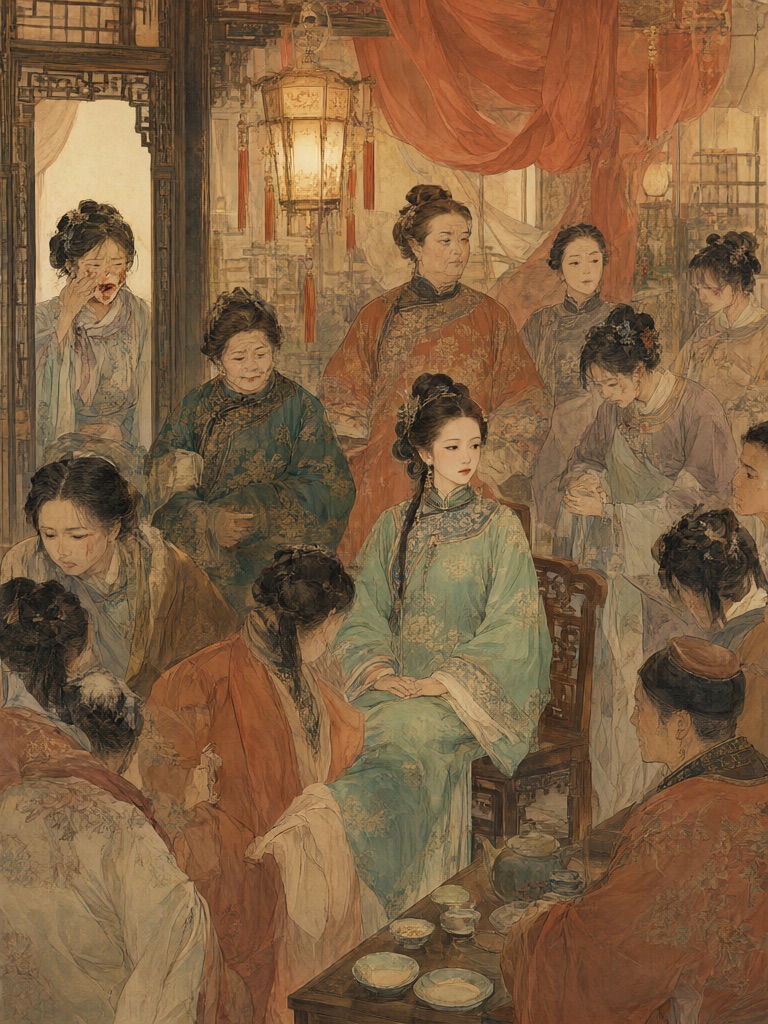
Earlier, after Cheng passed, a courier had come with the good news, but the whole household hated to hear it; and on finding the name did not match, they shouted him away. Now the third son was being married, and the relatives had come to the hall to celebrate; the sisters and aunts were all there—only Siniang had not been invited by her brothers and their wives. Suddenly a man galloped in and presented a letter from Cheng to Siniang. The brothers opened it, looked at each other, and went pale. Only then did the relatives and guests at the feast ask to see Siniang. The sisters were anxious, afraid she would bear a grudge and refuse to come. But before long, there she was, gliding in. People congratulating her, people pulling her to a seat, people asking after her—the room was full of the din. Every ear was listening to Siniang, every eye was watching Siniang, every mouth was talking of Siniang; and Siniang was as grave and composed as ever. Seeing that she held nothing against them, they began to relax, and then they jostled to raise their cups and toast her.
In the midst of the feasting and laughter, there was frantic wailing outside the gate. Everyone wondered what it was. A moment later Chunxiang rushed in, her face smeared with blood. They all pressed her, but she was crying too hard to answer. The second sister scolded her, and at last she sobbed, "Gui'er demanded my eyes! If I hadn't broken free, she'd have gouged them out!" The second sister was mortified; sweat and face powder ran down together. Siniang looked on unmoved. The whole table fell silent, and one by one the guests took their leave. Siniang, dressed in her finest, bowed farewell only to Lady Li and her third sister, then went out, got into her carriage, and left. Only then did they learn that the man who had bought the estate was Cheng.
When Siniang first moved to the estate, many household things were lacking. The lady of the house and the brothers each sent maids, servants and furnishings, but she accepted none of them; only a maid sent by Lady Li did she accept. Not long afterwards Cheng took leave to come home and visit the family graves, with carriages, horses and retinue thick as clouds. He went to his in-laws' house, paid his respects at Lord Hu's coffin, and then called on Lady Li. By the time the brothers had finished putting on their formal robes and caps, he was already back in his carriage. After Lord Hu died, his sons had spent their days fighting over the property and paid no attention to his coffin. After several years the mourning hall leaked and crumbled, and the fine hall was well on its way to becoming a grave mound. Cheng was saddened to see it, and without even consulting the brothers he set a date and arranged the burial, doing everything with full ceremony. On the day of the funeral, officials' carriages followed one after another, and the whole neighborhood praised him.
Over more than ten years Cheng rose through honorable and prominent posts, and whenever people from his home district were in trouble, he did everything he could for them. Then Hu's second son happened to be arrested over a man's death. The imperial inspector touring the region had passed the examinations in the same year as Cheng and was known for his severity. The eldest brother begged his father-in-law, Intendant Wang, to write to him, but no reply came at all, and he grew more frightened. He wanted to go and beg his sister but felt he had no face to do it, so he took a letter in Lady Li's own hand and went. In the capital he did not dare call right away; he waited until he saw Cheng leave for court, and only then went to the house, hoping Siniang would think of the bonds of kinship and forget old petty grudges. When the gatekeeper announced him, an old servant woman came out and led him into the hall, where wine and food were served—rather perfunctorily. When he had eaten, Siniang came out, her face mild and pleasant, and asked, "Big brother, you're so busy with your affairs—how did you find time to come all this way to see me?" The eldest brother threw himself flat on the ground and tearfully explained why he had come. Siniang raised him up and laughed: "You're a grown man, brother. What's so serious that you must carry on like this? I'm only a woman, and when have you ever seen me whimpering at anyone?" Then he produced Lady Li's letter. Siniang said, "My brothers' wives are all heavenly beings. Each of them need only ask her own father and brothers and the matter would be settled. Why go to the trouble of coming all the way here?" He had nothing to say and could only keep pleading. Siniang's face hardened: "I thought you'd traveled all this way to visit your little sister. So you've come to ask a favor of 'the noble lady' over a big lawsuit!" She flicked her sleeve and went straight inside. The eldest brother left, humiliated and furious.
Back home he told the whole story, and young and old alike cursed her; even Lady Li called her heartless. A few days later the second brother was released and came home. Everyone was overjoyed and laughed at Siniang for having earned nothing but resentment. Soon after, Siniang sent a servant to pay respects to Lady Li. He was called in, laid out gold and silk, and said, "For the matter of the second young master, my mistress sent word off in great haste and had no time to write back. She sends these small gifts in place of a letter." Only then did everyone realize that the second brother's release was Cheng's doing. Later, when Sanniang's family grew poor, Cheng repaid her far beyond the usual measure. And because Lady Li had no son, he brought her to live with them and cared for her as if she were his own mother.