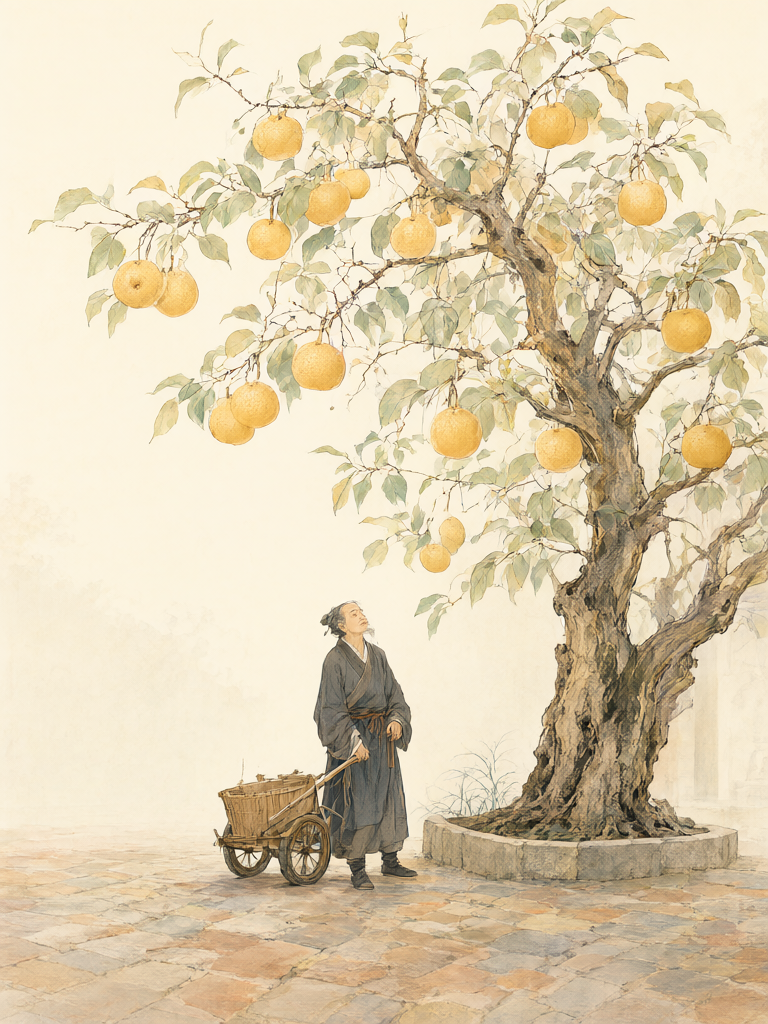
A countryman was selling pears in the market. They were quite sweet and fragrant, so their price soared. A Taoist priest, wearing a tattered turban and ragged clothes, begged in front of his cart. The countryman shooed him away, but he would not leave. The countryman grew angry and began to curse him. The Taoist said, 'There are several hundred pears in this cart. I, an old monk, only beg for one. It is no great loss to you, a layman. Why are you so angry?' The onlookers suggested he give one of the inferior ones to let the priest go, but the countryman stubbornly refused.
A hired hand in the shop, seeing the endless haggling, took out some money to buy a pear and handed it to the Taoist. The Taoist bowed in thanks and said to the crowd, 'Those who have left the secular world do not understand stinginess. I have fine pears; please let me offer them to the guests.' Someone asked, 'If you have them, why not eat them yourself?' He replied, 'I specifically need this seed to plant.' He then scooped up the pear and ate it in great bites until it was gone. Holding the seed in his hand, he took the spade from his shoulder and dug a hole several inches deep in the ground. He placed the seed inside, covered it with soil, and asked the market-goers for hot water to water it. An eager bystander went to a nearby tea shop and brought back a bowl of boiling water. The Taoist received it and poured it into the hole. With a thousand eyes watching, a sprout emerged, gradually growing larger. Soon it became a tree, its branches and leaves spreading out. Suddenly it bloomed, and suddenly it bore fruit. The pears were large, fragrant, and hung in clusters all over the tree. The Taoist then picked pears from the branches and gave them to the onlookers. In a moment, they were all gone. Then he used his spade to chop down the tree. The spade struck with a ringing sound for a long time before it finally fell. Carrying the leafy trunk on his shoulder, he walked away calmly and slowly.
At first, when the Taoist was performing his magic, the countryman had been mixed in with the crowd, stretching his neck to watch, and had completely forgotten his business. After the Taoist had left, he finally looked back at his cart, only to find it empty. He then realized that the pears the Taoist had just given away had all come from his own cart. He also noticed that one handle on the cart was missing; it was a freshly cut piece. He was greatly indignant. He hurriedly chased after the Taoist, turning a corner of the wall, and found the broken handle discarded under the wall. He then understood that the pear tree he had chopped down was actually his cart handle. The Taoist was nowhere to be found, and the whole market burst into laughter.