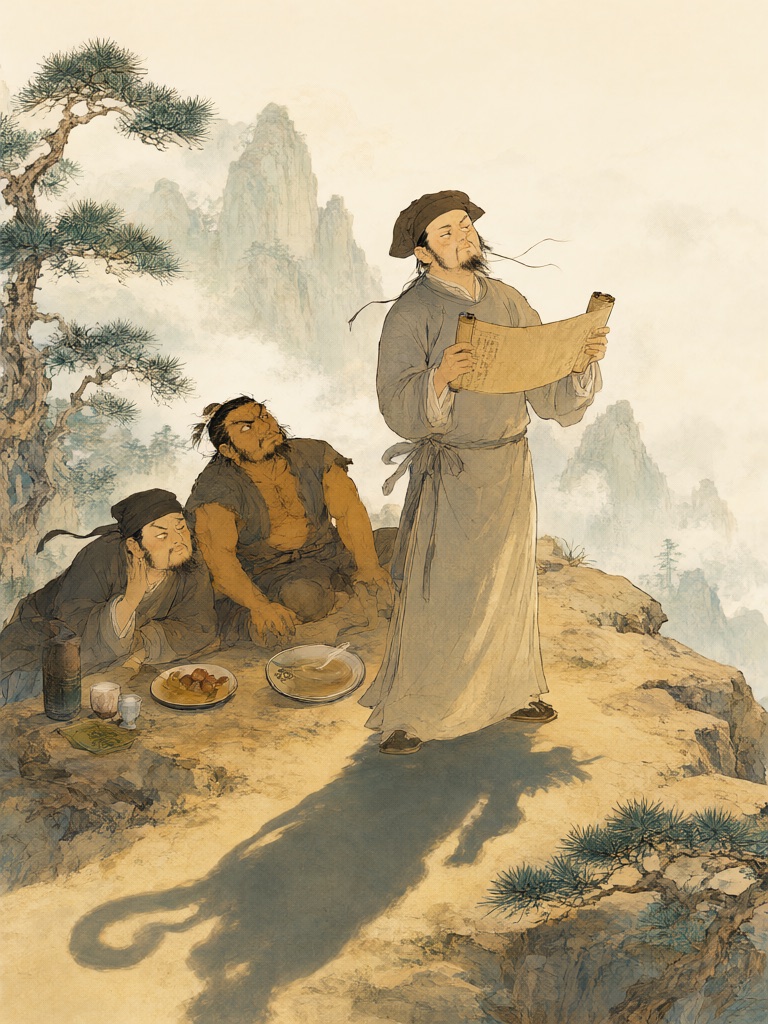
A one-inch tongue is a sword to steady the realm; a five-word line of verse is a ladder to the sky. The road to the blue clouds will be reached at last—with no name on the golden list, I swear I won't go home. Our story is set in the reign of Emperor Renzong of the great Song. There was a young scholar surnamed Zhao, given name Xu, courtesy name Bosheng, a native of Chengdu prefecture in Western Sichuan. From boyhood he had studied composition; the Odes, the Documents, the Rites and Music—he had only to glance at them and could write. He was a thoroughly learned scholar. Glad to hear that the examinations were being held in the Eastern Capital, he set his heart on sitting them, and went to the hall to tell his parents. His father, Zhao Lun, courtesy name Wenbao, and his mother, Lady Liu, both came from families steeped for generations in poetry and ritual. Seeing their son wanted to go to the capital for the examinations, they gave their consent. Zhao Xu chose a day and packed his things, and his father gave him a poem. It said: Let only poetry and books come often before your eyes; don't let flowers and wine bewitch your heart. When the peach-blossom waves rise next spring, win the silk robe and come home.
His mother, Lady Liu, also urged him, “May you soon come first on the list, my son, and live up to a man's ambitions.” Zhao Xu bowed farewell to his parents and, with his zither, sword and book chest and a single servant, set straight off for the Eastern Capital. A party of relatives and friends saw him off beyond the south gate. Zhao Xu composed a song lyric on the spot, to the tune “River God.” It said: Who is singing the Weicheng farewell in the wine pavilion? We two will long for each other; my thin silk robe shrinks from the cold. At the wild ferry a boat lies crosswise; the willows are stripped of broken branches. I dread the sight of a thousand miles of green mountains: the traveller goes far, and the grass and mist blur together. Autumn dew washes the rouge from the hibiscus; the broken wind is bleak, the dawn frost faint. My sword hangs like autumn water; parting is so bitter even the rainbow turns pale. All that's left is a thousand tears on my scholar's blue gown—what day will they stop falling?
When he had finished his lyric, Zhao Xu took leave of his friends and set out. All along the way he ate when hungry and drank when thirsty, stopped at night and travelled at dawn, and after some days he reached the Eastern Capital. He went into the city to see the sights. Towers and terraces like brocade, crowds of splendid people—it was truly a place where dragons and tigers gather. He walked to Zhuangyuan Ward, found an inn to stay at, and waited for the examination date. He entered the examination hall, finished the papers of all three sessions, and returned to his lodgings to wait for the yellow list. Zhao Xu was secretly delighted: “I'm sure to pass.” The next day, after breakfast, he went with some friends from the inn to a teahouse across the street. Zhao Xu saw a poetry tablet on the table, took up a brush, and wrote a song lyric on the whitewashed wall. It said: My feet on the cloud ladder, my hand reaching for the immortal cassia, my name is already on the list of graduates. Before my horse they cry, “Make way for the top graduate!” Gold saddles and jade bridles in line. Back from the banquet, I roam the streets drunk—now a man's ambition shows. I'll write at once to tell my lady in her tower: this time she's got herself a dashing husband. When he had written it, Zhao Xu was very pleased with himself. In the evening they all went back to the inn—but no more of that.
Now Emperor Renzong held his morning audience, and the examiners, having finished grading the papers, came to court together. Emperor Renzong asked, “The top candidates you have chosen—three, as is customary—where are they from?” The examiners presented the three papers before the throne, and Renzong read them himself. Having read the first, the dragon face smiled slightly, and he said to the examiners, “This paper is extremely well done! What a pity there is one character written wrong in it.” The examiners prostrated themselves and asked, “May we ask which character is miswritten?” Renzong laughed and said, “The character wei. It should have the 'mouth' radical; why has it been written with the si radical?” The examiners bowed again, knocked their heads, and replied, “Both forms are interchangeable.” Renzong asked, “What is this man's name? Where is he from?” When the sealed name was opened, it proved to be a man from Chengdu prefecture in Sichuan, surnamed Zhao, named Xu, now lodging at an inn in Zhuangyuan Ward. Renzong sent a fast runner to summon him at once.
Summoned at his inn, Zhao Xu dared not delay and followed the messenger straight to court. He borrowed a blue gown and a court tablet of locust wood, was led before the throne, and knocked his head and performed the dance of obeisance. Emperor Renzong asked, “Where are you from?” Zhao Xu knocked his head and replied, “Your servant is from Chengdu prefecture in Sichuan. From boyhood I have studied letters; I came expressly to sit the examinations, and am fortunate to look upon the golden palace.” The emperor asked further, “What topics did you get? How long was your composition? How many characters in it?” Zhao Xu knocked his head and answered each question without a single mistake. Seeing that the man's words poured out like water, Renzong was secretly pleased and impressed—only it was a pity about the one miswritten character. His Majesty said, “There is one character written wrong in your paper.” Zhao Xu, alarmed, prostrated himself, knocked his head and asked, “May I ask which character is miswritten?” Renzong said, “The character wei. It has the 'mouth' radical; why did you write it with the si radical?” Zhao Xu knocked his head and replied, “Both forms are interchangeable.” Renzong was displeased. He took up the brush and ink from the imperial desk, wrote eight characters, handed them to Zhao Xu and said, “Look at these. I have written dan and dan, qu and ji, wu and yi, lü and tai. You say they are interchangeable—take them apart for Us.” Zhao Xu looked at them for a long time and had no answer. Renzong said, “You may withdraw for now and study your books.” Zhao Xu left the court in shame, went back to the inn, and brooded endlessly.
His friends came and asked, “You must have done splendidly!” Asked, Zhao Xu told them what had happened, and they were all astounded. So they invited him to the teahouse to drink tea and cheer up. Zhao Xu suddenly caught sight of the lyric he had written on the wall days before and sighed over and over. Again he took up brush and ink and wrote a lyric. It said: My wings were nearly grown, fame almost won, my name already to a man's liking. The Lord of Spring announced the peonies' bloom, but the Jade Grove banquet was given to others to get drunk on. Because I erred over the character wei, my fame fell to the ground; Heaven has thwarted my life's ambition. I ask about going home and look back toward my village—waters far, mountains distant, more than three thousand li.
When the golden list was posted and he sent someone to look, sure enough there was no Zhao Xu on it. He sighed and wept, and stayed on, stranded, in the Eastern Capital, ashamed to go home. “If I wait three more years, it surely won't fail me.” Brooding in his lodgings, he idly wrote four lines on the wall. The poem said: Song Yu grieved in vain, Jiang Yan was all regret, Han Yu was banished to the wilds, Su Qin was stuck in poverty. When he had written it, Zhao Xu sat in the inn, depressed, weary and with nothing to do, and wrote another lyric, to the tune “Silk-Washing Stream”: Autumn air, cold skies, ten thousand leaves drifting; crickets chirp, the night is dreary; at sunset a man's shadow lies across the flat bridge. Near autumn the chrysanthemums are all in riotous bloom; let them grow bleaker after the frost—last night's wind and rain were just like this morning's. Thinking of home, his fame not won, he tossed and turned and could not sleep. He got up, sat alone, and wrote another lyric, to the tune “Little Layered Hills”: Sitting alone by the clear lamp, sleepless through the night, my heart in a thousand threads pulls two ways. Mandarin ducks by the pond lotus in the autumn rain—how bitter to be parted, red tears before the evening wind. I turn to watch the wild geese winging; I write my longing to send back, but it is far as the sky. I plan to put my hopes off until next year—but sorrow can hardly wait, and my tears soak the blue felt.
From then on he was stranded in the Eastern Capital. By late autumn his servant, unwilling to wait any longer, had slipped off home. Zhao Xu was alone at the inn with no money for travel, and every day he went out into the streets to write compositions and letters for people. But his clothes were in rags; he wore only a gown of coarse yellow grass-cloth, and when the west wind blew through it Zhao Xu felt bitter and wrote a lyric to the tune “Partridge Sky”: Yellow grass-cloth is the worst for keeping out the cold, and worse still, worn so long its colour's gone to ash; the shoulders through, the sleeves in tatters, the pattern down to threads—and the autumn wind blows morning and night. No sooner is it on than my tears wet it; going out, I'm ashamed to meet old friends. The girl next door asks softly: could you find me some scraps to paste for shoe soles?
It was a season of drizzling autumn rain, and Zhao Xu sat in the inn. The waiter said, “Scholar, you're so hard up now—why not go and play the flute in the teahouses and wine shops in the streets? You could pick up some money and get by.” Hearing this, Zhao Xu was vexed and wrote a poem. It said: In the bleak inn, alone with my shadow, I sometimes gather wild greens for soup. The yokel doesn't know a hand fit to season the state's broth—he asks if I can play the flute!
Time slipped by, and before he knew it more than a year had passed. Then one day, in the palace, at the third watch of the night, Emperor Renzong dreamed of a god in golden armour driving a Great Peace chariot loaded with nine red suns, which came straight into the inner court. He woke with a start—it had all been a dream. The next day he held the morning audience, and when the officials had finished their obeisances and the civil and military ranks had dispersed, Renzong summoned Eunuch Miao of the Bureau of Astronomy and asked, “Last night We had a dream. We dreamed of a god in golden armour driving a Great Peace chariot loaded with nine red suns. Is this dream lucky or unlucky?” Eunuch Miao replied, “'Nine' and 'sun' together make the character xu. It may be a person's name, or the name of a prefecture.” Renzong said, “If it is a person's name, We want to see this man now. How can We find him? Cast a divination for Us.” Eunuch Miao, it happened, had once met an extraordinary man who taught him Zhuge Liang's “before-the-horse” divination, which was most accurate. He cast it then and there, and reported, “If Your Majesty wishes to see this man, it must be today. Your Majesty and I must dress as scholars in plain white and walk the streets incognito; then we will meet him.” Renzong agreed. He took off his dragon robe, unfastened his jade belt, and dressed as a scholar in white, and Eunuch Miao dressed the same. They went out through the palace gate and strolled along the imperial avenue and through the lanes and alleys. After about half a day they saw a wine tower—how lofty it was! It was the famous Fan Tower. There is a lyric to the tune “Partridge Sky” to prove it: The wine tower in the city rises to the sky; they cook dragon and stew phoenix, rich and fresh. Young lords dismount, drunk on the smell alone, and spend ten thousand cash on a single drink. It welcomes noble guests and draws high worthies; upstairs, pipes and strings play in rows. A hundred fine things, rare delicacies; railings on all four sides, painted eaves.
Emperor Renzong and Eunuch Miao went upstairs to drink, sovereign and servant seated by rank. It was the height of summer and the weather was hot. Renzong held a moon-shaped fan of white pearwood with a jade handle, and leaned on the railing watching the street. Tapping the pillar with the fan handle, he lost his grip and the fan fell to the street below. They hurried down to look for it, but it was gone. Renzong had Eunuch Miao cast another divination. Eunuch Miao obeyed, cast it, and interpreted: “This fan too will be seen again today.” When the two had finished drinking, they paid for the wine, went downstairs and out into the street.
They came to Zhuangyuan Ward, where there was a teahouse. Renzong said, “Let's have a cup of tea.” The two went in and sat down, and suddenly saw on the white wall two song lyrics, the lines fresh and fine, the calligraphy vigorous, and signed after them: “Written by Zhao Xu, scholar of Jinli.” Renzong was startled and said, “Could this be the man?” Eunuch Miao called the tea-master over and asked, “Who wrote the lyrics on the wall?” The tea-master answered, “If it please you, sir, the man who wrote them is a scholar who failed the examinations, too ashamed to go home, and stranded here.” Eunuch Miao asked further, “Where is he from? Where is he staying now?” The tea-master said, “He's from Chengdu in Western Sichuan, and he's staying at the inn across the way in Zhuangyuan Ward. He makes his living writing for people while he waits for the next examination.” Renzong remembered what had happened and said privately to Eunuch Miao, “This man was the top candidate chosen by the examiners last time. His writing is excellent; only because he miswrote one character and, as We felt, refused to admit his mistake, We failed him and did not employ him. We never expected he would be stranded here.” He told the tea-master, “Go and find him. I want to ask him for some writing. If you can find him, I'll reward you myself.” The tea-master went off and came back without finding him, sighing, “That scholar really has no luck. Who knows where he's gone.” He reported, “Gentlemen, I can't find him.” Renzong said, “We'll sit a while longer. Bring more tea.” While they drank, he again sent the tea-master to find the scholar. The tea-master went asking at the inn and every wine shop around, but could not find him, and said, “A poor scholar indeed! If he met these two gentlemen he'd get some help from them. What wretched luck!” Once more he reported, “I can't find him.”
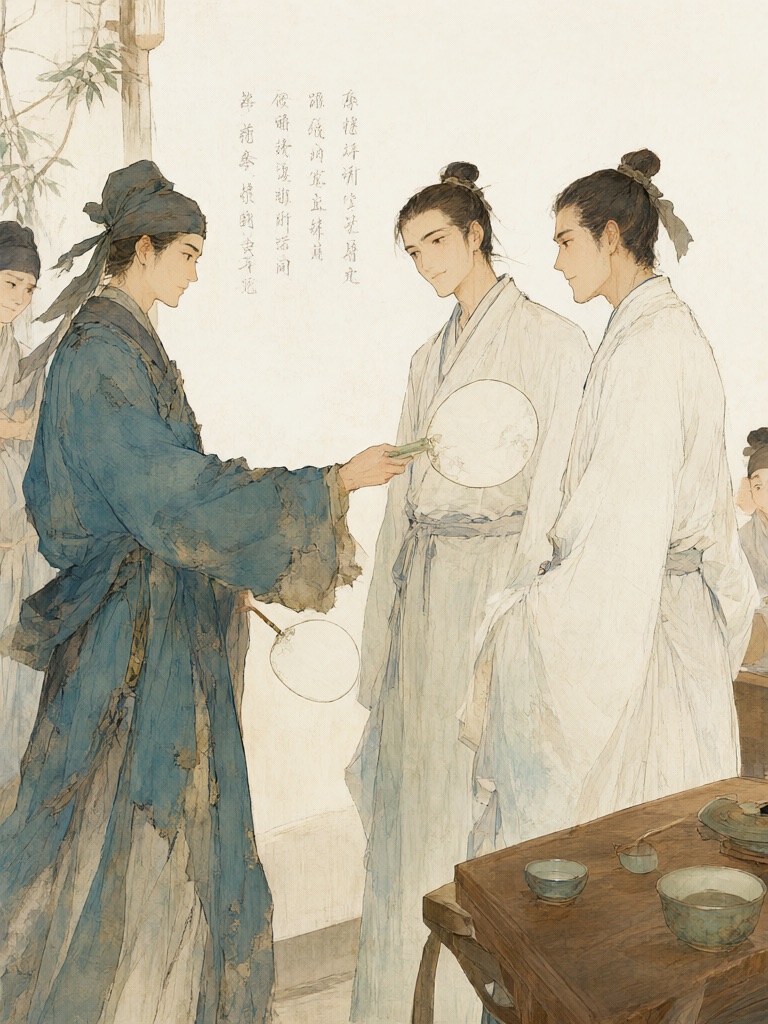
The two paid for their tea and were about to get up when the tea-master pointed and said, “Look, there's Scholar Zhao coming!” “Where?” asked Eunuch Miao. The tea-master pointed to the street: “The one coming this way in the ragged blue gown.” Eunuch Miao told him to invite the man in. The tea-master went out into the street, met him and said, “Scholar Zhao, there are two gentlemen in my teahouse waiting for you. They sent me to find you, and twice I couldn't.” Zhao Xu hurried into the teahouse, exchanged greetings, and sat below Eunuch Miao, and the three drank tea. They asked, “Did you write the lyrics on the wall, sir?” Zhao Xu answered, “Untalented as I am, I just scribbled whatever came into my head—quite laughable.” Renzong asked, “You are from Chengdu, sir—how is it you are here?” Zhao Xu answered, “Through ill fortune I failed the examination, and I am ashamed to go home.” While they were talking, Zhao Xu fumbled in his sleeve. “What have you got in your sleeve?” asked Eunuch Miao. Without a word Zhao Xu took it out: it was the moon-shaped white pearwood fan with the jade handle. He held it out in both hands for Eunuch Miao to see, and on it was a newly written poem. It said: Twisting, interlacing branches, a deep blue-green; a trapped dragon, its time not come, lies hidden in the earth. If one day it meets the wind and clouds, it will surely become a white jade beam holding up the sky.
Eunuch Miao asked, “Where did you get this fan?” Zhao Xu answered, “I was walking past below the Fan Tower when someone upstairs dropped this fan, and by chance it caught in the sleeve of my ragged blue gown. I was on my way to Chancellor Wang's house to write a poem on pines, and when I began I wrote it on the fan.” Eunuch Miao said, “This fan belongs to this gentleman, Master Zhao; he dropped it from the tower while drinking.” Zhao Xu said, “Since it's yours, sir, I must return it at once.” Emperor Renzong was delighted! He asked further, “Why did you not pass last time, sir?” Zhao Xu answered, “I had finished my papers for all three sessions. I never imagined that the sage Son of Heaven himself would read them and find one character written wrong. So I failed, and I've been stranded here.” Renzong said, “Then the present emperor is not wise.” Zhao Xu answered, “The present emperor is most wise.” Renzong asked, “Which character was miswritten?” Zhao Xu said, “The character wei. I wrote it with the si radical; the Son of Heaven, in his wisdom, said it should have the 'mouth' radical. I replied, 'Both are interchangeable.' His Majesty wrote eight characters with his own brush: 'dan and dan, qu and ji, wu and yi, lü and tai. You say they are interchangeable—take them apart for Us.' I had no answer, and so I was failed and have been stuck here ever since. It was because my learning was not thorough—I brought it on myself. It was not the sage Son of Heaven's fault.”
Renzong asked, “You live in Jinli, sir—that's Western Sichuan. Do you know Military Commissioner Wang?” Zhao Xu answered, “I know of Commissioner Wang, but Commissioner Wang doesn't know me.” Renzong said, “He is my nephew. What if I write a letter and have someone take you to him, so you can get a position and make your way?” Zhao Xu threw himself down and bowed: “If you two gentlemen will raise me up, I shall never dare forget your kindness.” Eunuch Miao said, “Sir, you've had the luck to meet this gentleman who will promote you—why not write a poem to thank him?” Zhao Xu agreed and wrote a poem. It said: White jade hidden in the stubborn rock, gold buried in the filthy mud. Today I meet a noble who lifts me up—like standing on a ladder to the ninth heaven. Emperor Renzong read the poem and said with great delight, “Why write such a poem? You don't yet know whether my recommendation will work. I'll answer with a poem too.” It said: One character in dispute cost you your degree; stranded in the capital, you missed your chance. I give you a letter to take to Western Shu—better than shouting 'Long live!' and bowing at the phoenix throne. Zhao Xu, receiving the gentleman's poem, was overcome with gratitude. Then Eunuch Miao said, “Sir, the gentleman has given you a poem—how can I say nothing?” And he too presented a poem. It said: Xu, the rising sun, came to the imperial gate in answer to the signs in heaven; he should have been first, but for one blurred character. Today he takes a letter to Commissioner Wang, and silk robes will bring glory to the house of Zhao.
Eunuch Miao said, “Go back to your lodgings, sir. Tomorrow morning I'll hurry the gentleman myself and have someone bring the letter and money for the journey, and see you off.” Zhao Xu asked, “Where is the gentleman's residence? I would like to come and thank him.” Eunuch Miao said, “The residence is very far from here; you needn't trouble to look for it.” Zhao Xu bowed his thanks right there in the teahouse, and the three went out together and parted.
The next day Zhao Xu rose early and waited. Sure enough, the beardless scholar in white from the day before arrived, leading an attendant who carried a clothes chest and a bundle—but Master Zhao did not come. Zhao Xu went out of the inn to greet them, and they exchanged courtesies. Eunuch Miao said, “Last night Master Zhao took my advice and appointed this man to see you on your way. He gives you an ingot of fifty ounces of silver, and documents to take to Chengdu. The documents are all with this man. Take care on the road and go straight there.” Zhao Xu thanked him again and again and asked, “May I ask your honourable name, sir?” Eunuch Miao said, “My surname is Miao, my name Xiu. I serve as a retainer in Master Zhao's household. When you see Commissioner Wang you will understand.” Zhao Xu said, “If I succeed on this journey, I will never forget to repay you like a faithful dog or horse.” Then he composed a poem, wrote it on plain paper, and gave it as a token of thanks and farewell. It said: Last year I was a candidate on the list; today I still hope someone will quietly nod. I meant to seek out a chancellor's mansion, and met by chance at a wine tower. A fan fell from the sky and caught in my blue gown; the poem in my sleeve was kept at court. Many thanks to the noble who wrote the letter—I go straight to the Commissioner of Western Sichuan. Eunuch Miao took the poem, said goodbye and went back. Zhao Xu chopped up the silver, paid his rent, got his clothes in order, and three days later set out.
All along the way he ate when hungry and drank when thirsty, stopped at night and travelled at dawn, and after some days, when he was perhaps a hundred-odd li from Chengdu, he heard people say, “Men have been sent far out to welcome the new Military Commissioner—soldiers and people are all in an uproar.” Zhao Xu was dismayed at the news and thought, “I came specially to see Commissioner Wang, and now he has left his post. How can my luck be this bad! What am I to do?” And he composed a poem, which said: I carry the letter in my hands into Sichuan—a thousand miles to seek a man, and all at once it's empty. I've failed the noble who meant to lift me up; home is near, yet I'm all the more troubled.
The attendant said, “Don't worry. Let's go on and find out what's really going on.” Zhao Xu dragged his feet with every step. After another twenty-five li they reached the Chengdu district. At the Welcoming Pavilion the officials were in a commotion, all saying, “We've been waiting three days to receive the new Commissioner, and there's no sign of him.” The attendant said, “Scholar, let's go up to the Welcoming Pavilion and have a look.” “We can't,” said Zhao Xu. “I'm a man with no one to back me.” The attendant paid no attention; carrying the bundle and the clothes chest on his pole, he went straight up to the pavilion and set them down. “What are all you gentlemen waiting for here?” he asked. “Why don't you welcome the new Commissioner?” The officials were startled and asked, “We haven't seen the new Commissioner come—where is he?” The attendant opened the bundle, unsealed the documents and said, “This scholar is the new Commissioner.” Zhao Xu was startled too. The attendant then opened the clothes chest, took out a purple robe, a gold belt, an ivory tablet and black boots, put the flared-wing official cap on him, and read out the imperial edict. Zhao Xu gave thanks, knocked his head and received the appointment: Military Commissioner-General of the fifty-four prefectures of Western Sichuan. The officials came forward to meet him and paid their respects. Zhao Xu sent men to find a good monastery where he could stay for the time being, and chose a day to take up his post. Thinking back over what had happened, he said to himself, “I had the top degree in my hand and was failed over a single character. Who knew it was my destiny to rise? I met Master Zhao in a teahouse—and he was Emperor Renzong himself.” Truly it was: Tend a flower with all your heart and it won't grow; stick in a willow without a thought and it gives you shade. Zhao Xu asked the attendant, “The man in white who saw me off the other day—what office does he hold?” The attendant said, “That was Eunuch Miao of the Bureau of Astronomy. By imperial order he told me to come with you.” Zhao Xu said to himself, “I had eyes but did not recognize Mount Tai!”
He chose a day to take office: a fine horse with a carved saddle, a three-tiered parasol held over him, troops drawn up in front, officials following behind—a stately, majestic sight. When he had taken office he went home to pay his respects to his parents. His parents were startled and frightened by the sudden sight; the whole family came out to meet him, and carriages and horses filled the street before the gate with noise. Zhao Xu dismounted and entered the hall in his purple robe and gold belt, ivory tablet and black boots, and went up to bow to his parents. His parents asked, “You failed the examination and were stranded in the capital—how did you suddenly get this post? And how is it you've been appointed to serve here at home?” Zhao Xu told them everything that had happened. Hearing it, his parents raised their joined hands to their foreheads, thanked the light of sun and moon, and wished that their son would repay the emperor's grace with loyal service. Zhao Xu wrote a poem, which said: I set my heart on fame and should have come first; one character in dispute kept me from coming home. I cursed the rough waves at the Dragon Gate—who knew a clap of thunder would break from level ground!
His parents were overjoyed, and the whole family rejoiced. Relatives and friends all came to congratulate him, and there were several days of feasting. The servant who had run home long ago he did not hold a grudge against, but took back into service as before. Thinking of the kindness of the Son of Heaven, Renzong, he wrote a memorial himself to thank the emperor. From then on he served as an official in Western Sichuan, in charge of both soldiers and people. He brought his parents to live at his official residence and cared for them there. As the saying goes, “One son receives the emperor's grace, and the whole family eats heaven's bread.” There is a poem to prove it: Sima Xiangru returned to Shu holding the imperial tally; Su Qin passed through Zhou again with gold in his robe. Coming home in silk is as old as history—but what can match meeting the emperor on his outing in a teahouse?