Liang Youcai, originally from Shanxi, had drifted to Jinan, where he made a living as a small-time pedlar. He had no wife or children and no land. He went with some fellow villagers to climb Mount Tai. Around the fourth month, Mount Tai swarmed with pilgrims. There were also lay Buddhist women and men leading crowds of followers by the hundred, all kneeling together before the shrine for as long as it took a stick of incense to burn down — a practice called “kneeling for incense.” Among the crowd Liang noticed a girl of seventeen or eighteen, very beautiful, and he took a fancy to her. Pretending to be a pilgrim, he knelt down next to her; then, making out that his knees were too weak to hold him, he deliberately put his hand on her foot. She turned her head, looking annoyed, and shuffled away on her knees. Liang shuffled after her; a little later, he put his hand on her foot again. Realising what he was up to, she sprang to her feet, gave up kneeling and walked out the door. Liang got up too and went out after her, but could not tell where she had gone. His hopes dashed, he trudged on in low spirits.
On the road he saw the girl walking with an old woman who seemed to be her mother, and he hurried after them. Mother and daughter were talking as they went. The old woman was saying, “It's a very good thing that you came to pay your respects to the Goddess! You've no brothers or sisters, but if only the Goddess will watch over you in secret and find you a fine husband — so long as he's dutiful to us, he needn't be some noble young lord or rich man's grandson.” Liang was secretly delighted, and edged his way into questioning the old woman. She said her name was Yun, and the girl, Cuixian, was her own daughter. Their home was in the Western Hills, forty li away. “The mountain roads are rough,” said Liang. “With you, mother, taking such small steps, and little sister so delicate, how will you ever get there?” “It's late already,” she said. “We'll spend the night at her uncle's.” Liang said, “You were just talking of choosing a son-in-law and not minding if he's poor or humble. I'm not married yet — would I suit you, mother?” The old woman asked her daughter, who did not answer. When the old woman had asked several times, the girl said, “He has little luck in him, and he's a dissolute good-for-nothing; a frivolous heart like that turns easily. I won't be wife to a lout like him!” Hearing this, Liang declared himself a simple, honest man and swore earnestly by the bright sun. The old woman was pleased and actually agreed. The girl was unhappy, but did no more than flush with anger. Her mother patted her firmly to bring her round.
Liang was all attentiveness: he reached into his purse and hired two mountain chairs to carry the old woman and the girl, while he walked alongside on foot like a servant. At every narrow pass he scolded the bearers not to jolt or sway the chairs — he was most solicitous. Soon they reached a village, and the old woman invited him into her brother's house. The uncle who came out was an old man, and the aunt an old woman. Mrs Yun called them brother and sister-in-law, and said, “Liang is my son-in-law. Today happens to be a lucky day, so there's no need to choose another — let the wedding be tonight.” The uncle was pleased too, and brought out wine and food to treat Liang. Afterwards they dressed Cuixian in her finery and brought her out, brushed the bed and urged the couple to retire. Cuixian said, “I knew all along you were no good. I'm only going along with you because my mother made me. If you behave like a human being, you needn't worry about our making a life together.” Liang meekly agreed to all she said.
Early the next morning the mother said to Liang, “You'd better go ahead; I'll bring my daughter after you.” Liang went home and swept out the house. Sure enough, the old woman brought her daughter. She went in, looked about, and saw the place was bare. “How can you live like this?” she said. “I'll hurry home and do a little to lighten your hardship.” And off she went. The next day several men and women arrived, each bringing clothes, food or household goods, until one whole room was full. They all left without staying to eat, leaving behind only a maid. From then on Liang sat back in comfort with food and warmth, except that every day he brought home the village riffraff to drink and gamble, and gradually began stealing Cuixian's hairpins and earrings to stake on his bets. She remonstrated with him, but he would not listen; she lost all patience with him, and could only keep her chests and jewel boxes under close guard, as if against bandits.
One day one of his gambling cronies knocked at the door to call on him, caught a glimpse of Cuixian, and was astounded. He said to Liang in jest, “You're sitting on a great fortune — why worry about being poor?” Liang asked what he meant. “I just saw your wife. She's a real fairy — far too good for a household like yours. Sell her as a concubine and you'd get a hundred taels; sell her to a brothel and you'd get a thousand. With a thousand taels in the house, why put up with having no money for drink and dice?” Liang said nothing, but in his heart he agreed. When he came home he began sighing at Cuixian, always saying how impossibly poor they were. She ignored him, so he kept banging the table, throwing down his spoon and chopsticks, cursing the maid, and putting on every kind of show.
One evening Cuixian bought wine and drank with him. Suddenly she said, “You fret day after day because we're poor. And I can't fend off poverty or share your worries — how can I not feel ashamed? But we have nothing of value, except this maid. If we sold her, it might help a little.” Liang shook his head. “What would she fetch!” After they had drunk a while longer, Cuixian said, “Is there anything I've ever refused you? It's only that I've nothing left to give. When I think how poor we are, even if I stay with you till death, we'd only share a lifetime of hardship — what future is there in that? Better to sell me to a rich family. It would do us both good, and I might fetch more than the maid.” Liang pretended to be shocked. “How could it come to that!” She insisted, her face grave. Liang said happily, “Let me think it over.”
So, through a palace eunuch, he arranged to sell her into the register of courtesans. The eunuch came to Liang in person, and was delighted when he saw Cuixian. Afraid he might not get her at once, he signed a contract on the spot for eight hundred strings of cash, and the deal was all but done. Cuixian said, “My mother is always worrying because her son-in-law's family is poor. Now that this tie is to be cut, I'll go home for a short visit. Besides, if you and I are parting for good, how can we not tell my mother?” Liang was afraid her mother would stand in the way. “It's what I want myself,” said Cuixian. “I promise nothing will go wrong.” Liang agreed.
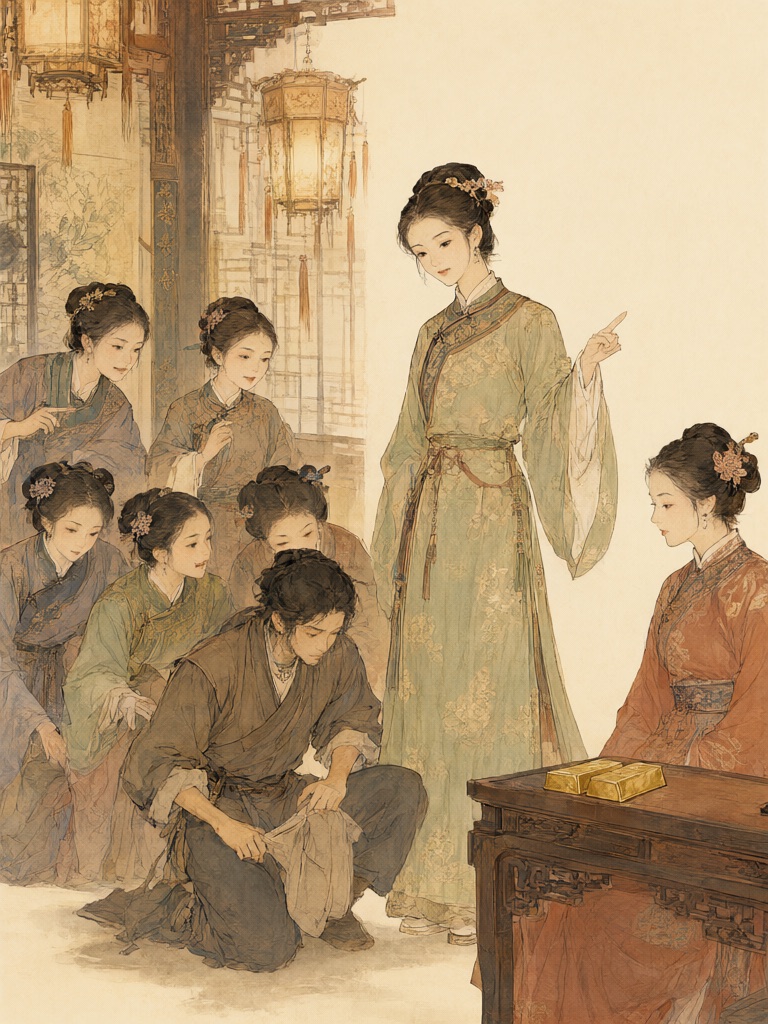
It was nearly midnight when they reached her mother's house. They knocked and went in, and Liang saw splendid towers and halls, with maids and servants bustling to and fro. In all the time he had lived with Cuixian, whenever he asked to visit her mother she had stopped him, so in more than a year as a son-in-law he had never once set foot in his wife's family home. Now he was astounded: with a family this grand, they would surely never stand for her being sold as a concubine or a courtesan. Cuixian led him upstairs. The old woman asked in surprise what had brought the two of them. Cuixian said bitterly, “I always said he was no good, and now it's proved!” From under her clothes she took two bars of gold and laid them on the table. “Luckily that wretch never wheedled these out of me. Now I give them back to you, mother.” Her mother, alarmed, asked what had happened. “He's going to sell me,” said Cuixian, “so there's no use in my keeping this gold hidden any more.”
Then she pointed at Liang and cursed him: “You jackal, you rat! Back then you carried a pole on your shoulder, your face caked with dust like a ghost's. When you first came near me you reeked of sweat, the grime on your skin was thick enough to flake off, and the cracks on your hands and feet were an inch deep — you made me sick all night long. It was only after I came to your house and you could sit at your ease and eat your fill that you shed that ghost's hide. With my mother here to hear it, am I telling any lies?” Liang hung his head and dared not breathe.
Cuixian went on, “I know I'm no world-toppling beauty, not fit to serve great lords; but for a man like you, I thought I was a fair enough match. What wrong did I ever do you, that you couldn't spare a single thought for the bond between husband and wife? Do you think I couldn't have built us fine houses and bought good land? It was only that, with your shallow bones and beggar's face, I knew you'd never be a partner to grow old with!” As she spoke, the maids and old servingwomen linked arms and closed in, circling round and round him. Hearing Cuixian list his offences, they all spat and cursed him, crying together, “Better to kill him — why bother talking any more!” Liang was terrified; he threw himself to the floor and could only say that he repented. Cuixian went on, in a towering rage, “Selling your wife is a great evil, but that's not even the worst of it. How could you bear to trick the woman who shares your bed into becoming a whore!” Before she had finished, the women, eyes blazing fit to burst, all stabbed at his ribs with sharp hairpins and scissor points. Liang howled and begged for his life. Cuixian stopped them. “Let him go for now. Even if he has no decency, I can't bear to watch him tremble like that.” And she led them all downstairs.
Liang sat listening for a long while until all the voices had died away, and then thought of slipping off. Suddenly, looking up, he saw the stars and the Milky Way; the east was already paling, and the open country stretched grey and vast; then the lamp went out. There was no house at all — he was sitting on a sheer cliff. Below him yawned a bottomless gorge. Frozen with terror, he was afraid he would fall. He moved a fraction, and with a crash the rock gave way and tumbled down. Halfway down the cliff a dead tree jutted out, and he was caught on it and did not fall. The dead trunk held him up by the belly, with nothing for his hands or feet to grip. Below there was only a blur, he could not tell how many fathoms deep. He dared not turn or shift; he howled in terror until his voice gave out, his whole body swelled, and every ounce of strength in his eyes, ears, nose, tongue and body was spent. Only when the sun was high did a woodcutter spot him from afar; he fetched a rope, let himself down, and brought him up onto the clifftop, barely breathing and on the point of death.
They carried him home. There he found the door wide open and the house as desolate as a ruined temple: the beds, the chests, the furnishings had all vanished, and only a rope cot and a broken table — things that had been his before — were left, forlorn. Dejected, he lay down alone. When he was hungry, he went once a day to beg a meal from the neighbours. Before long his swellings burst and turned to leprous sores. The villagers despised him for what he had done and all shunned him. With no way to live, Liang sold the house and lived in a cave, begging along the roads, and always carried a knife with him. Someone advised him to trade the knife for something to eat, but he would not. “Living out in the wild, I need protection from tigers and wolves. It's for self-defence,” he said. Later he met on the road the very man who had urged him to sell his wife. He went up to him, speaking piteously, then suddenly drew the knife and hacked him to death. He was arrested. The magistrate looked into the case and learned the whole story, and could not bring himself to treat Liang harshly; he only kept him in prison, where before long he died of sickness.