In Dongchang there was a man named Bian who made his living as a cattle doctor. He had a daughter called Yanzhi, "Rouge," who was clever and lovely. Her father doted on her and hoped to marry her into a respectable scholarly family, but the old established clans looked down on his humble trade and would not stoop to an alliance; so she had come of age still unbetrothed. Across the street lived the Gong family, and Gong's wife, Mrs. Wang, a flighty woman fond of teasing, was Yanzhi's confidante. One day, as Yanzhi saw her to the gate, a young man passed by, dressed in white with a cap, strikingly handsome. Yanzhi seemed moved, and her eyes followed him. The young man lowered his head and hurried off. Long after he was gone, she was still gazing after him. Mrs. Wang saw what was on her mind and teased her: "With your looks and talents, miss, if you could marry a man like that, you'd have nothing to regret." A blush rose to Yanzhi's cheeks, and she said not a word. "Do you know who he is?" asked Mrs. Wang. "No," she answered. Mrs. Wang said, "That's the scholar E Qiusun from South Lane, son of the late provincial graduate. I used to live on the same street, so I know him. There isn't a gentler, kinder man in the world. He's in white now because he's still in mourning for his wife. If you're interested, miss, I'll drop him a word and have him send a matchmaker." Yanzhi said nothing, and Mrs. Wang laughed and left.
Several days passed without news. Yanzhi suspected that Mrs. Wang hadn't found time to go yet, and then that a young man of an official family would not deign to stoop to her. Restless and downcast, she pined bitterly; little by little she stopped eating and fell ill, wasting away in bed. Mrs. Wang happened to come and visit, and pressed her about the cause. "I don't know myself," Yanzhi answered. "Only, ever since we parted that day, I've felt dazed and wretched. I'm just clinging on to life; I may go any day now." Mrs. Wang said softly, "My husband's away peddling and not back yet, so there's been no one to take word to young E. Could this be why you're unwell?" Yanzhi flushed and was silent a long while. Mrs. Wang teased her, "If that's really it, and you're this ill already, why hold back? Let him come one night for a tryst first. Surely he won't refuse?" Yanzhi sighed. "Things have gone so far I'm past being shy. If only he doesn't scorn my humble family and sends a matchmaker at once, I'll get well. But a secret meeting? Never!" Mrs. Wang nodded and left.
When Mrs. Wang was young she had carried on an affair with a neighbor's son, the scholar Su Jie, and after her marriage, whenever Su learned her husband was away, he came to renew the old intimacy. That very night Su happened to come, and she told him what Yanzhi had said as a joke, teasingly asking him to pass the message on to young E. Su had long known how beautiful the girl was; hearing this, he was secretly delighted at such an opening. He thought of plotting it with Mrs. Wang but feared her jealousy, so, as if idly chatting, he learned every detail of the layout of the girl's house. The next night he climbed over the wall, went straight to Yanzhi's room, and tapped on the window. "Who's there?" came a voice from inside. "E," he answered. Yanzhi said, "I long for you for the sake of a lifetime together, not for one night. If you truly love me, hurry and engage a matchmaker; but if you're talking of a secret union, I dare not consent." Su agreed for the time being, and begged hard just to hold her slender wrist as a pledge. Not having the heart to refuse him too harshly, she forced herself up from her sickbed and opened the door. Su burst in and seized her, demanding her. Too weak to fight him off, she collapsed on the floor, gasping for breath. Su hurriedly pulled her up. Yanzhi said, "What scoundrel is this? You can't be E. If you really were E, he's gentle and mild, and knowing why I'm ill he'd pity and cherish me. How could he be so brutal? If you go on like this, I'll scream, and our good names will be ruined, with nothing gained for either of us!" Afraid the impersonation would be exposed, Su dared not force her further, but asked for another meeting. Yanzhi named the wedding day. Su thought that too far off and pressed her again. Tired of his pestering, she agreed to wait until she was well. Su asked for a keepsake; she refused. He grabbed her foot, pulled off one of her embroidered shoes, and made off. Yanzhi called him back. "I've already promised myself to you; what would I begrudge you? I only fear that 'trying to paint a tiger, I'll end up with a dog,' and bring disgrace and slander on myself. Now that so intimate a thing is in your hands, I don't suppose I can get it back. If you betray me, there's nothing left for me but to die!"
When Su left, he went to spend the night at Mrs. Wang's again. Lying in bed, his mind still on the shoe, he felt secretly in his sleeve, and it was gone. He jumped up, lit a lamp, and shook out his clothes, searching everywhere. She asked what he was doing; he didn't answer. He suspected she had hidden it, and she laughed on purpose to keep him guessing. Unable to hide it any longer, he told her the truth. Then he searched all around outside the door with the lamp, but it was nowhere to be found. He went back to bed vexed, consoling himself that in the dead of night there had been no one about, so the lost shoe must still be lying in the street. But when he got up early to look for it, there was no trace of it either.
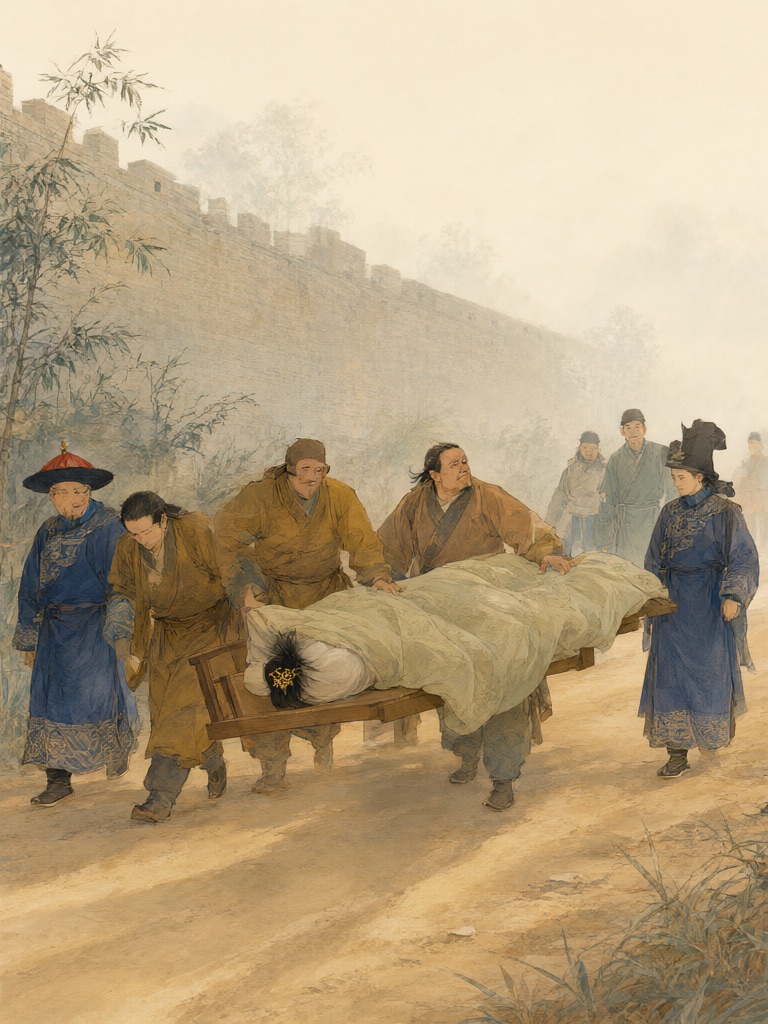
Now, there was a man in the lane named Mao Da, a shiftless good-for-nothing. He had once made advances to Mrs. Wang and been rebuffed, and knowing about her and Su, he meant to catch them in the act and blackmail them. That night he passed her door, gave it a push, found it unbarred, and slipped in. Just as he reached the window, he stepped on something soft, like cotton or silk; he picked it up and found a kerchief wrapped around a woman's shoe. Crouching to listen, he heard Su telling the whole story in detail. Overjoyed, he crept back out. A few nights later he climbed the wall into Yanzhi's house, but not knowing the layout, he blundered up to the old man's room instead. Old Bian peered out of the window and saw a man; from the sound and look of him he knew he had come for his daughter. Furious, he grabbed a knife and rushed straight out. Mao Da panicked and ran. He was about to scramble over the wall when Bian came up close behind; with nowhere to escape, Mao turned and wrenched the knife away. The old woman got up and screamed, Mao couldn't get away, and so he killed the old man. Yanzhi, somewhat recovered, got up only when she heard the uproar. When they brought a light, the old man's skull was split; he could no longer speak, and in a moment he was dead. Beneath the wall they found an embroidered shoe, and the mother saw it was Yanzhi's. She pressed her daughter, and Yanzhi tearfully told her the truth, except that, not having the heart to drag Mrs. Wang into it, she said only that E had come of his own accord.
At daybreak they brought charges before the county. The magistrate arrested E. E was a reserved, tongue-tied young man; at nineteen he was still as bashful as a child in front of strangers. When he was seized, he was frightened out of his wits. In the courtroom he didn't know what to say and could only tremble. This convinced the magistrate all the more that he was guilty, and he had him brutally tortured. Unable to bear the pain, E confessed falsely. He was sent up to the prefecture, where he was beaten just as in the county. Choking with the injustice of it, E longed to confront Yanzhi face to face; but whenever they met she heaped abuse on him, and he would be struck dumb, unable to defend himself. So he was sentenced to death. The case went back and forth through several reviews, and official after official came to the same conclusion.
Later the case was referred to the prefecture of Jinan for review. Lord Wu Nandai was prefect of Jinan at the time. The moment he saw E, he doubted this was a man who could kill, and he secretly sent someone to question him privately and at leisure, so that he could tell his whole story. That made Lord Wu all the surer E had been wronged. He pondered it for several days before opening the hearing. First he asked Yanzhi, "After you made your agreement, did anyone else know of it?" "No one," she answered. "When you saw E, was anyone else there?" Again: "No one." Then he called E up and spoke to him kindly. E said, "I did pass by her door once, but I only saw my old neighbor Mrs. Wang come out with a young girl, and I hurried away. Apart from that, I never said a word." Lord Wu barked at Yanzhi, "You just said no one else was there. So where does this neighbor woman come from?" He made to have her tortured. Frightened, Yanzhi said, "Mrs. Wang was there, but she truly has nothing to do with it."
Lord Wu broke off the hearing and ordered Mrs. Wang arrested. She was brought in a few days later; he kept her from any contact with Yanzhi, put her on trial at once, and asked her straight out, "Who did the killing?" "I don't know," said Mrs. Wang. Lord Wu bluffed her: "Yanzhi has testified that you know all about the murder of old Bian. How can you hide it?" The woman cried out, "That's a lie! The little hussy was pining for a man all on her own. I did talk about matchmaking, but only in jest. She let her lover into the courtyard herself; how would I know anything about it?" Lord Wu questioned her closely, and only then did she tell all the teasing talk from beginning to end. He called Yanzhi up and said angrily, "You said she knew nothing. So why does she now admit she played go-between?" Yanzhi wept. "It's my own wickedness that got my father so cruelly killed. Who knows what year this case will end; I couldn't bear to drag someone else into it too." Lord Wu asked Mrs. Wang, "After you made that joke, whom did you tell?" "No one," she testified. He said angrily, "Husband and wife in bed tell each other everything. How can you say no one?" She testified, "My husband's been away a long time and hasn't come back." "Even so," said Lord Wu, "anyone who plays a joke on another does it to laugh at their foolishness and show off their own cleverness. If you never told a single soul, who were you fooling?" He ordered her ten fingers put in the press. Left with no choice, she confessed: "I told Su."
So Lord Wu released E and arrested Su. When Su arrived, he testified, "I know nothing." Lord Wu said, "A man who beds a wanton woman can't be a decent scholar!" and had him severely tortured. Su testified, "It's true I tricked the girl. But after I lost the shoe I never dared go back. I truly know nothing about the killing." Lord Wu said angrily, "A man who climbs other people's walls will stop at nothing!" and tortured him again. Unable to endure the abuse, Su confessed. The confession was written up and sent to higher authority, and everyone praised Lord Wu's uncanny judgment. The case was as solid as a mountain, and Su could only stretch out his neck and wait for the autumn executions.
But dissolute and unprincipled as he was, Su was a well-known scholar of Shandong. He had heard that the Education Commissioner, Lord Shi Yushan, was the ablest and most upright of officials, and moreover cherished talent and cared for scholars; so he sent him a petition protesting his innocence, written in heart-rending terms. Lord Shi called for the record of his confession and pondered it over and over. Then he struck the table. "This scholar has been wronged!" He applied to the governor and the provincial judge to have the case transferred to him for retrial. He asked Su, "Where did you lose the shoe?" Su testified, "I don't remember. But when I knocked at Mrs. Wang's door, it was still in my sleeve." Lord Shi turned to Mrs. Wang: "Apart from Su Jie, how many lovers do you have?" "None," she testified. Lord Shi said, "How could a wanton woman keep herself to just one man?" She testified, "Su Jie and I have been together since we were children, so I couldn't break it off. Since then it isn't that no one has tried, but I truly never dared go along with them." So he had her name names to prove it. She testified, "Mao Da from our lane made passes at me again and again, and I turned him down every time." Lord Shi said, "How have you suddenly become so chaste and pure?" and ordered her beaten. She kowtowed until her forehead bled, insisting there was no one else, and at last he let her go.
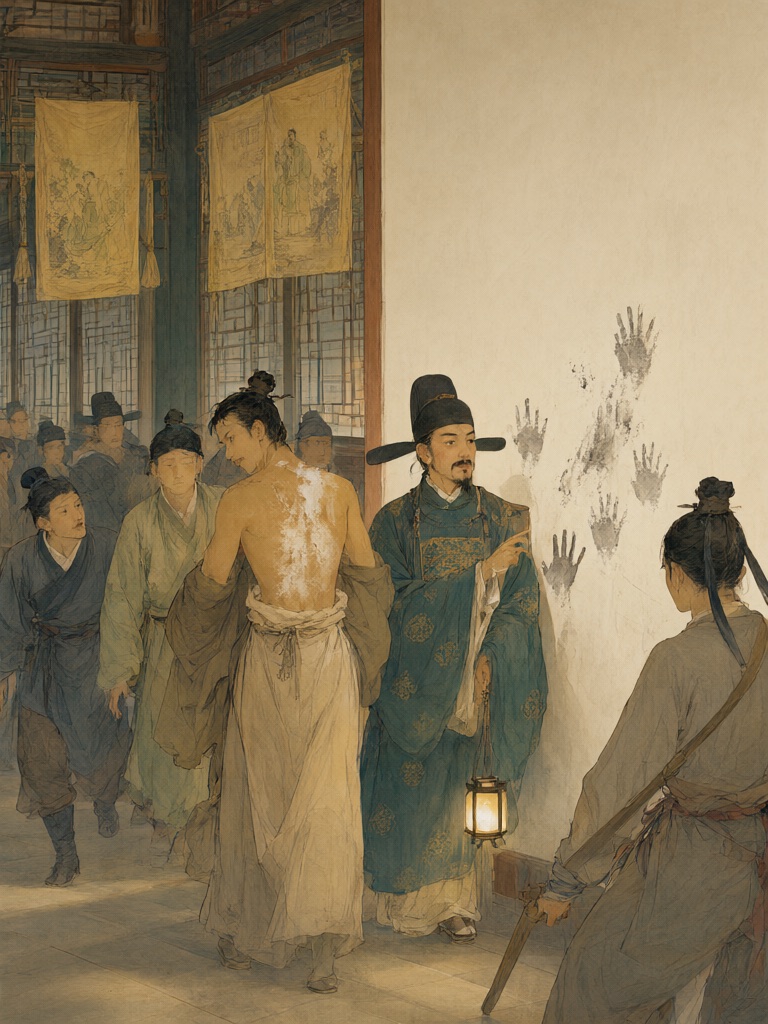
He went on: "With your husband away, didn't anyone ever come around on some pretext?" "Yes," she said. "So-and-so and Such-and-such each came to my house once or twice, on the excuse of lending money or bringing gifts." These two were idlers of the lane who had designs on her but had never acted on them. Lord Shi took down all their names and had them arrested together. When they were all assembled, he went to the Temple of the City God and made them all kneel before the altar. Then he said, "Not long ago a god told me in a dream that the murderer is one of you four or five. You are now before the gods; let no one lie. If you confess of your own accord, you may yet be pardoned; if you lie and are found out, there will be no mercy!" With one voice they all said they had killed no one. Lord Shi had the three instruments of torture laid on the ground, ready to use them on all of them; their hair was bound up, their bodies stripped, and they all cried out together that they were innocent. Lord Shi ordered them released and said, "Since you won't confess, I'll have the spirits point him out." He had the windows of the hall hung with felt and quilts, leaving not the smallest chink; then he bared all the prisoners' backs and drove them into the darkness, first handing them a basin of water and ordering each in turn to wash his hands. He had them tied up along the wall and warned them: "Face the wall and don't move. On the murderer's back, a god will write." After a while he called them out and inspected them, and pointing at Mao Da he said, "This is the real murderer!" What Lord Shi had done was have the wall smeared with lime beforehand, and the water mixed with soot for washing their hands. The murderer, afraid the god would write on him, had pressed his back against the wall and picked up the lime; as he came out, he had covered his back with his hands, leaving smudges of soot. Lord Shi had suspected Mao all along, and now he was certain. Under severe torture, Mao spat out the whole truth.
The verdict read: "Su Jie: He took the road of Pencheng Kuo, whose cleverness got him killed, and earned the name of Dengtu Zi, the notorious lecher. Because he and she had been childhood sweethearts, he fell into a wild duck's longing for the barnyard hen; because one remark leaked out, he got a taste for more and set his sights higher still. Like the lover in the old song he climbed the garden wall and dropped down like a falling bird; passing himself off as Liu Chen at the fairy grotto, he tricked the door into opening. Tugging at a girl's sash and setting the dog barking: even a rat has its hide, so how can a man be so shameless? Climbing for flowers and breaking off branches: what kind of conduct is that for a scholar! Fortunately, hearing the plaintive cries of the sick swallow, he still had some care for the precious jade; pitying the frailty of the drooping willow, he did not run wild like the oriole. In letting the little phoenix out of the net, he still showed something of a scholar's sentiment; but in robbing her of a love-token from beneath her stocking, was he not the worst of rogues? The butterfly crossed the wall, and beyond the window someone was listening; the lotus shed its petal, and it fell to earth without a trace. From one deception grew another; who would believe there was injustice beyond injustice? Heaven sent calamity, and cruel torture brought him to the brink of death; his own sins brimmed over, and his head was all but parted from his body. His climbing over walls and creeping through gaps has indeed disgraced the scholar's cap; yet to die like the plum tree in place of the peach is an injustice hard to dispel. It is fitting that his flogging be somewhat lightened, to offset the suffering he has already endured, and that he be demoted for now to a lower student rank, opening a road for him to reform.
"As for Mao Da: a cunning, rootless rogue, a ruffian of the marketplace. Rebuffed by the neighbor woman, his lust did not die; spying on the wild youth as he entered the lane, a thief's cunning suddenly came to him. Through a door left open to the breeze, he was delighted to find the footprint of Zhang Sheng; asking for water and finding wine, he dreamed of stealing perfume like Han Shou. Little did he know that Heaven would rob him of his wits and the spirits snatch away his soul. Drifting on a raft at random, he sailed straight into the Moon Palace; rowing his fishing boat headlong, he mistook the way to Peach Blossom Spring. So the fire of passion was snuffed out, and the sea of lust rose in waves. When the knife came straight at him, he struck at the rat with no thought for what he might break; a bandit with nowhere to run, he turned like a cornered hare to bite back. He climbed into another man's house hoping only to wear another man's cap; he seized the blade and left the embroidered shoe behind, so that the fish slipped the net and a wild goose was caught in its place. That such a demon should arise on the path of romance! How can such a fiend exist in the land of tenderness? Let his head be struck off forthwith, to gladden the hearts of the people.
"Yanzhi: not yet betrothed, though already of age. An immortal of the Moon Palace should surely have a husband fair as jade; one of the old troupe of the Rainbow Robes need hardly fear lacking a golden house. Yet, stirred by the song of the ospreys, she longed for a mate and wandered into a spring dream; lamenting with the song of the falling plums, she yearned for a good man, and like Qiannü her soul left her body. Because of one entangling thread of feeling, a whole host of demons came crowding. Fighting over a girl's beauty, each feared to lose his 'Rouge'; stirring up birds of prey in a flurry, each borrowed the name of 'Autumn Falcon.' Her lotus-hook foot was stripped of its shoe, and she could hardly keep the fragrance of a single petal; the iron threshold was knocked upon, and the priceless jade was all but shattered. Red beans set into dice: her lovesick longing became the root of disaster; the tall tree felled by the axe: her lovely gifts truly proved a curse! Having guarded herself with modesty, happily she remains a flawless white jade; having fought bitterly from her chains, she may rejoice that a brocade coverlet can yet cover all. We commend her for barring her door, still a lover pure and white; we grant her wish of throwing fruit to the one she chose, a refined romance after all. Let the county magistrate act as your matchmaker." When the case was closed, the verdict was recited far and near.
It was only after Lord Wu's hearing that Yanzhi learned E had been wronged. When they met below the courtroom, she blushed with shame, her eyes full of tears, as if there were words of sorrow and regret she longed to say but could not. E was moved by her devotion and came to love her dearly; yet he also thought of her low birth, and of how she had appeared in court day after day, stared at and pointed at by thousands, and he feared that marrying her would make him a laughingstock. Day and night he turned it over and could not make up his mind. Only when the verdict came down did he settle at ease. The county magistrate sent the betrothal gifts on his behalf and provided the wedding musicians.
The chronicler comments: "How grave a thing it is! In hearing a case one cannot be too careful! Even if one can see that the plum standing in for another was wronged, who would think that the peach that died in its place was wronged as well? Yet however murky a matter may be, there is always a gap somewhere; and without careful thought and close inquiry, it cannot be found. Alas! People all admire the wise man's brilliance in judging cases, without knowing how hard the good craftsman labors in his mind. Those in this world who sit above the people pass their days over the chessboard and leave their offices for silk quilts, and will not spend the least thought on the lot of those below or the hardships of the people. When the drum sounds and the court opens, they sit loftily on high, and those who clamor for justice they simply silence with shackles. Small wonder so many grievances lie buried beneath the upturned bowl!"
Master Yushan was my teacher. When he first took notice of me, I was still a boy. I saw for myself how he encouraged and promoted scholars, earnestly, as if afraid he could never do enough; and if a scholar suffered the slightest injustice, he would go out of his way to shield him, never willing to throw his weight around in the schools to curry favor with the powerful. He was truly a guardian of the Sage's teaching, not merely a great master of his age whose grading never wronged a scholar. And his love of talent, as dear to him as life itself, was far beyond anything the education commissioners of later times, merely going through the motions, could match. Once a well-known scholar sitting the examination wrote an essay on the theme "Treasures arise from it," but mistakenly placed the treasures "beneath the water." Only after he had copied out his paper did he realize, and he was sure he would be failed. So he wrote a song: "The treasure lies among the hills, / but I took it for the water's side. / On the mountaintop a crystal palace rises; / coral grows on the peaks, / pearls hang from the treetops. / This time the boatman falls off the cliff and dies! / I appeal to Heaven above: / leave me a little stub, to show my friends." When the Master came to this in his reading, he wrote a reply to the same tune: "The treasure should be the mountain's boast, / yet suddenly it turns up on the shore. / The woodcutter rambles in a fisherman's words. / The theme is off, / but the writing is fine; / how could I rank it below the rest? / I've seen men afraid of heights when they climb; / but whoever saw a good swimmer drown?" This, too, is a glimpse of his refinement, and one instance of how he cherished talent.