Xiao'e was of the Xie family, a native of Yuzhang and the daughter of a travelling merchant. She lost her mother at eight, and was married to Duan Juzhen, a gallant of Liyang. Juzhen was high-spirited and set great store by honour, and his friends were all bold and outstanding men. Xiao'e's father had amassed a great fortune, though he kept his name hidden among ordinary traders, and he often shipped goods up and down the rivers and lakes in the same boat as his son-in-law Duan. When Xiao'e was fourteen and had only just come of age, her father and her husband were both murdered by bandits, who carried off all their gold and silk. Duan's brothers, Xie's nephews and several dozen servants were all thrown into the river. Xiao'e herself, her chest wounded and her leg broken, was left drifting in the water; she was picked up by another boat and came back to life after a night. From then on she wandered from place to place begging for food, until she came to Shangyuan county and took shelter in the quarters of the nun Jingwu at Miaoguo Temple. When her father first died, Xiao'e dreamed that he said to her, "The one who killed me is 'monkey in the cart; gate, cart, grass.'" A few days later she dreamed that her husband said to her, "The one who killed me is 'running through the grain; one day, man.'" Xiao'e could not work it out. She often wrote the words down and sought out clever people everywhere to decipher them, but year after year no one could.
In the spring of the eighth year of Yuanhe, I left my post as an aide in Jiangxi and went east downriver in a small boat. While I was lying over at Jianye I climbed the tower of Waguan Temple. A monk there named Qiwu, a man who honoured worth and loved learning, was a friend of mine. He told me, "There's a widow called Xiao'e who often comes to the temple. She has shown me a riddle of twelve characters, and I can't make it out." At once I asked him to write it on paper, and leaning on the railing I traced the characters in the air and pondered in silence. Before the other guests had grown tired of waiting, I had grasped its meaning. I had a temple boy run and fetch Xiao'e, and asked her the story. She sobbed for a long while before she spoke. "My father and my husband were both killed by bandits. Afterwards I dreamed my father told me, 'The one who killed me is "monkey in the cart; gate, cart, grass."' And I dreamed my husband told me, 'The one who killed me is "running through the grain; one day, man."' All these years no one has understood it." I said, "If that is so, I have it clear. The man who killed your father is Shen Lan, and the man who killed your husband is Shen Chun. 'Monkey in the cart': take one stroke off the top and one off the bottom of 車, cart, and you have 申, Shen; and Shen, in the cycle of years, belongs to the monkey — so, 'monkey in the cart.' Grass on top with a gate beneath, and 東 inside the gate: that is 蘭, Lan. Then 'running through the grain' — passing right through the field 田 — is also 申, Shen. And 'one day, man': add a stroke above 夫, man, put 日, day, beneath, and you get 春, Chun. The man who killed your father is Shen Lan, the man who killed your husband is Shen Chun — it could not be plainer." Xiao'e wept bitterly and bowed to me again and again. She wrote the four characters Shen Lan, Shen Chun inside her clothes and vowed to track down and kill the two bandits to avenge her wrong. Then she asked my name, office and family, and left in tears.
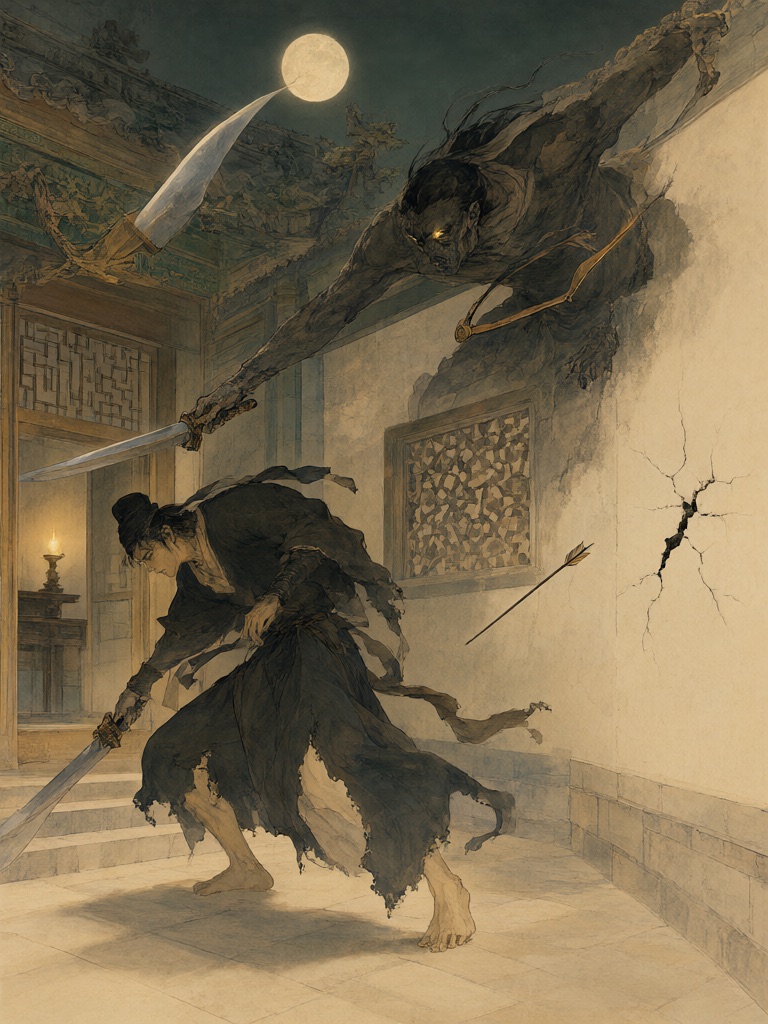
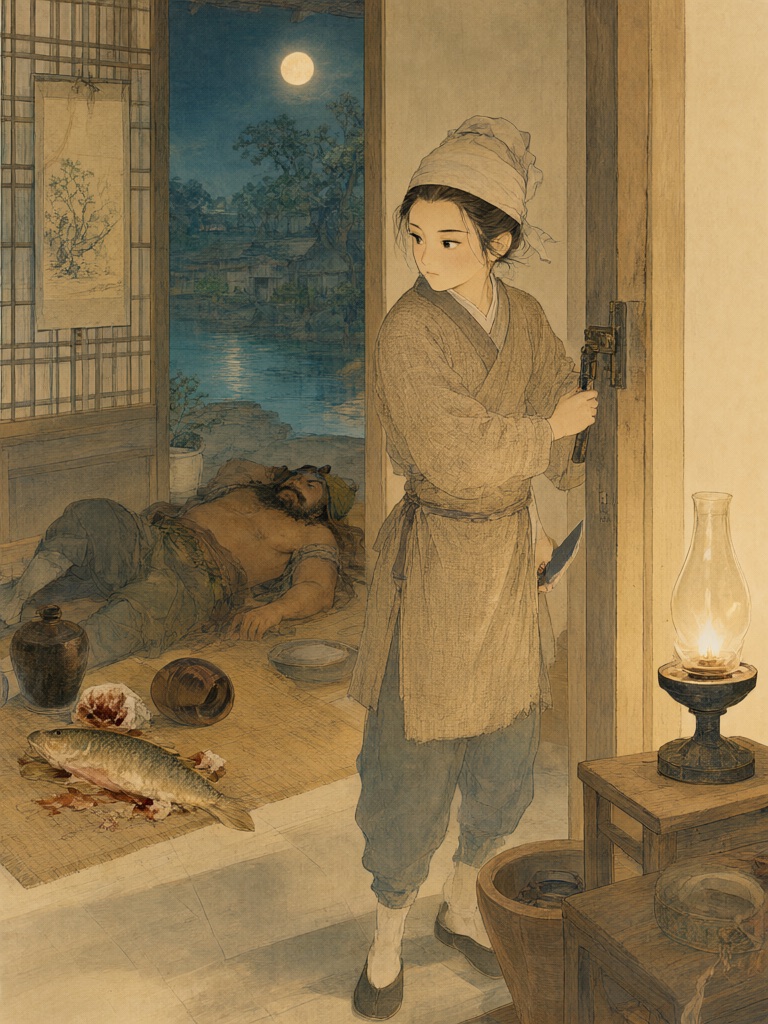
After that Xiao'e put on men's clothes and hired herself out as a labourer along the rivers and lakes. After a year or so she came to Xunyang prefecture, where she saw a paper notice on a bamboo door saying a hired hand was wanted. Xiao'e went to the door to answer it. When she asked who the master was, it was Shen Lan. Lan took her home. Seething inside but meek on the surface, she waited on him and won his trust and affection, until every coin and bolt of silk that came in or went out passed through her hands. More than two years went by, and Lan never discovered she was a woman. All the Xie family's gold, jewels, brocades, clothes and household things had been carried off to Lan's house, and whenever Xiao'e handled one of those old things she could not help weeping in secret for a long while. Lan and Chun were cousins of the same clan. Chun's family lived at Lone Tree Creek on the north bank of the Great River, and he and Lan were always back and forth together. The two of them would go off for a month at a time and come back with plenty of plunder. Each time they left Xiao'e to keep house with Lan's wife, Madam Liang, and gave her wine, meat and clothing in abundance. One day Chun came to Lan's with a big carp and some wine, and Xiao'e sighed to herself, "Master Li's insight was keen and profound, and everything has matched the words of the dreams. Heaven opened his mind; my purpose is about to be fulfilled." That night Lan and Chun gathered their band of thieves, who all came and drank heavily. When the ruffians had gone, Chun lay dead drunk in the inner room, and Lan, too, was sleeping out in the courtyard. Xiao'e quietly locked Chun in the inner room, drew her knife and first cut off Lan's head, then raised a cry that brought the neighbours running. Chun was seized inside, Lan lay dead outside, and the loot and goods recovered were worth some ten million. Lan and Chun had had several dozen accomplices; Xiao'e had secretly memorised their names, and every one of them was arrested and executed. The prefect of Xunyang at the time, Lord Zhang, admired Xiao'e's loyalty and resolve and reported her to the surveillance commissioner for an official commendation, and so she escaped the death penalty.
In the summer of the twelfth year of Yuanhe, having finished avenging her father and her husband, Xiao'e returned to her home village to see her kin. The great families of the district vied to ask for her hand, but she had vowed in her heart never to marry again. She cut off her hair, put on a coarse robe, and went to Mount Niutou to seek the Way, taking the nun Jiang, a master of the monastic rule, as her teacher. Xiao'e was firm of purpose and austere in practice: she pounded rice in the frost and gathered firewood in the rain, and never spared her strength. In the fourth month of the thirteenth year she at last received the full precepts at Kaiyuan Temple in Sizhou, and took Xiao'e itself as her name in religion, so as never to forget where she came from.
In the fifth month of that summer I was returning to Chang'an, and my route took me along the banks of the Si. I stopped at Shanyi Temple to pay my respects to the venerable nun Lingcao, and saw several dozen newly ordained nuns, heads cleanly shaven and fresh capes on their shoulders, grave and composed, standing in attendance on either side of their teacher. One of them asked the teacher, "Isn't this gentleman Assistant Magistrate Li of Hongzhou, the twenty-third son?" "It is," said the teacher. The nun said, "That I was able to avenge my family and wipe out the wrong and the shame, I owe to the Assistant Magistrate's kindness." She looked at me and wept. I did not know her, and asked what she meant. The nun told her teacher, "My name is Xiao'e. I'm the widow who was begging for food not long ago. The Assistant Magistrate worked out for me the names of the two bandits, Shen Lan and Shen Chun — don't you remember, sir?" I said, "I didn't recognise you at first, but now I do." Weeping, Xiao'e then wrote out in full how she had kept the names of Shen Lan and Shen Chun, avenged her father and husband and fulfilled her vow, and all the hardships she had gone through from beginning to end. She also said to me, "The day will come when I repay your kindness, sir." Could those be empty words?
Alas! That I could make out the names of the two bandits, and that Xiao'e could carry her vengeance for her father and husband through to the end, shows plainly that the ways of the spirits are not blind. Xiao'e was sincere in manner and deep in speech, quick-witted, upright and plain. She had burned her fingers in devotion, she walked with a limp, and she had vowed to seek true suchness. Since entering religion she wore no silk or floss, took no salt or curds with her meals, and spoke of nothing but the monastic rule and the principles of Chan. A few days later she told me she was going back to Mount Niutou; she set off in a small boat on the Huai to wander the south like a drifting cloud, and I never met her again. A gentleman has said: "To keep her vow without wavering and avenge her father and husband — that is constancy. To live among hired labourers without anyone knowing she was a woman — that is chastity. A woman's conduct consists in nothing but chastity and constancy, and one who can preserve both from beginning to end, as Xiao'e did, is enough to warn every heart in the world that defies the Way and overturns the moral order, and enough to encourage the constancy of every faithful husband and filial wife." I have set out these events in detail and brought to light the hidden words, which tallied secretly with the unseen powers and accord with the human heart. To know of goodness and leave it unrecorded is not in the spirit of the Spring and Autumn Annals; therefore I have written this account to honour her.