Xiang Gao, styled Chudan, was a man of Taiyuan. He and his half-brother Xiang Sheng, the son of a concubine, were as devoted as brothers could be. Sheng was in love with a courtesan named Bosi; the two had sworn to marry and sealed the vow with blood from their arms, but her madam asked so extravagant a price that the match could not be made. Then the madam herself decided to leave the trade and wanted to settle Bosi first. A certain young master Zhuang, long fond of Bosi, offered to buy her freedom and take her as his concubine. Bosi said to the madam, "Since we both want to escape this misery together, it's like climbing out of hell into heaven. If I go off to be someone's concubine, how much better off am I? If you'll let me have my wish, young Xiang is the one." The madam agreed and passed the message on to Sheng. Sheng, a widower who had not remarried, was overjoyed; he spent everything he had on betrothal gifts and brought Bosi home. When Zhuang heard of it, he was furious that his favorite had been taken from him, and when he happened upon Sheng on the road, he heaped abuse on him. Sheng would not take it, so Zhuang set his servants on him; they beat him with broken whip-handles until he was nearly dead, and then left. Gao heard and ran to him, but his brother was already dead. Overcome with grief and rage, Gao filed a complaint at the prefecture. Zhuang spread bribes far and wide, so that Gao's case never got a fair hearing. His fury knotted inside him with nowhere to turn, and he thought only of ambushing Zhuang on the road and stabbing him to death. Every day he hid a sharp blade in his clothes and lay in wait in the brush beside a mountain path. As time went on, word of his plot leaked out. Zhuang learned of it and went out only under heavy guard; hearing that a man of Fenzhou named Jiao Tong was brave and a fine archer, he hired him at a high price as his bodyguard. Gao had no way to strike, yet still he kept watch day after day.
One day, as he lay in ambush, a sudden storm broke and drenched him from head to foot, and he shivered miserably with cold. Then a fierce wind blew from every side, hail followed, and all at once his body went numb, past feeling pain or itch. On the ridge stood an old shrine to the mountain god, and he forced himself up and ran to it. Inside he found a Taoist priest he knew. The priest had once gone begging in the village, and Gao had always fed him, so the priest knew him. Seeing Gao's clothes soaked through, the priest handed him a cotton robe and said, "Put this on for now." Gao changed, and as he crouched like a dog, enduring the cold, he looked down at himself: fur and hide had sprouted all over him, and he had turned into a tiger. The priest had vanished. Gao was shocked and bitter. Then he thought again: if he could catch his enemy and eat his flesh, this would suit him well enough. He went down the mountain and lay in his old spot, where he saw his own corpse lying in the brush, and only then understood that his former body was dead; still afraid it would end up in the bellies of crows and kites, he kept constant watch over it.
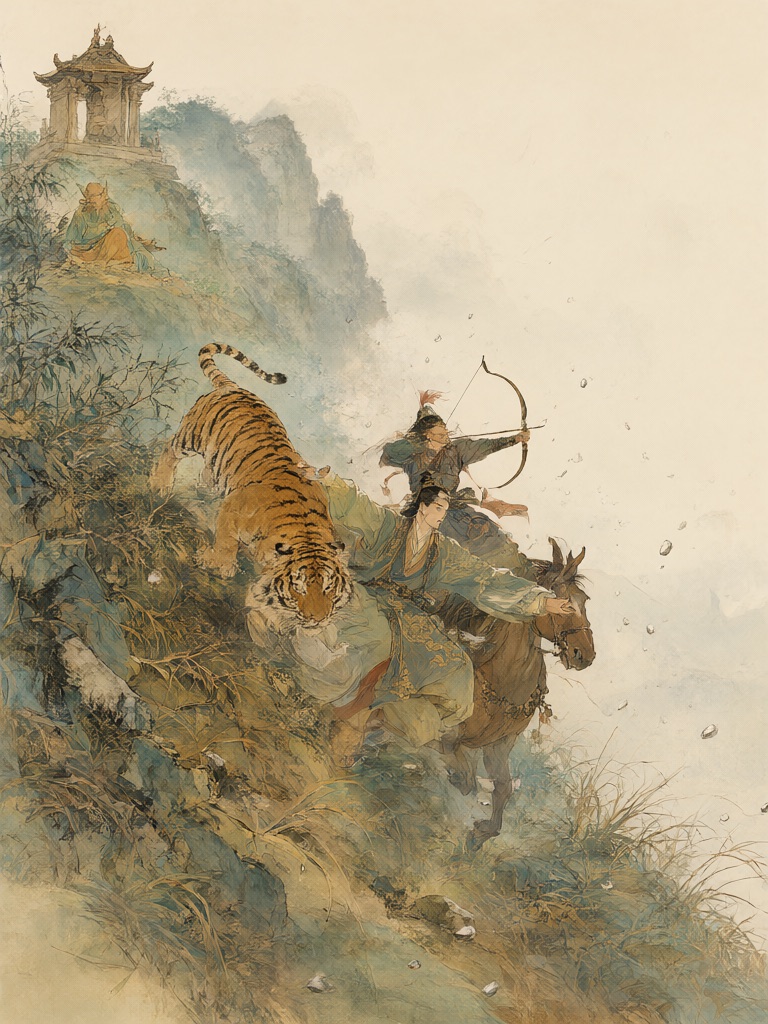
The next day Zhuang at last came by. The tiger burst out, knocked Zhuang off his horse, bit off his head and swallowed it. Jiao Tong wheeled his horse and shot, hitting the tiger in the belly, and it toppled over dead. Gao, lying among the thorns, felt as though he were waking from a dream; it took another night before he could walk, and he dragged himself home, weak and listless. His family, since he had been gone several nights running, had been anxious and puzzled; when they saw him they were overjoyed and crowded round to ask after him. Gao only lay in bed, his tongue too stiff to speak. A little later the news about Zhuang arrived, and they rushed to his bedside to tell him the happy tidings. Then Gao spoke: "That tiger was me." And he told them the whole strange story. From then on it spread far and wide. Zhuang's son, grieving over his father's horrible death, heard it and hated Gao for it, and brought a suit against him. But the magistrate, finding the tale absurd and without evidence, let the matter drop.