Xi Fangping was from Dong'an. His father, Xi Lian, was blunt and simple by nature. He had a feud with a rich man of the village named Yang. Yang died first; several years later, when Lian lay gravely ill, he said to those around him, "That Yang has bribed the underworld bailiffs to beat me." Soon his whole body swelled up red, and he died screaming. Fangping was too grief-stricken to eat. "My father was a simple, honest man," he said, "and now a powerful ghost is bullying him. I'm going down below to fight his case for him." From then on he said not another word; he sat a while, stood a while, looking like an idiot—for his soul had already left his body.
As Xi first went out of the door, he did not know where to go; whenever he saw someone on the road, he asked the way to the city. Before long he entered the city. His father had already been thrown into prison. At the prison gate he saw his father lying under the eaves in a wretched state; looking up and seeing his son, the old man burst into tears. "The jailers have all been bribed," he said. "They beat me day and night—my legs are smashed to pieces!" Xi was furious and cursed the jailers: "If my father is guilty, there are royal laws for that! It's not for dead fiends like you to decide!" Then he went out, took up a brush and wrote a complaint. The city god was holding morning court, so he cried out his grievance and submitted it. Yang took fright and bribed everyone inside and out before he would appear to answer. The city god ruled that Xi's accusation had no evidence and found against him.
With no way left to vent his rage, Xi walked more than a hundred li through the darkness to the prefecture and accused the officials and clerks of corruption before the prefect. Only after half a month's delay did the case get a hearing. The prefect had Xi beaten and sent the case back to the city god for review. Back in the county, Xi suffered every kind of shackle and torture, and his grievance had no outlet. Afraid he would appeal again, the city god sent bailiffs to escort him home. At his door they took their leave. Xi would not go in; he slipped away to the court of the King of the Underworld and accused both the prefect and the city god of cruelty and greed. The King immediately summoned them to face him. The two officials secretly sent trusted men to talk Xi round, offering him a thousand taels. Xi would not listen. A few days later his innkeeper told him, "You've pushed your stubbornness too far. The officials wanted to settle and you refused. Now I hear they've each sent letters to the King. I'm afraid you're in danger." Xi took it for street gossip and did not quite believe it.
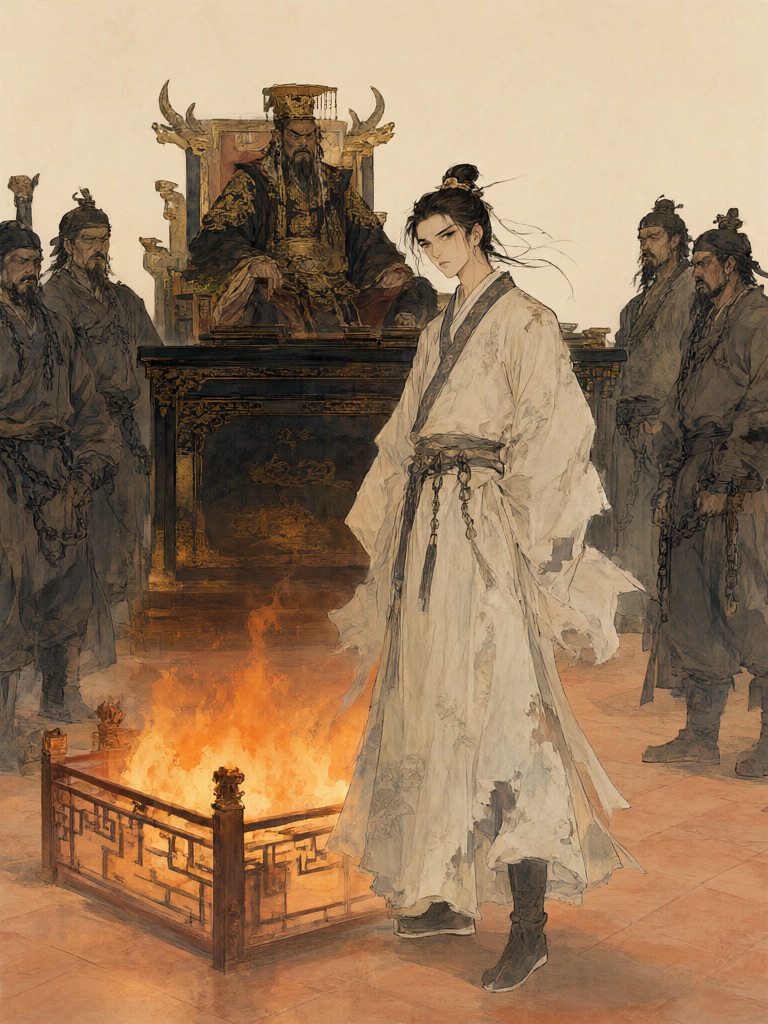
Presently a man in black came to summon him. When he entered the hall, the King was glaring and, without letting him say a word, ordered twenty strokes of the rod. Xi demanded loudly, "What crime have I committed?" The King acted as though he had not heard. As the blows fell, Xi shouted, "I deserve the beating—who told me to have no money?" The King grew angrier still and ordered him put on the fire bed. Two ghosts dragged Xi down; on the east side of the courtyard stood an iron bed with a fierce fire beneath it, its surface glowing red. The ghosts stripped off his clothes, lifted him onto it, and rolled and pressed him back and forth. The pain was unbearable; his flesh and bones were charred black, yet in his agony he could not die. After about two hours a ghost said, "That'll do." They helped him up and made him get off the bed and dress; luckily he could still limp along. Back in the hall, the King asked, "Will you dare sue again?" Xi said, "While this great wrong goes unrighted, my heart will not die. If I said I wouldn't sue, I would be deceiving Your Majesty. I will sue!" The King asked, "And what will you charge?" Xi said, "Everything I have suffered—I will tell all of it."
The King flew into another rage and ordered him sawn in two. The two ghosts dragged him off. There stood an upright post eight or nine feet high, with two wooden boards laid face up on it, smeared top to bottom with clotted blood. Just as they were about to tie him on, someone in the hall shouted "Xi!" and the ghosts marched him back. The King asked again, "Do you still dare sue?" He answered, "I will sue!" The King ordered them to take him and saw him at once. Down below, the ghosts clamped Xi between the two boards and bound him to the post. As the saw came down, he felt the top of his skull slowly splitting open; the pain was beyond enduring, but he bore it without a cry. He heard a ghost say, "What a tough fellow!" The saw rumbled on down and soon reached below his chest. Then he heard another ghost say, "This man is a great filial son and has done no wrong. Angle the saw a little so it doesn't harm his heart." He felt the blade curve as it went down, and the pain doubled. In a moment his body was split in half. When the boards were undone, both halves fell to the ground. The ghosts went up to the hall and reported in loud voices. Word came down to put his body together and bring him in. The two ghosts pushed the halves back together and pulled him along. Xi felt a seam running down his body that hurt as if it would split open again; after half a step he collapsed. One ghost took a silk sash from his waist and handed it to him, saying, "This is my gift to reward your filial devotion." He took it and tied it on, and at once his whole body was strong again, without the least pain. He went up into the hall and prostrated himself. The King asked the same question as before; afraid of more savage torture, Xi answered, "I won't sue." The King ordered him sent back to the world of the living at once. A bailiff led him out of the north gate, pointed out the road home, and turned and left.
Xi reflected that the underworld's courts were even darker than those of the living, but he had no way to bring the matter to the Emperor of Heaven. People said that Erlang of Guankou was a kinsman and favored lord of the Emperor, a god wise and upright; an appeal to him was bound to work. Glad that the two bailiffs had gone, he turned and headed south. As he hurried along, two men caught up with him: "The King suspected you wouldn't go home, and sure enough!" They hauled him back before the King. He expected the King to be angrier than ever and his punishment crueler; instead the King showed no sternness at all and said to him, "Your devotion is truly filial. But I have already cleared your father's name for you. He has been reborn into a rich and noble family—what need is there for all your outcry? Now I'll send you home and grant you an estate worth a thousand taels and a lifespan of a hundred years. Will that satisfy you?" He entered it in the register, stamped it with a great seal, and had Xi see it with his own eyes. Xi thanked him and went down. The ghosts went out with him, and on the road they drove him along, cursing: "Sly villain! Back and forth, again and again, running us ragged! Do it once more and we'll throw you in the great millstone and grind you fine!" Xi glared and shouted, "What do you think you're doing, you ghosts! I can take knives and saws, but I won't take a beating or abuse. Let's go back to the King. If he'll let me go home on my own, I don't need you two escorting me." And he ran back the way they had come. The two ghosts were afraid and coaxed him back with gentle words. Xi deliberately dawdled, stopping to rest by the road every few steps. The ghosts swallowed their anger and dared not say another word. After about half a day they came to a village where a door stood half open; the ghosts led him to sit down with them, and Xi sat on the threshold. Catching him off guard, the two ghosts shoved him through the door.
When the shock had passed, he looked at himself and found he had been reborn as a baby. In his fury he cried and refused the breast, and in three days he was dead. His soul, drifting, never forgot Guankou. He had run some tens of li when a procession appeared, feathered canopies, banners and halberds blocking the road. He crossed the road to avoid it and so blundered into the cortege; the outriders seized him, tied him up and brought him before the carriage. Looking up, he saw a young man in the carriage of splendid bearing, who asked him, "Who are you?" Xi, his grievance still bursting for an outlet, and guessing that this must be a very great lord who might be able to wield his power, poured out the whole story of his sufferings. The young man ordered him untied and told him to follow the carriage. Soon they came to a place where a dozen or so officials stood by the road to greet them, and the man in the carriage spoke with each in turn. Then he pointed to Xi and said to one of them, "This is a man from the world below who was on his way to bring you a complaint. You should judge his case at once." When Xi asked the attendants, he learned that the man in the carriage was the Ninth Prince, son of the Emperor of Heaven, and the one he had given the order to was Erlang himself. Xi looked at Erlang: he was tall and heavily bearded, not at all as the world portrays him. When the Ninth Prince had gone, Xi followed Erlang to a government office, where his father, Yang and the bailiffs were all present. A little later prisoners were brought out of a cage cart: the King of the Underworld, the prefect and the city god. The case was examined in open court, and everything Xi had said proved true. The three officials trembled like cowering rats. Erlang took up a brush and wrote his judgment on the spot; shortly the verdict was passed down for everyone in the case to read.
The verdict read: "It is found concerning the King of the Underworld: holding a royal title and enjoying the Emperor's grace, he ought to have been pure and upright to lead his ministers, not greedy and corrupt to bring scandal on his office. Yet with his tasseled trappings and ceremonial halberds he merely flaunted the dignity of his rank; fierce as a ram and greedy as a wolf, he disgraced the honor of a servant of Heaven. As the axe strikes the chisel and the chisel bites the wood, wives and children were stripped to skin and bone; as the whale swallows the fish and the fish eats the shrimp, the tiny lives of the ant-like people deserve pity. Let the waters of the West River be scooped up to wash out your guts; and let the iron bed by the east wall be fired up—pray, sir, step into the urn yourself.
"The city god and the prefect are father-and-mother officials to the common people, herding the Emperor's flock of cattle and sheep. Though their posts are lowly, the dutiful do not mind bending at the waist; and even under pressure from great officials, men of spirit should hold their necks stiff. Instead they turned their talon hands up and down as suited them, with no thought for the people's poverty, and flaunted their monkey cunning, not even scorning the leanness of a ghost. Taking bribes and bending the law, they are truly beasts with human faces! They should have their marrow scraped and their hair plucked, and be sentenced first to die in the underworld; then they should have their skins stripped and exchanged for hides, and be reborn from the womb as animals.
"As for the bailiffs: being in the ranks of ghosts, they are no longer human. They ought to have practiced virtue in the halls of office, in hope of being reborn in human form; how could they stir up waves in the sea of suffering and pile up sins that fill the sky? Swaggering and overbearing, their dogs' faces wore the frost of midsummer; rampaging and roaring, their tigerish airs blocked every road. They abused their power in the underworld so that all knew the jailer was king; they abetted the cruelties of a benighted official so that everyone feared them like butchers. Let their four limbs be chopped off on the execution ground, and their sinews and bones fished from a cauldron of boiling water. As for Yang: rich and without humanity, cunning and full of deceit. The glitter of his gold covered the earth, so that the hall of the King of the Underworld was nothing but dark mist; the stench of his copper rose to heaven, so that the City of the Wrongly Dead had neither sun nor moon. Even the leftover reek of his money could still command ghosts; its great power could buy even the gods. Let the Yang family's property be confiscated to reward the filial devotion of young Xi. Let them be taken at once to the Eastern Peak for sentence to be carried out."
Then Erlang said to Xi Lian, "In view of your son's filial devotion and righteousness, and your own good and meek nature, you are granted another thirty-six years of life." He sent two men to escort them home. Xi copied out the verdict, and father and son read it together on the way. When they reached home, Xi revived first. He had the family open his father's coffin; the body was stiff and still cold, but after they had waited a whole day it slowly grew warm and came back to life. When they looked for the copied verdict, it was gone. From then on the family grew richer by the day; within three years their good fields stretched across the countryside, while the Yang descendants dwindled and their mansions and lands all passed into Xi's hands. When a villager bought some of those fields, a god appeared in his dream that night and roared at him, "This belongs to the Xi family! How dare you take it!" At first he did not quite believe it; but when he planted and worked it, he harvested not a single measure of grain all year, so he sold it back to Xi. Xi's father died at over ninety.