Wang Xianke of the Tang was the nephew of Liu Zhen, a court official in the Jianzhong era. Earlier, when Xianke's father died, he went with his mother to live with her family. Liu Zhen had a daughter named Wushuang, a few years younger than Xianke. Both were small children who played and romped together on intimate terms, and Liu's wife would often jokingly call Xianke "young Master Wang." So it went for several years, and Liu cared most attentively for his widowed sister and for Xianke. One day his sister fell ill, gravely so, and she called Liu to her and made him promise: "I have one son—you know how I worry for him—and my only regret is that I won't see him married. Wushuang is lovely and clever, and I am very fond of her. Don't let her marry into another family someday; I entrust Xianke to you. If you truly promise me this, I can close my eyes without regret." Liu said, "Sister, you should rest quietly and take care of yourself, and not trouble yourself with other matters." She never recovered.
Xianke escorted her coffin home to Xiang and Deng for burial. When his mourning was over, he reflected on his situation: so alone in the world, he ought to marry and continue the family line. Wushuang must be grown by now—would his uncle, now so high and mighty, abandon the old promise? So he packed his things and went to the capital. Liu Zhen was then a Minister and Commissioner of Taxes, his household resplendent, its gates crowded with officials' caps and carriages. After Xianke paid his respects, he was lodged in the family school among the pupils. The bond between uncle and nephew remained as before, but not a word was said about a match.
Then, through a crack in a window, he glimpsed Wushuang—radiant and lovely, like one of the immortals—and Xianke was wild with longing, terrified only that the marriage would not come about. So he sold off what he had brought, raising several million cash, and gave generous gifts to everyone who served his uncle and aunt, down to the lowliest menials. He also gave dinners again and again, until he was free to come and go even beyond the inner gate. He treated all his cousins living there with respect. When his aunt's birthday came, he bought novelties to present to her, carved rhinoceros horn and jade made into hair ornaments. She was delighted. Ten days later he sent a serving woman to raise the matter of the marriage with her. His aunt said, "That is just what I want. We'll discuss it at once." A few evenings later a maid told Xianke: "The mistress just spoke to the master about the match, and the master said, 'I never promised him anything before.' From the look of it, I'm afraid things may go wrong." Hearing this, Xianke lost all heart and lay awake till dawn, fearing his uncle would reject him; yet he did not dare slacken in serving them.
One day Liu Zhen set off for court, and just as the sun rose he suddenly came galloping back into the house, dripping with sweat and gasping for breath, saying only, "Lock the gate! Lock the gate!" The whole household was terrified, unable to guess why. After a long while he said, "The Jingyuan troops have mutinied. Yao Lingyan has led soldiers into the Hanyuan Hall, the Son of Heaven has fled through the north gate of the park, and all the officials are hurrying to join him. I was worried about my wife and daughter and came back to make arrangements." He hastily summoned Xianke: "Take charge of my household affairs for me, and I will marry Wushuang to you." Hearing this, Xianke bowed his thanks, startled and overjoyed. Liu then loaded twenty packhorses with gold, silver, silks and brocades and said to Xianke, "Change your clothes, take charge of these goods and leave by the Kaiyuan Gate. Find an out-of-the-way inn and settle in. Your aunt, Wushuang and I will leave by the Qixia Gate, circle round the city and join you."
Xianke did as he was told. By sunset he had waited a long time at the inn outside the city, and still they had not come. The city gates had been locked since noon; he gazed south until his eyes ached. So he mounted his dapple-grey and, carrying a torch, rode around the city to the Qixia Gate, but it too was locked. There were several gatekeepers, holding white cudgels, some standing, some sitting. Xianke dismounted and asked calmly, "What has happened in the city to cause all this?" And then, "Who has come out this way today?" A gatekeeper said, "Grand Commandant Zhu has made himself emperor. After noon a man in a double hat, leading four or five women, tried to go out this gate. People in the street all recognised him—they said it was Minister Liu, the Commissioner of Taxes. The gate officer didn't dare let him out. Toward nightfall pursuing horsemen arrived and drove them all off to the north." Xianke burst out sobbing and went back to the inn. Near the end of the third watch, the city gates suddenly opened, torches blazed bright as day, and soldiers with weapons and drawn blades came out calling for the Executioner Commissioner, searching outside the walls for court officials. Xianke abandoned his baggage and horses and fled in terror back to Xiangyang, where he lived in the country for three years.
Later he learned that the capital had been recovered, the court restored and peace returned to the realm, so he went to the capital to seek news of his uncle. In South Xinchang Street, as he sat his horse wavering about where to go, a man suddenly bowed before his horse. Looking closely, he saw it was Saihong, an old servant he had once had. Saihong had been born a servant in the Wang household, but Xianke's uncle had often used him and found him capable, so he had kept him. They clasped hands in tears, and Xianke said to Saihong, "Are my uncle and aunt well?" "They are both at the house in Xinghua Ward," said Saihong. Overjoyed, Xianke said, "I'll go across right now." Saihong said, "I've been freed and am a commoner now, registered as a lodger with a little house of my own, and I deal in silk. It's night already, young master—stay the night at my lodging, and it won't be too late to go together first thing tomorrow." He led Xianke to where he lived and laid out a full meal.
When it grew dark, word came: "Minister Liu accepted office under the usurper; he and his wife have both been executed, and Wushuang has been taken into the palace women's quarters." Xianke wailed at the injustice until he nearly fainted, moving even the neighbours. He said to Saihong, "The world is so vast, yet I look around and have no kin. I don't know where to turn." Then he asked, "Who is left of the old household?" Saihong said, "Only Wushuang's maid Caiping, who is now in the house of Wang Suizhong, General of the Imperial Guard." Xianke said, "I shall surely never see Wushuang again, but if I could see Caiping, I would die content." So he sent in his card and called on Wang Suizhong with the courtesy of a nephew, told him the whole story, and offered to pay a high price to ransom Caiping. Suizhong understood him well, was moved by his story and agreed. Xianke rented a house and lived there with Saihong and Caiping. Saihong would often say, "You're getting older, young master; you ought to seek an official post. Moping like this—how will you pass your days?" Moved by his words, Xianke earnestly confided his situation to Suizhong. Suizhong recommended him to Li Qiyun, Governor of the Capital, and Li, on the strength of Xianke's former rank, made him magistrate of Fuping, in charge of the Changle post station.
Some months passed. Then word came that a palace eunuch was escorting thirty palace women to the imperial tombs to serve as caretakers, and they would stay the night at Changle station. Ten felt-covered carriages drew up and unloaded. Xianke said to Saihong, "I've heard that the palace women chosen for the inner quarters are mostly daughters of official families. I'm afraid Wushuang may be among them. Will you take a look for me?" Saihong said, "There are thousands of palace women—how could it happen to be Wushuang?" Xianke said, "Just go. In human affairs, nothing is certain." So he had Saihong pose as a station clerk and brew tea outside the curtain, and gave him three thousand cash besides. "Stay by the tea things," he instructed, "don't leave them for a moment, and if you see anything, come and tell me at once." Saihong agreed and went. The palace women were all behind the curtain and could not be seen; there was only the noise of their chatter in the night.
Late at night, when all was still, Saihong was washing the cups and tending the fire, not daring to sleep, when suddenly he heard a voice from behind the curtain: "Saihong, Saihong, how did you know I was here? Is the young master well?" Then came sobbing. Saihong said, "The young master is in charge of this station. Today he guessed that you might be here, miss, and sent me to ask after you." The voice said, "I can't talk long. Tomorrow after I've gone, look under the purple quilt in the small room of the northeast building, take the letter there and give it to the young master." With that she went away. Then suddenly there was a great commotion behind the curtain: "One of the palace women has been taken ill! The eunuch wants medicine, quickly!" It was Wushuang.
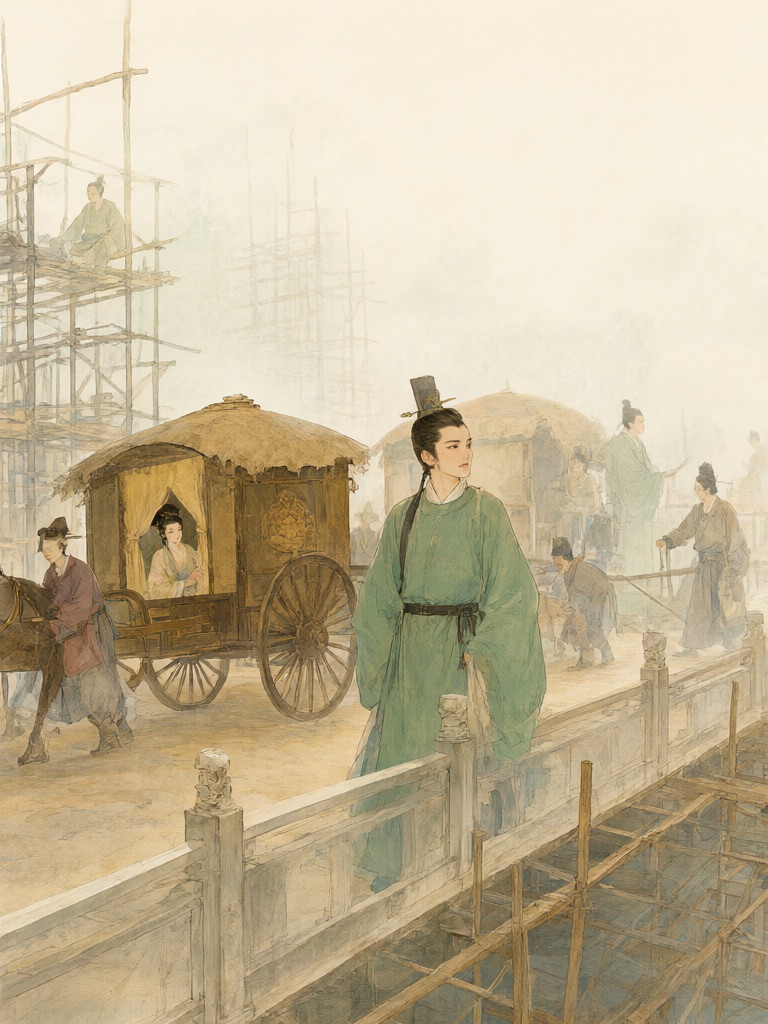
Saihong hurried to tell Xianke, who exclaimed, "How can I get a glimpse of her?" Saihong said, "The Wei Bridge is being repaired. You could pose as an official overseeing the work and stand close by when the carriages cross. If Wushuang recognises you, she's sure to lift the curtain, and you'll get a glimpse." Xianke did as he said. At the third carriage, the curtain did lift, and he saw—it was truly Wushuang. Xianke was overcome with grief, longing and bitterness, more than he could bear.
Saihong found the letter under the quilt in the small room and brought it to Xianke. There were five sheets of flowered notepaper, all in Wushuang's own hand, the words full of sorrow and longing, recounting everything in full. Xianke read it, swallowing his grief in tears: this was farewell forever. At the end the letter said: "I have often heard the imperial envoys say that Constable Gu of Fuping County is a man in this world who truly cares. Could you seek his help now?" Xianke then petitioned the prefecture to be relieved of the post station and return to his regular office. He then sought out Constable Gu and found that he lived in a country cottage. Xianke called on him and met Mr. Gu. Whatever Gu wanted, Xianke made every effort to get for him, and his gifts of silks, jewels and jade were beyond counting. For a whole year he did not speak a word of his request.
When his term was over and he was living idly in the county, Gu suddenly came and said to Xianke, "I, Hong, am a mere soldier, and young besides—what use could I be? You have done everything you could for me, young master, and I can see you have something to ask of me. I am a man who truly cares; moved by your great kindness, I am willing to be ground to dust to repay you." Xianke bowed in tears and told Gu the truth. Gu looked up at the sky and slapped his head several times: "This will be very hard. But I'll try for you—only don't expect it overnight." Xianke bowed: "So long as I may see her while I live, how could I set a time limit?"
Half a year passed with no news. Then one day there was a knock at the door: Gu had sent a letter. It said, "The envoy from Mount Mao has returned. Come here for now." Xianke galloped off and saw Gu, but Gu said not a word. When Xianke asked about the envoy, Gu said only, "Killed. Have some tea." Late that night Gu said to Xianke, "Is there a woman in your household who knows Wushuang by sight?" Xianke named Caiping and had her fetched at once. Gu looked her over carefully, smiling with pleasure: "Let me keep her here for three to five days. You go home for now." Some days later word suddenly spread: "A high-ranking eunuch has come through and dealt with the palace women at the tombs." Xianke felt something was strange and sent Saihong to find out who had been put to death—it was Wushuang. Xianke wailed and sighed: "I had pinned my hopes on Gu, and now she is dead. What can I do?" He wept and sobbed, unable to stop.
Late that night there was an urgent knocking at the door. When he opened it, it was Gu, leading in a bamboo litter. He said to Xianke, "This is Wushuang. She is dead now, but there's still a little warmth over her heart, and the day after tomorrow she'll come back to life. Give her a little broth and medicine, and be sure to keep it quiet and secret." When he had finished, Xianke carried her into a small room and kept watch over her alone. By dawn her whole body was warm. When she saw Xianke, she gave one cry and fainted away again; they nursed her until nightfall before she recovered.
Gu then said, "Lend me Saihong for a moment to dig a pit behind the house." When the pit was fairly deep, Gu drew his blade and cut off Saihong's head into the pit. Xianke was horrified. Gu said, "Don't be afraid, young master. Today I have fully repaid your kindness. Some time ago I heard that a Taoist of Mount Mao had a drug: whoever takes it dies at once and comes back to life three days later. I sent a man specially to obtain one pill. Yesterday I had Caiping pose as an imperial envoy and, declaring Wushuang an accomplice of the rebels, give her this drug and order her to take her own life. When she reached the tombs, I claimed to be a relative and old friend and ransomed her body for a hundred bolts of silk. Every post station along the road has been heavily bribed, so nothing will leak out. The envoy from Mount Mao and the litter-bearers have been dealt with out in the wilds. And for your sake, young master, I shall cut my own throat too. You cannot stay here any longer. Outside the gate are ten bearers, five horses and two hundred bolts of silk. At the fifth watch, take Wushuang and leave; change your names and wander far to escape disaster." With that he raised his blade; Xianke rushed to stop him, but his head had already fallen. So Xianke covered the bodies together. Before dawn they set out, travelled through the lands of Shu and down the Gorges, and settled at Zhugong. When no word from the capital reached them, he quietly took his family back to his estate in Xiang and Deng, where he and Wushuang grew old together, with a houseful of sons and daughters.
Alas! Partings and reunions in human life are many, but few compare with this one; I have always said its like was never seen, past or present. Wushuang was swept up in a time of turmoil and confiscated into the palace, yet Xianke's devotion would not be shaken even by death, and at last he met Gu, whose extraordinary method won her back—at the cost of more than ten people who died innocent. After hardship and flight they were able to return home and lived as husband and wife for fifty years. How remarkable!