A certain governor of Hunan sent a sub-prefect to escort six hundred thousand taels of tax silver to the capital. On the way they were caught in the rain; night fell before they had made their stage, and with nowhere to lodge, they saw an old temple in the distance and went there to stop for the night. At dawn they looked at the silver they were escorting: it had vanished without a trace. Everyone was horrified and amazed, but no one could be found to blame. The sub-prefect went back and reported to the governor, who thought he was lying and was going to have him punished by law. But when the runners were questioned, their stories all agreed. The governor ordered him to go back to the place and search for clues. In front of the temple he saw a blind man of strange appearance, whose own sign read: “I can read the secrets of the heart.” So he asked him to tell his fortune. The blind man said, “You're the one who lost the silver.” “I am,” said the sub-prefect, and poured out his troubles. The blind man asked for a sedan chair and said, “Just follow me and you'll find out for yourself.” The sub-prefect did as he said, and the officers and runners all followed. The blind man said, “East”—and they went east. The blind man said, “North”—and they went north. After five days in all they entered deep mountains, and suddenly saw a walled city, its streets thronged with people. They entered the city and walked for some time, then the blind man said, “Stop.” He got down from the chair and pointed south: “You'll see a tall gateway facing west. Knock and ask for yourself.” And with a bow of his clasped hands, he went off.
The sub-prefect did as he was told and indeed found a tall gateway, and made his way in. A man came out dressed in the clothes and cap of Han times, who did not give his name. The sub-prefect explained why he had come, and the man said, “Please stay a few days, and I'll take you to see the one in charge.” He led him in, lodged him alone in a separate place, and supplied him with food and drink. In his idle hours the sub-prefect went for walks, and behind the mansion he came upon a garden pavilion and went in to explore. Old pines shaded out the sun, and fine grass lay like felt. After winding past several galleries and pavilions he came to another tall pavilion, climbed the steps and went in—and saw several human skins hanging on the wall, every feature of the face intact, giving off a rank stench. His hair stood on end, and he hurried back to his room. He reckoned his hide would be left in this strange land and that he had no hope of living. But then he reflected that whether he went forward or back he was a dead man, so he might as well let things take their course.
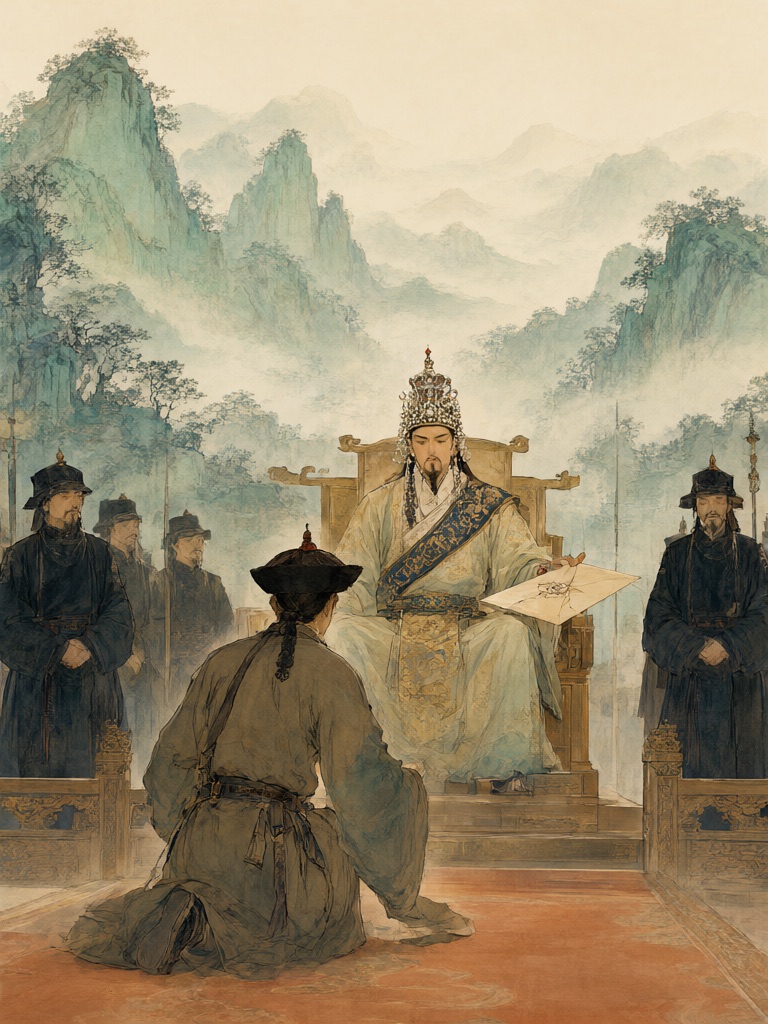
The next day the man in the Han cap came to fetch him and said, “Today you may have your audience.” The sub-prefect said yes, yes. The man rode a spirited horse at great speed, and the sub-prefect ran on foot to keep up. Soon they came to a gate like that of a viceroy's headquarters, with men in black lined up on either side, stern and imposing. The man in the Han cap dismounted and led him in. Through another gate he saw a king wearing a pearl crown and an embroidered sash, seated facing south. The sub-prefect hurried forward and prostrated himself. The king asked, “Are you the officer from Hunan escorting the silver?” The sub-prefect said he was. The king said, “The silver is all here. Such a trifling sum—it would be no bad thing if your governor made me a generous present of it.” The sub-prefect wept and pleaded, “My deadline has passed. When I go back I'm sure to be punished. What proof can I offer in my report?” The king said, “That's not difficult.” He handed him a large envelope and said, “Answer him with this, and you'll be safe.” He also sent a strongman to escort him. The sub-prefect, cowed into silence, dared not argue; he took the envelope and went back.
The mountains, rivers and roads were none of them the ones he had passed on the way there. Once he was out of the mountains, his escort left him. A few days later he reached Changsha and respectfully reported to the governor. The governor, all the more convinced that he was lying, flew into a rage, would hear no explanation, and ordered his attendants to tie him up at once. The sub-prefect undid his bundle and brought out the envelope. The governor opened it, and before he had finished reading, his face turned the colour of ashes. He ordered the man untied, and said only, “The silver is a small matter. You may go for now.” Then he hurriedly sent orders to his subordinate officials to find some way of making up the sum and sending it on. A few days later the governor fell ill, and soon afterwards he died. Before all this, the governor had been sleeping with his favourite concubine, and when they woke, all the concubine's hair was gone. The whole yamen was alarmed and baffled, and no one could guess how it had happened. It was her hair that had been in the envelope. With it was a letter that said: “You rose from county magistrate and prefect to the highest rank a subject can hold. Your bribe-taking and greed are past counting. The six hundred thousand taels have been received and checked into our treasury. You shall open your own greedy purse and make up the original sum. The escorting officer is innocent and shall not be punished. Taking your concubine's hair the other day was a small warning. If you do not obey these instructions, sooner or later we will take your head. The concubine's hair is enclosed, as proof.” Only after the governor's death did his household let the letter be known. Later his subordinates sent men to look for the place, but there was nothing but range upon range of cliffs and sheer gorges, and no path at all.