During the Dali reign of the Tang, there was a young man named Cui. His father was a high official and on close terms with a lord of the first rank, the greatest hero of his age. Cui was then serving in the Qianniu imperial guard, and his father sent him to call on the lord, who was ill.
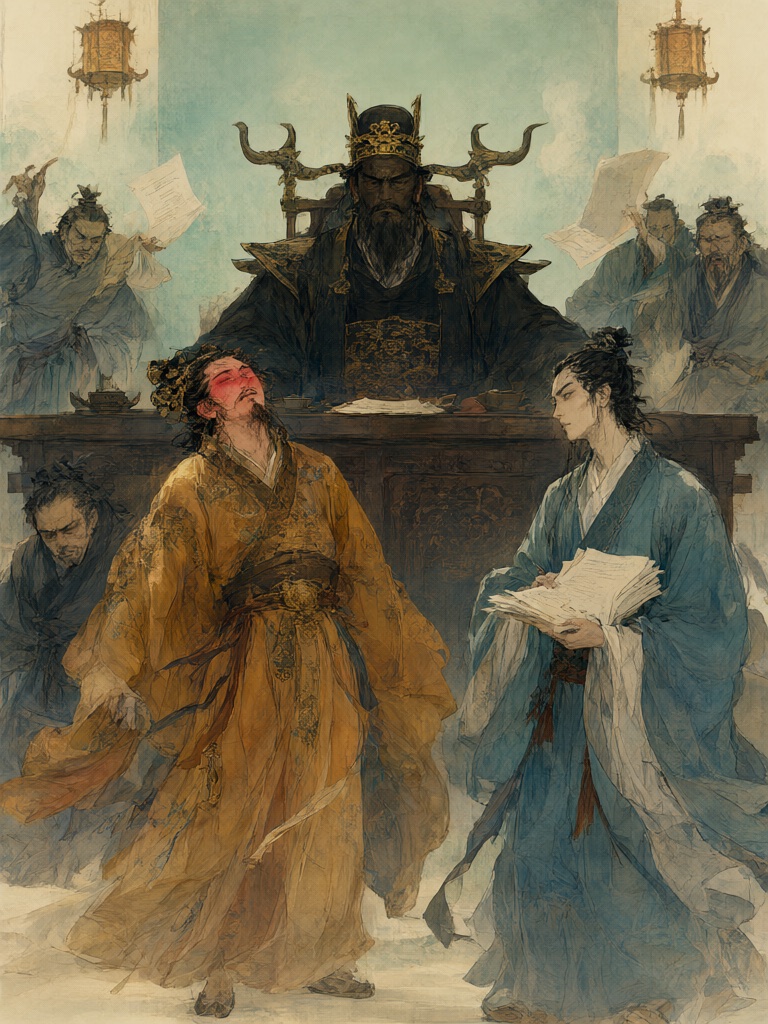
Cui was young, with a face like jade; he was proud and reserved by nature, calm in his bearing and refined in his speech. The lord had his concubines roll up the curtain and called Cui into the inner room. Cui bowed and delivered his father's message, and the lord, delighted and taken with him, bade him sit and talk. Three singing girls, each the greatest beauty of her day, stood before them; they filled golden bowls with crimson peaches, split them open, poured sweet cream over them and served them. The lord told the girl in red silk to offer a bowl to Cui. Being young and shy in front of the girls, Cui would not eat. The lord then had the girl in red silk feed him with a spoon, and Cui had no choice but to eat. The girl smiled at him. Cui then took his leave. The lord said, "When you have time, young sir, you must come and visit again. Don't keep away from an old man." And he had the girl in red silk see him out of the courtyard.
As Cui looked back, the girl held up three fingers, then turned her palm over three times, and finally pointed to the small mirror on her breast. "Remember," she said, and nothing more.
Cui went home and passed on the lord's message. Back in his study, he was lost and dazed; he spoke less, his face grew wan, he sat staring in a trance, forgetting even to eat, and only chanted a poem: "By chance I strayed to the top of Mount Penglai, / Where a jade maiden in bright pendants turned her starry eyes. / Behind the half-closed vermilion door, the deep-palace moon / Must shine on a snow-white beauty's sorrow." No one around him could make out what he meant.
The household had a Kunlun slave named Mo Le, who looked his young master over and said, "What is weighing on your heart, that you brood like this without end? Why not tell your old servant?" Cui said, "What would the likes of you know, prying into the affairs of my heart?" Mo Le said, "Just tell me. I'll untangle it for you; near or far, I can bring it about." Startled by such strange words, Cui told him everything. Mo Le said, "Is that all? A small matter. Why didn't you say so sooner, instead of tormenting yourself?" Cui then explained the silent riddle, and Mo Le said, "What's so hard about that? Three fingers raised: the lord's house has ten courtyards of singing girls, and hers is the third. The palm turned three times: fifteen fingers, for the fifteenth day of the month. The little mirror on her breast: on the night of the fifteenth the moon is round as a mirror. She's telling you to come then." Cui was beside himself with joy and said to Mo Le, "What plan can get me to her and ease this knot in my heart?" Mo Le laughed. "The night after next is the fifteenth. Fetch me two bolts of deep-blue silk, and I'll make you a close-fitting suit. The lord keeps a fierce dog guarding the gate of the singers' courtyard. No ordinary person may go in; whoever does is mauled to death. It is as watchful as a spirit and as savage as a tiger, one of the dogs of Meng Hai of Caozhou. In all the world, no one but this old slave can kill it. Tonight I'll go and club it to death for you." Cui feasted him with wine and meat. At the third watch, Mo Le set off with a chain-hammer. In the time it takes to eat a meal he was back. "The dog is dead," he said. "Nothing stands in the way now."
That night, at the third watch, Mo Le dressed Cui in the dark-blue suit, took him on his back, and leapt over ten walls, one after another, into the singers' courtyard, stopping at the third door. The embroidered door was not barred; a golden lamp glowed faintly, and they heard only the girl sighing long as she sat, as if waiting for someone. Her jade hair-rings had just slipped loose, her rosy face had only just softened; a jade beauty in her grief, she had lost her bloom, and her pearl-like sorrow only glistened the brighter. She was chanting a poem: "In the deep grotto the oriole cries, resenting her Master Ruan, / Who stole beneath the flowers to loosen her pearl pendants. / The blue clouds drift apart, and no letters come; / In vain I lean on my jade flute, grieving for the phoenix." The guards were all asleep, and all around lay utterly still. Cui gently lifted the curtain and went in. It was a long while before she made sure it was him. She sprang down from the couch and took his hands. "I knew you were quick-witted and would read my meaning in silence. That's why I spoke with my hands. But what magic do you have, that you could get in here?" Cui told her all about Mo Le's plan and how he had been carried in. "Where is Mo Le?" she asked. "Just outside the curtain." She called him in and poured him wine in a golden bowl.
The girl said to Cui, "My family was wealthy; we lived in Shuofang. My master, who holds a general's banner, forced me to become one of his concubines. I could not bring myself to die, so I go on living as best I can. My face may be powdered, but my heart is knotted with grief. Though I lift jade chopsticks to fine dishes, though golden censers waft their incense, though behind cloud-painted screens I am brought silks and gauzes every day and sleep among pearls and kingfisher feathers under embroidered quilts, none of it is what I want. It is like being in shackles. Since your worthy servant has such magic, why not free me from this prison? Once my wish is granted, I would die without regret. I ask to be your servant and wait upon you. What do you think, my lord?" Cui grew grave and said nothing. Mo Le said, "If the lady is so determined, this too is a small matter." She was overjoyed.
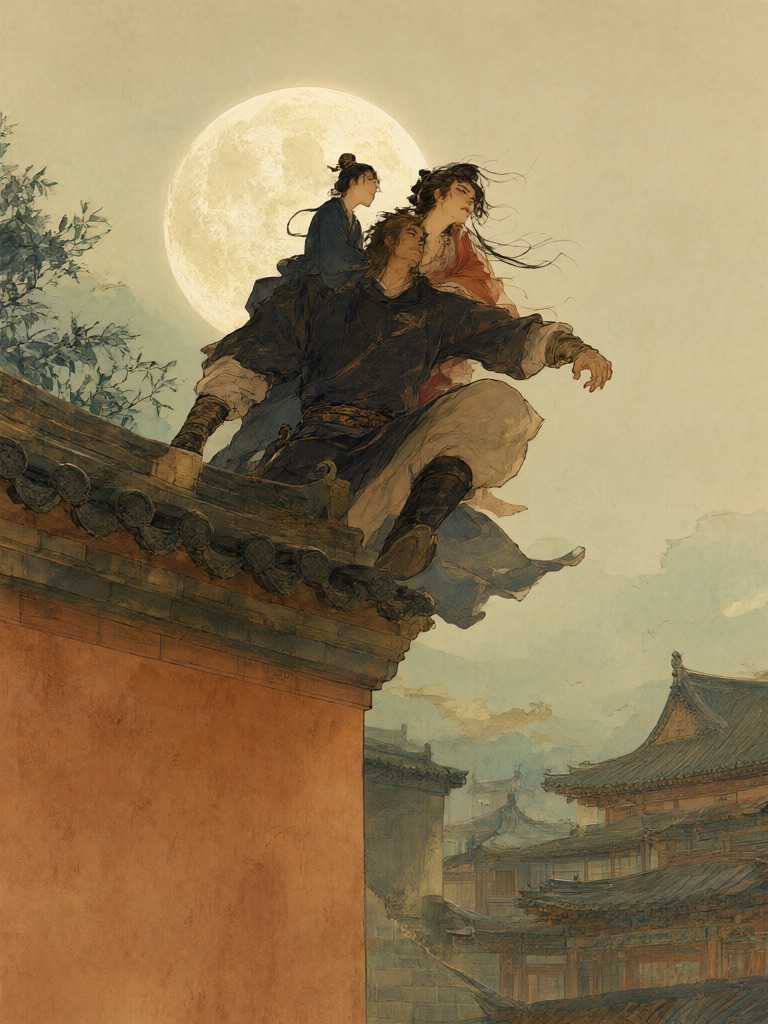
Mo Le first carried out her bundles and dressing cases for her, making three trips. Then, saying he feared dawn was near, he took Cui and the girl on his back and flew out over more than ten steep walls. Not one of the lord's guards noticed a thing. They returned to the study and hid her there.
Only at daybreak did the lord's household discover what had happened. Seeing too that the dog was dead, the lord was badly shaken. "The gates and walls of my house have always been deep and secure, and the locks are strict. Whoever did this seems to have flown; there's not a trace. It must have been some knight-errant who carried her off. Make no noise about it, or it will only bring disaster on us."
The girl hid in Cui's house for two years. Then, in the flower season, she rode out in a small carriage to Qujiang, where someone from the lord's household secretly recognized her and reported it to the lord. Puzzled, the lord summoned Cui and questioned him. Cui was afraid and dared not hide anything; he told the whole story in detail, and that it was the slave Mo Le who had carried her off. The lord said, "The girl's offense is grave, but she has served you for over a year now, so I won't ask who was right or wrong. But that slave, I must rid the world of him." He ordered fifty armored soldiers, weapons in hand, to surround Cui's courtyard and seize Mo Le. Mo Le, dagger in hand, flew out over the high wall, quick as the flick of a wing, swift as a hawk. Arrows rained down on him, but not one struck. In the blink of an eye, no one knew where he had gone.
The Cui household was thrown into alarm. Afterward the lord, regretting it and afraid, kept many house servants armed with swords and halberds guarding him every night, and only stopped after a full year.
More than ten years later, someone from the Cui household saw Mo Le selling medicines in the Luoyang market, looking exactly as he had before.