Jade trees before the hall, like the sons of the Xie clan; beneath the redbud blossoms, the three Tian brothers. When brothers live in harmony, like ocarina and flute in tune, their parents' hearts rejoice. How many quarrel over wealth and fight over property! Born of one root, why torment each other so? The snipe and the clam locked in struggle, drooling in vain, only let the fisherman take the prize.
This lyric is set to the tune "West River Moon," and it urges brothers to live in harmony.
Now, the scriptures of the Three Teachings all teach people to do good. The Confucians have the Thirteen Classics, the Six Classics, the Five Classics; the Buddhists have all the sutras of the Great Canon; the Daoists have the Zhuangzi, the Liezi and all the books of their canon—chests full, desks piled high, thousands upon thousands of words, and to my mind they are all superfluous. As I see it, to be a good person you need only a two-word scripture: "filial and fraternal." And of those two words, you need only grasp one: "filial." If you are truly devoted to your parents, then whatever your parents love, you love too; whatever they respect, you respect too. How much more so with brothers, who share the same blood like branches of one tree—if you think of your parents, how could you fail to live in harmony? As for family property and land, it was all earned by your parents—why divide it into yours and mine? Why haggle over rich fields and poor? If you had been born into a poor family and inherited not a cent, you would have to roll up your sleeves and struggle to make a living. Yet with fields and land handed to them ready-made, people still fight for more and complain of getting less, and at every turn claim their parents played favorites and the shares were unfair. Down in the Nine Springs, the parents' hearts must be troubled. Is that how a filial son behaves? So the ancients said it well:
Brothers are hard to come by; land is easy to come by.
Why are brothers hard to come by? In this life, no one is closer to us than our parents; but by the time they bore us they were already grown, and how could they stay with us all the way? We can share at most half a lifetime with them. As for the one we love most, our spouse, growing old together is about as long-lasting as it gets; yet before the wedding, you were a Zhang and I a Li, different families, different gates, and the years of childhood are missing. Only brothers are born into one family and keep each other company from childhood to old age; they plan together when there is trouble and rescue each other in hardship, truly like hands and feet—what a bond! Good fields and fine property can be lost today and earned back tomorrow; but lose a brother, and it is like cutting off a hand or breaking a foot, a lifelong loss. Put that way, aren't brothers hard to come by and land easy? If you ruin the bond between brothers over land, you'd be better off a poor man with nothing at all to inherit—that would be cleaner, and spare you a great deal of quarreling and gossip.
Now I shall tell a story of our own dynasty, called "Magistrate Teng Settles an Estate with a Ghost." This story urges people to value duty above wealth and never forget the two-word scripture "filial and fraternal." Whether you listeners have brothers or not is none of my business; each of you search your own heart, learn to be good, and behave well. As the saying goes:
Good people hear it and feel a sting in the heart; bad people hear it as wind past the ear.
In the Yongle reign of our dynasty, in Xianghe County of Shuntian Prefecture in Northern Zhili, there lived a retired prefect named Ni Shouqian, styled Yizhi, who had a fortune of a thousand in gold, rich fields and a fine house. His wife, Lady Chen, bore him only one son, named Shanji. After Shanji grew up and married, Lady Chen died. Prefect Ni, retired from office and a widower, was old, yet still vigorous. Collecting rents, lending money—he kept a close eye on every matter and would not sit back and enjoy his ease. In his seventy-ninth year, Ni Shanji said to his father: "Few men live to seventy, as the saying goes. Father, you're seventy-nine this year, and next year you'll be a round eighty. Why not hand the household affairs over to me, and just enjoy your meals? Wouldn't that be nice?" The old man shook his head and recited a few lines: "While I live a day, I manage a day. I'll do your worrying, do your work, earn some interest for clothes and food. When my two legs stretch out stiff and straight, then it won't be my business."
Every year in the tenth month, Prefect Ni went in person to his estate to collect rents, and stayed a whole month. The tenant families gave him their fat chickens and fine wine to enjoy. That year he had again been there a few days. One afternoon, having nothing to do, he strolled around the estate admiring the countryside. Suddenly he saw a young woman and a white-haired old woman beating clothes on a stone by the stream. Although she was dressed like a village girl, the young woman was quite lovely:
Hair black as lacquer, eyes bright as rippling water. Ten slender fingers like tender scallions, curving brows as if painted with kohl. In ordinary cotton, her graceful figure outshone silk; adorned with wild flowers, her beauty needed no gold pins or jewels. Petite of build yet all the more charming, sixteen years old and just in bloom.
Prefect Ni's old passions flared up, and he stared, entranced. When the young woman finished her washing, she followed the old woman away. The old man watched closely and saw her pass several houses and go in through a small white wicker gate. Prefect Ni hurried back and called his estate steward, told him this and that, and had him find out who the girl was and whether she was promised to anyone: "If she isn't, I want to take her as a concubine. I wonder if she'd be willing?" The steward, eager to please his master, went off at once.
It turned out the girl was surnamed Mei; her father had also been a licentiate of the prefectural school. Having lost both parents when she was small, she lived with her maternal grandmother. She was seventeen and not yet betrothed. Once the steward had confirmed this, he said to the old woman: "My master sees that your granddaughter is a fine-looking girl and wishes to take her as a secondary wife. Though she'd be a concubine, his lady died long ago, so there's no one above her to keep her in line. If the match is made, she'll have plenty to wear and eat, that goes without saying; and you yourself will be provided with clothes, tea and rice every year by our household, and given a fine funeral when your time comes—if only you have the luck for it." Hearing such a flowery speech, the old woman agreed at once. It was a match fated beforehand: as soon as it was proposed, it was settled. The steward reported back to Prefect Ni, who was overjoyed! They agreed on the betrothal gifts and consulted the almanac for a lucky day; and fearing that his son would object, he sent the betrothal gifts and held the wedding right there on the estate. On the wedding night, one old and one young—what a sight! There is a "West River Moon" to prove it:
One with a black official's cap and white hair, the other with green-black tresses and rouged cheeks. A withered vine twined round a tree, a tender flower fragrant—it looked like a nanny's old husband keeping her company. One was sad at heart, the other secretly alarmed. The only worry was that the old thing would be too feeble to stand even with two hands to prop it up. That night Prefect Ni summoned all his strength and at last crossed this item off in the register of marriages.
Truly:
Do not forget tonight's tender love; the splendor is no less than in youth.
After three days, he sent a sedan chair to bring Mei back to his house to meet his son and daughter-in-law. All the men and women of the household came to kowtow, calling her "Little Madam." Prefect Ni handed out cloth and silk to everyone, and they were all pleased. Only Ni Shanji was unhappy. He said nothing to his father's face, but behind his back he and his wife discussed it: "The old man has lost all sense! At his age, a candle guttering in the wind, he ought to think ahead before doing anything. He knows he has five or ten years left at most, and he goes and does a thing like this that can only end badly! If you take a girl as pretty as a flower, you need the vigor to keep up with her; he can't just leave her there with a name and nothing more. And another thing: in so many families where an old man has a young wife, he can't keep up; the young wife can't bear it, strays from the straight path, makes a public scandal and disgraces the family. And another thing: a young wife who follows an old man is plainly like someone who leaves home to wait out a famine—once the harvest is good, she's gone. Meanwhile she pinches a bit here and a bit there, builds up a private hoard, and stashes it away in all sorts of places; and she plays coy and sulks to make her man buy her clothes and jewelry. When the tree falls and the birds scatter, off she goes to marry again, taking it all with her in one bundle to enjoy. She's a worm in the wood, a weevil in the rice. A family with someone like that in it loses its very lifeblood."
They also said: "This girl, with her coy, dainty airs, is like a courtesan, with nothing of a decent woman about her. She looks like the type who puts on a show and lords it over her husband. With our father, she ought to count as half concubine, half maid, and be called 'Auntie'—then there'd be some room to put her in her place later. It's ridiculous that Father is so muddled as to have everyone call her 'Little Madam'—does he expect us to call her Mother? We won't recognize her. We mustn't flatter her too much and let her get above herself, or we'll be the ones putting up with her temper later on." The couple whispered and muttered on and on, and before long some gossip passed it all on.
When Prefect Ni found out, he was displeased, but he kept it to himself. Fortunately Mei was gentle and good-natured, respectful to those above and kind to those below, all harmony, so everyone got along.
Two months later Mei became pregnant. She kept it from everyone; only the old man knew. Day after day she waited out the full ten months and gave birth to a baby boy—the whole household was astounded! It was the ninth day of the ninth month, the Double Ninth, so the baby was given the milk-name Chongyang, "Double Ninth." On the eleventh came Prefect Ni's birthday; he was exactly eighty that year, and guests filled the house. Prefect Ni laid on a feast, partly for his birthday and partly for the baby's third-day bath, so it served as the newborn's noodle banquet too. The guests said: "At your great age, sir, you have a new young son—clearly your vigor hasn't waned. It's a sign of long life!" Prefect Ni was overjoyed! Behind his back, Ni Shanji said again: "A man's seed is spent at sixty, let alone eighty—whoever saw flowers grow on a dead tree? Who knows where this bastard came from? He's certainly not Father's own flesh and blood, and I'll never acknowledge him as my brother." The old man found out about that too, and kept that to himself as well.
Time flew like an arrow, and before they knew it another year had passed. On Chongyang's first birthday, they prepared the custom of the "grabbing tray." Relatives from both sides came again to celebrate. Ni Shanji went out instead and did not come to entertain the guests. His father knew what he meant by it and didn't go looking for him, but kept the relatives company and drank with them all day himself. Though he said nothing, he could not help feeling aggrieved. As the old saying goes, "When the son is dutiful, the father's heart is at ease." But Ni Shanji was greedy and vicious by nature. His one fear was that the little boy would grow up and take a share of the family fortune; that was why he refused to acknowledge him as a brother, and spread malicious talk in advance so he could deal with mother and son later. Prefect Ni had studied and held office—how could he not see through this? He only regretted being old, unable to wait until Chongyang grew up; in time he would have to depend on his elder son for every needle and thread, so he could not make an enemy of him now and could only endure it. When he looked at the little boy, he loved him dearly; when he looked at young Mei, he pitied her deeply. He would often brood a while, feel gloomy a while, get angry a while, and then regret a while.
Four more years passed, and the little boy was five. Seeing that he was bright and loved to play, his father wanted to send him to school. He gave him a school name: since his brother was called Shanji, he would be Shanshu. He picked a good day, prepared fruit and wine, and took him to pay respects to his teacher. The teacher was the one Prefect Ni had engaged to teach his grandson at home, so the little uncle and nephew could study together—convenient for both. But Ni Shanji was not of one mind with his father. Seeing the boy named Shanshu, in the same generation as himself, he was displeased to begin with. And with the boy studying alongside his own son, his son would have to call him "Uncle"; once used to that from childhood, he'd be kept under the boy's thumb later on. Better to take his son out and find him another teacher. That very day he took his son out, claiming he was ill, and for days the boy did not come to class. At first Prefect Ni thought he really was ill.
A few days later, the teacher remarked: "The eldest young master has hired another tutor and split us into two schoolrooms. I wonder why?" Had Prefect Ni not heard this, all would have been well; but hearing it, he flew into a rage and was about to find his elder son and demand the reason. Then he thought: "Heaven made him such an unfilial wretch—there's no use talking to him. Let him be!" Choking down his anger, he went back to his room, and, dragging his foot a little, tripped over the threshold and fell. Mei rushed to help him up and supported him to a reclining chair, but he had already lost consciousness. They hurried to call a doctor, who said it was a stroke. They quickly brought ginger broth to revive him and helped him into bed. Though his mind was clear, his whole body was numb and he could not move. Mei sat at the head of the bed, brewing broths and medicines and nursing him devotedly. He took several doses in a row, with no effect at all. The doctor felt his pulse and said: "We can only prolong his days; he will not recover."
When Ni Shanji heard, he came to look in a few times. Seeing his father gravely ill and not expected to rise again, he began shouting orders, beating the pages and cursing the servants, putting on the airs of the master of the house ahead of time. His father heard it and was all the more distressed. Mei could only weep; even the little schoolboy stopped going to school and stayed in the room to keep his father company.
Knowing that he was critically ill, Prefect Ni called his elder son before him and took out a register listing the totals of the family's fields, houses, servants and accounts. He instructed him: "Shanshu is only five and still needs someone to look after his clothes; Mei is young and probably can't manage a household. Giving them a share of the property would be no use, so now I'm handing it all over to you. If Shanshu grows up, then for your father's sake find him a wife, give him a small house and fifty or sixty mu of good land, enough to keep him from hunger and cold. I've written all this down in the register as final; it counts as the division of the estate, and I give it to you as your deed. If Mei wants to remarry, let her do as she pleases; if she is willing to stay and raise her son, don't force her. After I die, if you do everything as I've said, you'll be a filial son, and I can close my eyes in peace in the Nine Springs." Ni Shanji opened the register and saw it was indeed itemized in detail and clearly written. His face broke into a broad smile and he agreed over and over: "Don't worry, Father, I'll do everything just as you say." Clutching the register, he went off delighted.
When he was far away, Mei, tears streaming from her eyes, pointed at the child and said: "This little one—isn't he your own flesh and blood? Yet you've handed everything over, lock, stock and barrel, to your elder son. What are we, mother and son, to live on in future?" Prefect Ni said: "You don't understand. I can see Shanji is not a good man. If I divided the property equally, even this child's life would be in danger. Better to give him everything and satisfy him, so he'll have nothing to be jealous of." Mei wept again: "Even so, as the old saying goes, 'Sons are not divided into wife's and concubine's.' Such a lopsided split will make people laugh." Prefect Ni said: "I can't worry about that now. You're still young. While I'm alive, entrust our son to Shanji. After I'm gone, in a year at most or half a year at least, pick a good match as you please and look to enjoying the rest of your life; don't stay with them and put up with their abuse." Mei said: "How can you say that? I'm a scholar's daughter too, and a woman stays with one husband to the end. Besides, I have this little boy—how could I bear to leave him? Whatever happens, I'll stay by his side."
Prefect Ni said: "Are you truly willing to stay a widow all your life? Won't you regret it as time goes by?" Mei swore a solemn oath. Prefect Ni said: "If your resolve is really firm, you needn't worry that you and your son will have nothing to live on." He felt by his pillow, took something out and gave it to Mei. At first Mei thought it was another property register, but it turned out to be a small scroll, one foot wide and three feet long. Mei said: "What use is this little scroll?" Prefect Ni said: "This is my portrait, and there's a secret inside it. Keep it hidden, don't let anyone see it, and wait until the boy is grown. If Shanji won't look after him, keep it to yourself. Wait until a wise and capable magistrate comes; then take this scroll to him to plead your case, tell him my last wishes, and ask him to study it carefully. He will surely find a way to settle it, and there will be enough for the two of you to live on." Mei took the scroll. To cut a long story short, Prefect Ni lingered a few more days, and then one night phlegm rose and choked him; they called to him but could not rouse him, and alas, he was dead, at the age of eighty-four. Truly:
While three inches of breath remain, a thousand things are needed; one day death comes, and everything is over.
Had he known he could take nothing to the Nine Springs, why toil so hard to build up the house?
Now, after Ni Shanji got the property register and demanded the keys to every granary and storehouse, he spent each day inspecting the family wealth and goods—what time did he have to visit his father's room and ask after him? Only when the old man had breathed his last and Mei sent a maid to tell them the sad news did the couple come running, and they too wailed "Dear Father!" a few times. Within an hour they turned and left, leaving Mei to keep watch over the body. Luckily the grave clothes, shroud and coffin had all been prepared in advance, so Ni Shanji had no trouble. After the body was placed in the coffin and mourning put on, Mei and the little boy kept vigil in the mourning hall, weeping morning and night, never leaving it for a moment. Shanji merely called the roll and received guests, with no grief at all, and picked a day for the burial within the forty-nine days. On the night they came back from the funeral, he ransacked Mei's room, turning out chests and boxes, afraid his father had hidden some private silver there. Mei was clever: fearing they would take away the portrait, she first opened the two trunks she had brought as a bride and took out some old worn clothes for the couple to examine. Seeing her so open about it, Shanji did not bother to look further. The couple rummaged about for a while and left. Thinking of her bitter lot, Mei burst into loud sobs. Seeing his mother like this, the little boy also wept pitifully without stopping. A scene like that would make a clay figure shed tears and an iron man's heart ache.
Early the next morning, Ni Shanji called in a builder to look over the house, meaning to rebuild it for his own son's wedding. He moved Mei and her son into three storerooms in the back garden. He gave them only a small four-legged bed and a few rough tables and stools—not a single decent piece of furniture. Of the two maids who had served in her room, he took back the elder and left only a little maid of eleven or twelve. Every day they had to fetch their meals from his kitchen, and whether there were any dishes or not, no one cared. Finding this awkward, Mei simply asked for some rice, built a clay stove, and cooked for herself. Morning and evening she did needlework, bought a few vegetables, and got by as best she could. The little schoolboy went to study at a neighbor's house, and Mei paid the tutor's fees herself. Shanji several times had his wife urge Mei to remarry, and found matchmakers to propose matches, but seeing that Mei vowed to die rather than agree, he had to give up. Because Mei was so long-suffering and said nothing about anything, Shanji, vicious as he was, paid mother and son no mind.
Time flew like an arrow, and before they knew it Shanshu was fourteen. Mei had always been careful and had never breathed a word about the past to her son, for fear that a child's loose tongue would stir up trouble and do more harm than good. By the time he was fourteen, he was gradually learning to tell right from wrong, and she could no longer keep things from him. One day he asked his mother for a new silk gown, and Mei replied: "There's no money to buy one." Shanshu said: "My father was a prefect and had only two sons, my brother and me. Now my brother is so rich, and I can't even get one gown—how can that be? If you have no money, Mother, I'll go and ask my brother myself." With that he started off. Mei grabbed him and said: "My son, a silk gown is no great matter—is it worth going to beg for? As the saying goes, 'Cherish your blessings and they will grow,' and 'Wear cotton when small, silk when grown.' If you wear silk as a child, you won't even have cotton when you're grown. In another couple of years, when you've made progress in your studies, I'd gladly sell myself to make you clothes. Your brother is not someone to cross—why pester him?" Shanshu said: "You're right, Mother." He agreed with his mouth, but in his heart he didn't accept it, and thought: "My father had a huge fortune, and surely we two brothers must share it. I'm not some stepchild Mother dragged along when she remarried—why does my brother not care for me at all? And Mother says this—am I really not entitled to even a bolt of silk, that she has to sell herself to clothe me? That's very strange! My brother isn't a man-eating tiger—why be afraid of him?"
He hatched a plan and, without telling his mother, went straight to the big house. Finding his brother, he greeted him: "My respects." Shanji was taken aback and asked: "What are you here for?" Shanshu said: "I'm the son of an official family, yet I go about in rags and people laugh at me. I've come to ask you, brother, for a bolt of silk to make clothes." Shanji said: "If you want clothes, ask your mother." Shanshu said: "Father's estate is managed by you, brother, not by Mother." When Shanji heard the word "estate," he saw this was a bigger matter, and asked, red in the face: "Who taught you to say that? Have you come today to ask for clothes, or to fight over the estate?" Shanshu said: "The estate will have to be divided some day; today I just want a gown first, to keep up appearances."
Shanji said: "A bastard like you—what appearances? Even if Father had a huge fortune, he has a true son and a true grandson—it's none of your damned business, you bastard! Who put you up to this, coming here looking for a beating? Don't provoke me, or I'll see that you and your mother have nowhere to live!" Shanshu said: "We were both fathered by Father—how am I a bastard? And if I provoke you, what then? Are you going to murder my mother and me so you can keep the whole estate yourself?" Shanji was furious and cursed: "You little beast, how dare you talk back to me!" Grabbing his sleeve, he raised his fist and rapped him on the head seven or eight times with his knuckles, until his scalp was black and blue and swollen. Shanshu broke free and ran off like a puff of smoke, crying all the way to his mother, and told her everything in detail. Mei scolded him: "I told you not to stir up trouble. You wouldn't listen—serves you right!" But even as she said it, she took the hem of her blue cotton jacket and rubbed the swellings on his head, and tears streamed down her cheeks. There is a poem to prove it:
A young widow clings to her orphan, with little to eat, thin clothes, and nothing at all.
Only because the family lacks a dutiful son, branches of one tree are split into the flourishing and the withered.
Mei turned it over and over. Fearing Shanji would bear a grudge, she sent the maid in with her apologies, saying the young scholar didn't know how the world worked and had offended his elder brother, and asking his pardon. Shanji was still seething. Early the next morning he invited several clansmen to his house, took out his father's handwritten deed of division, and asked Mei and her son to come and look at it with everyone. Then he said: "Honored elders, it isn't that I'm unwilling to support them and want to throw them out. But yesterday Shanshu came to fight with me over the estate and said a great many things. I'm afraid that when he's older he'll say even more, so today I'm dividing the household and moving mother and son out to live elsewhere. A house on the East Estate and fifty-eight mu of land—all in accordance with Father's last wishes, nothing on my own authority. I beg you, honored elders, to witness it." These clansmen had long known how formidable Shanji was, and with the father's own handwritten will before them, who would speak out and make a pointless enemy? They all said agreeable things. Those who toadied to Shanji said: "'A thousand in gold can't buy a dead man's writing.' Go by the deed of division, and there's nothing more to be said." Even those who pitied Shanshu and his mother only said: "'A good man doesn't live on his inheritance; a good woman doesn't wear her trousseau.' So many people make their fortunes with bare hands; now you have a house to live in and land to farm, so you're not without a foundation. Just work hard for yourselves. When you get gruel, don't complain it's thin; everyone has his own fate."
Mei reckoned that living in the garden rooms could not go on forever, so she had to accept the division. With her son she thanked the elders, bowed farewell at the ancestral hall, took leave of Shanji and his wife, had a few pieces of old furniture moved along with the two trunks she had brought as a bride, hired animals to ride, and came to the house on the East Estate. Weeds covered the ground and tiles were missing from the roof—it had not been repaired for years. Leaking above and damp below, how could anyone live there? They swept out one or two rooms as best they could and set up their beds. When she called the tenants and asked, it turned out that even the fifty-eight mu were the very worst land: even in a bumper year they wouldn't yield half a harvest, and in a bad year they'd have to pay the grain tax out of pocket. Mei could only groan. It was the young scholar who had the wits to say to his mother: "We two brothers are both Father's own sons—why is the deed of division so one-sided? There must be a reason behind it. Could it be that it isn't in Father's own hand? As the old saying goes, 'In family property there's no high or low.' Mother, why not take it to the magistrate? Let the court decide how much each gets; then at least we'll have no grievance."
Now that her son had brought up the matter, Mei told him everything she had kept hidden for more than ten years: "My son, don't doubt the deed of division; it really is your father's hand. He said you were young and he feared your brother would plot against you, so he assigned all the property to him to set his mind at ease. On his last day he gave me only a scroll with his portrait, and told me again and again: 'There's a riddle hidden in it. Wait until a wise magistrate is in office, take it to him to examine carefully, and I promise you and your son will have enough to live on and won't be poor.'" Shanshu said: "If that's so, why didn't you tell me before? Where's the portrait? Quick, bring it and let me see." Mei opened her trunk and took out a cloth bundle. When she untied it, there was another layer of oiled paper wrapped around it. She unwrapped it, unrolled the little scroll, one foot wide and three feet long, and hung it on a chair, and mother and son bowed before it together. Mei prayed: "In the countryside it's hard to get incense and candles; please forgive our disrespect." When Shanshu had finished bowing, he got up and looked closely. It was a seated portrait, with black official cap and white hair, painted so vividly it seemed alive, holding a baby in his arms, with one hand pointing at the ground. He pondered it for a long time but could make nothing of it. He could only roll it up and wrap it away as before, deeply frustrated.
A few days later, Shanshu went to the village ahead to look for a teacher to explain it, and happened to pass the temple of Lord Guan. There he saw a crowd of villagers carrying pigs and sheep as a grand offering of thanks to Lord Guan. Shanshu stopped to watch, and saw an old man passing by, leaning on a bamboo staff, who also stopped to look and asked the crowd: "Why are you giving thanks to the god today?" They said: "We were caught up in a wrongful lawsuit, and luckily the magistrate saw clearly and settled the case. Some time ago we made a vow to the god, and today we've come to fulfill it." The old man asked: "What wrongful lawsuit? How was it settled?" One of them said: "Some time ago this county received orders from above to group every ten households into a jia. I'm the head of our jia, Cheng Da. In our jia there was a tailor named Zhao, the best needleman around. He often worked nights in people's homes and stayed away several days at a time. Then one day he went out and didn't come back for over a month. His wife, née Liu, had people search everywhere, but there was no trace of him. A few days later a body floated up in the river with the head smashed in, and the local warden reported it to the authorities. Someone recognized the clothes as Tailor Zhao's. The day before Tailor Zhao left home, he and I had words after drinking. In a fit of temper I went and fought with him at his house and broke a few of his things—that's true. Who'd have thought his wife would accuse me of his murder? The former magistrate, Qi, believed her side of the story alone and sentenced me to death. Because the rest of the jia hadn't reported me, they were all charged too. I had no way to clear my name, and I spent three years in prison."
"Luckily the new magistrate, His Honor Teng, came. Though he only passed the provincial examination, he's very clear-sighted. During the summer review of prisoners I wept and told him of my wrong. He found it suspicious too: 'A quarrel over wine isn't a great feud—why would he plot to take a man's life?' He accepted my petition and issued a warrant to bring everyone in for a retrial. His Honor Teng took one look at Tailor Zhao's wife and, of all the things he might have asked, the first thing he asked was whether she had remarried. Liu said: 'My family was poor and I couldn't hold out; I've remarried.' He asked: 'Whom did you marry?' Liu said: 'A tailor in the same trade, named Shen Bahan.' His Honor Teng had Shen Bahan arrested on the spot and asked him: 'When did you marry this woman?' Bahan said: 'Her husband had been dead over a month when I married her.' His Honor Teng said: 'Who was the matchmaker? What betrothal gifts did you give?' Bahan said: 'While Tailor Zhao was alive he borrowed seven or eight taels of silver from me. When I heard Tailor Zhao was dead, I went to his house to ask about it and to press for the silver while I was at it. Liu had nothing to repay it with, so she offered to marry me to cancel the debt. In fact there was no matchmaker.' His Honor Teng asked again: 'A craftsman like you—where did you get seven or eight taels?' Bahan said: 'I lent it to him bit by bit.' His Honor Teng had him given paper and brush and told him to list in detail each loan and its amount. Bahan wrote it out: rice or silver, thirteen times in all, adding up to seven taels and eight qian."
"His Honor Teng read it and shouted: 'You killed Tailor Zhao—how dare you falsely accuse someone else?' He had him put to the leg-press, but Bahan still wouldn't confess. His Honor Teng said: 'I'll lay out the facts so that you'll be convinced. Since you lend money at interest, wasn't there a single other person to lend to, that you lent it all to Tailor Zhao? You must have been carrying on with his wife all along, and Tailor Zhao, greedy for your things, knew it and let it go. Later you wanted to be husband and wife for good, so you murdered Tailor Zhao. Then you coached the woman to file the complaint and pin it on Cheng Da. The handwriting in the account you've just written is the same as in the original complaint—if you didn't commit this murder, who did?' Then he had the woman's fingers put in the finger-press to make her confess. When Liu heard His Honor Teng's words fit the facts exactly, as if he were the sage of Guiguzi himself, she was frightened out of her wits and didn't dare deny it. As soon as the press was put on, she confessed. Bahan had no choice but to confess too. It turned out that Bahan had first been secretly carrying on with Liu, without anyone knowing. Later, when his visits grew frequent, Tailor Zhao, afraid people would notice, began to want to keep him away. Bahan secretly proposed to Liu that they murder Tailor Zhao so the two of them could marry. Liu refused. When Tailor Zhao was coming home from working at someone's house, Bahan lured him into a tavern and got him dead drunk; when they reached the river, he knocked him down, smashed his skull with a rock, and sank the body in the river. He just waited for things to cool down before marrying the woman. Later, when the body floated up and was recognized, Bahan heard that I had quarreled with Zhao, and egged the woman on to file the complaint. Only after marrying him did the woman learn that Bahan had murdered her husband; since they were already married, she kept quiet. But His Honor Teng got the truth out of them, sentenced the couple to pay with their lives, and released me to go home. My kind relatives and neighbors chipped in together to pay for this offering of thanks on my behalf. Old sir, have you ever heard of such an injustice?"
The old man said: "Such a wise magistrate is truly rare! The people of this county are lucky."
Ni Shanshu took all this in, went home, and told his mother everything, just as he had heard it: "With such a good magistrate, if we don't take the portrait to him now, when will we?" Mother and son made up their minds. Finding out the day when complaints were received, Mei got up before dawn, took her fourteen-year-old son and the scroll, and went to the county yamen to cry out for justice. The magistrate, seeing no written complaint but only a small scroll, found it very odd and asked the reason. Mei told him in detail all that Ni Shanji had done and the old man's last instructions. Magistrate Teng took the scroll and told her: "Go home for now. I'll examine it closely in my quarters." Truly:
A painting hides a riddle; a fortune of a thousand in gold depends on solving it.
Because the widow and the orphan suffer so, the wise magistrate racks his brains.
Leaving Mei and her son on their way home, we turn to Magistrate Teng. When he had finished hearing complaints, he retired to his private quarters, took out the little scroll, one foot wide and three feet long, and looked at it: it was Prefect Ni's portrait, holding a baby in one arm and pointing at the ground with the other hand. He pondered it for a long while and thought: "The baby is Ni Shanshu, that goes without saying. The hand pointing at the ground—could it mean he wants the magistrate to take pity on his feelings down below and exert himself on the boy's behalf?" Then he thought: "Since there's a deed of division in his own hand, it's hard for the court to overrule it. He said a riddle is hidden in the scroll; there must be something more to it. If I can't solve this case, all my cleverness will have been for nothing." Every day after court he would unroll the painting and study it, thinking it over a thousand ways. Several days went by like this, and still he couldn't figure it out.
But this matter was destined to come to light, and naturally an opportunity arose. One day after lunch he went to look at the scroll again. A maid brought him tea, and as he reached out with one hand to take the cup, he slipped and spilled some tea, wetting the scroll. Magistrate Teng put down the cup, went to the front steps, held the scroll open with both hands, and dried it in the sun. Suddenly, in the sunlight, he saw the shadows of some characters inside the scroll. Growing suspicious, Magistrate Teng peeled back the mounting and found a sheet of writing pasted behind the painting—Prefect Ni's last testament. It read:
I, an old man who held the office of prefect, am past eighty. I may die any day, and I have no regrets. But my son by a concubine, Shanshu, is barely a year old and cannot soon come of age. My son by my wife, Shanji, has always lacked filial and brotherly feeling, and I fear he will do the boy harm. The two great houses I recently acquired and all my fields and property I give entirely to Shanji. Only the old small house on the left side may go to Shanshu. Small as it is, under the left wall of the room are buried five thousand taels of silver in five jars, and under the right wall five thousand taels of silver and one thousand of gold in six jars, enough to equal the value of the fields and gardens. Should a wise magistrate one day adjudicate this, my son Shanshu shall reward him with three hundred taels of silver. Written by my own hand, Ni Shouqian, aged eighty-one. Date, signature and mark.
It turned out that Prefect Ni had made this portrait in advance, at eighty-one, for the baby's first birthday. As the ancients said, "No one knows a son better than his father"—how true. Magistrate Teng was a most resourceful man; seeing so much gold and silver listed there, he could not help coveting it. Knitting his brows, he hit on a plan and sent men out: "Quietly arrest Ni Shanji and bring him to me; I have something to say to him."
Now Ni Shanji, having the whole estate to himself, was perfectly content and enjoyed himself at home every day. Suddenly county runners arrived with a warrant to summon him, allowing not a moment's delay. Shanji couldn't get out of it and had to follow them to the county yamen. The magistrate was just holding court, and the runners reported: "Ni Shanji has been brought in." The magistrate called him before the bench and asked: "Are you Prefect Ni's eldest son?" Shanji answered: "I am." The magistrate said: "Your father's concubine, Mei, has filed a complaint against you, saying you drove out your stepmother and brother and seized the land and houses. Is this true?" Ni Shanji said: "My half-brother Shanshu was raised by my side from infancy. Recently he and his mother wanted to live apart on their own; I didn't drive them out. As for the family property, it was all divided by my father's own hand before he died, and I would not dare go against it." The magistrate said: "Where is your father's writing?" Shanji said: "It's at home now; allow me to fetch it and present it." The magistrate said: "Her complaint speaks of a vast fortune—no small matter; and whether the will is genuine or not is hard to say. Since you're the descendant of an official family, I won't be hard on you for now. Tomorrow, have Mei and her son assembled, and I'll come to your house in person to inspect the property. If the shares really are unequal, there will be justice; personal favor won't come into it." He ordered the constables to escort Shanji out and go at once to summon Mei and her son, so they could all be heard together the next day. The runners, having been treated by Shanji, let him go home, and went off to the East Estate to summon the others.
Now Shanji, hearing how severe the magistrate sounded, was badly frightened. In fact the property had never been divided at all; he had nothing to rely on but his father's deed of division, and to make it carry the weight of a thousand catties he needed his relatives as witnesses. That very night he sent silver to the elders of his father's, mother's and wife's clans, asking them all to come to his house early next morning, and if the magistrate asked about the will, to back him up with one voice. Ever since Prefect Ni's death, these relatives of the three clans had never received so much as a tray or a box from Shanji, nor been offered a cup of wine at the New Year or festivals. Now that big lumps of silver had arrived, it was exactly "never burning incense in quiet times, then clutching the Buddha's feet in a crisis." Each of them laughed up his sleeve and was glad to accept the money and buy himself something to eat. Tomorrow, when they saw the magistrate, they would watch which way the wind blew and decide then. Someone at the time wrote a poem:
Don't blame the stepmother for bringing a reckless suit; it was the elder brother who was far too selfish.
Today he buys the three clans with silver—how much better to have given the orphan a bolt of silk!
Now Mei, when the county runners came to summon her, knew that the magistrate meant to take her side. After a night had passed, early the next morning, mother and son went first to the county yamen to see Magistrate Teng. The magistrate said: "Out of pity for you, an orphan and a widow, I naturally ought to find a way for you. But I hear Shanji holds a deed of division in his late father's hand. What's to be done about that?" Mei said: "Though the deed was written, it was a plan to protect the child, not my late husband's true intention. If Your Honor will just look at the figures in the property register, it will all be clear." The magistrate said: "As the saying goes, 'Even an honest official finds family affairs hard to judge.' I'll guarantee that you and your son have enough food and clothing for life, but don't expect too much." Mei thanked him: "If we can just be spared hunger and cold, that's enough—how could we hope to be as rich as Shanji?" Magistrate Teng instructed Mei and her son: "Go ahead to Shanji's house and wait."
Ni Shanji had already swept out the hall and set up a tiger-skin armchair in it, with a censer of fine incense burning. He also sent urgent invitations to his relatives: "Come early and wait." When Mei and Shanshu arrived and saw all the relatives gathered there, they greeted each one and could not help saying a few words asking for their sympathy. Though Shanji was seething inside, he could not vent it now. Each of them privately rehearsed what to say before the magistrate.
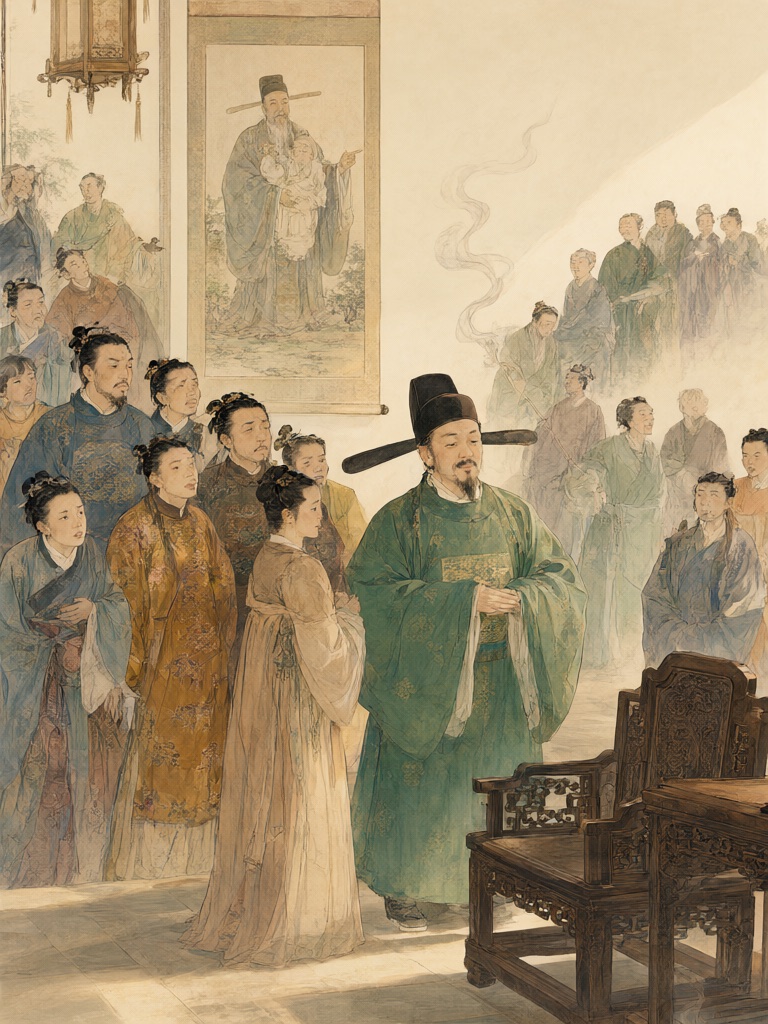
Before long they heard, in the distance, the runners crying to clear the way, and guessed the magistrate had arrived. Shanji straightened his clothes and cap and went out to meet him; among the relatives, the elder and more sensible ones got ready to step forward and meet the magistrate, while the younger and more timid ones all stood behind the screen wall, peeking out to see what would happen. Pairs of attendants with insignia lined up on both sides, and behind them, under a blue silk parasol, came the able and clever Magistrate Teng. When they reached the Ni gate, the attendants knelt and gave a shout. Mei and the Ni brothers all knelt together to welcome him. The gatekeeper called: "Rise!" The bearers set down the five-peaked screened sedan chair, and Magistrate Teng stepped down unhurriedly. Just as he was about to go in, he suddenly began bowing again and again to the empty air, murmuring replies, exactly as if a host had come out to greet him. Everyone was startled and watched to see what he was doing. Magistrate Teng went all the way into the hall, bowing and yielding precedence, and there bowed several more times, saying many polite words of greeting. First he bowed toward the south-facing tiger-skin chair, as if someone were offering him a seat; then he quickly turned, dragged over another chair and set it facing north in the host's place; again he politely deferred to the empty air several times before he finally took the seat of honor.
Seeing him behave as if he saw ghosts, no one dared come forward; they all stood on either side, staring. Magistrate Teng, from his seat, cupped his hands, bowed, and began: "Your lady has brought the matter of the family property before me. How do things really stand?" With that he put on the air of listening intently. After a long while, he shook his head, stuck out his tongue, and said: "The eldest young master is most unkind." After listening quietly for a while, he said again: "How is the second young master to live?" After a pause he said: "The small house on the right side—what living could be made from that?" Then he said several times: "I understand, I understand." After another pause he said: "This item also goes to the second young master? I accept all your instructions." A little later he cupped his hands and bowed again: "How could I accept such a generous gift?" After declining for a long time, he said: "Since you insist so earnestly, I will accept it reluctantly, and I'll issue a certificate for the second young master to keep." Then he rose and bowed several more times, saying: "I'll go at once." Everyone watched, dumbstruck.
Then Magistrate Teng stood up, looked this way and that, and asked: "Where has Lord Ni gone?" The gatekeeper reported: "I didn't see any Lord Ni." Magistrate Teng said: "How strange!" He called Shanji over and asked: "Your esteemed father came out to the gate in person to greet me just now, sat opposite me, and talked with me all this while—you must all have heard." Shanji said: "I didn't hear anything." Magistrate Teng said: "Just now—tall and long of body, thin of face, high cheekbones, narrow eyes, long brows and large ears, a fine three-strand beard white as silver, a gauze official cap and black boots, red robe and gold belt—wasn't that Lord Ni's appearance?" Everyone broke out in a cold sweat, and they all knelt and said: "That is exactly how he looked when alive." The magistrate said: "How did he suddenly vanish? He said that the family has two great halls, and also an old small house left on the east side—is that so?" Shanji didn't dare hide it and could only admit: "Yes, there is." The magistrate said: "Let's go and look at the small house on the east side; I'll have something to say there." Seeing the magistrate talk to himself all that while, describing the old man so vividly that it was plainly Prefect Ni, they all believed Prefect Ni had truly appeared. Every one of them stuck out his tongue in fright; every heart quaked. Who would have guessed it was all Magistrate Teng's clever talk? He had looked at the portrait and described the man from it—not a word of it was true! There is a poem to prove it:
The sages' teachings are just empty words; only ghosts and gods no one dares offend.
Had the magistrate not feigned this ghostly talk, how would the unfilial son have been made to submit?
Ni Shanji led the way, and everyone followed the magistrate to the old house on the east side. This old house was where Prefect Ni had lived before he passed the examinations; after he built the great halls, he left it empty, using it only as a granary for odds and ends of rice and wheat, with one servant family living there. The magistrate walked through it front and back, then sat down in the main room and said to Shanji: "Your father truly has a spirit. He told me all about your family affairs in detail and asked me to decide that this old house should go to Shanshu. What do you say?" Shanji kowtowed: "I leave it entirely to Your Honor's wise judgment." The magistrate asked for the property register, looked through it carefully, and said several times: "Quite a large estate." When he got to the will and deed of division at the back, he laughed heartily: "Your venerable father wrote this himself, yet just now he told me so many bad things about Shanji. The old gentleman can't make up his mind either."
He called Ni Shanji over: "Since the deed of division is settled in writing, all these fields, gardens and accounts are yours, one and all; Shanshu may not dispute them." Mei groaned inwardly and was about to step forward and plead, when the magistrate went on: "This old house is awarded to Shanshu, and whatever is in this house, Shanji may not dispute either." Shanji thought: "The house is full of broken furniture, worth nothing. Even the rice and wheat stored here—seventy or eighty percent was sold off a month ago, there's not much left. I've done well enough." So he quickly agreed: "Your Honor's judgment is most clear." The magistrate said: "You two have given your word; neither may go back on it. Since you here are relatives, you shall all be witnesses. Just now Lord Ni told me in person: 'Under the left wall of this house are buried five thousand taels in gold, in five jars, which should go to my second son.'" Shanji didn't believe it and said: "If that's really so, even if it were ten thousand, it belongs to my brother; I wouldn't dare dispute it." The magistrate said: "Even if you did dispute it, I wouldn't allow it."
He had his men fetch hoes, spades and other tools, and with Mei and her son pointing out the place, he led the militiamen to dig up the foundation under the east wall. Sure enough, five big jars were buried there. When they were dug up, the jars were full to the brim with shining silver. They weighed one jar and reckoned it at sixty-two and a half catties—exactly one thousand taels. Everyone who saw it was astonished. Shanji believed it all the more: "If Father's spirit hadn't appeared and told the magistrate in person, even we didn't know about this buried silver—how could the magistrate have known?" Then Magistrate Teng had the five jars of silver set out in a row before him and said to Mei: "Under the right wall there are five more jars, also five thousand. And there's a jar of gold besides, which Lord Ni just now insisted on giving me as a reward. I declined, but he pressed me again and again, so I had to accept." Mei and Shanshu kowtowed and said: "The five thousand under the left wall is already beyond our hopes; if there's more under the right wall, how could we dare go against our late father's wishes?"
The magistrate said: "How would I know? Since your venerable father said so, I suppose it isn't false." He had men dig under the west wall, and sure enough there were six big jars: five of silver and one of gold. Seeing so much gold and silver, Shanji's eyes blazed, and he longed to grab an ingot; but having given his word, he didn't dare say a thing. Magistrate Teng wrote out a certificate and gave it to Shanshu as proof of title, and awarded the servant family of that house to Shanshu and his mother as well. Mei and Shanshu were overjoyed and kowtowed together in thanks. Shanji, though thoroughly unhappy, had to kowtow a few times too and force out: "Thank you, Your Honor, for your decision." The magistrate wrote out several seals, sealed up the jar of gold, set it in front of his sedan chair, had it carried back to the yamen, and was glad to enjoy it. Everyone believed that Prefect Ni had really promised it to him as a reward and thought it only right and proper—who would dare say "no"? This is exactly what is called "When the snipe and the clam fight, the fisherman profits."
If Ni Shanji had been honest and kind at heart, lived in harmony with his brother, and been willing to divide the family property equally, these thousand taels of gold would have given each brother five hundred—how could they have ended up in Magistrate Teng's hands? He handed it to someone else for nothing, got only vexation for himself, and earned the name of an unfilial, unbrotherly son besides. For all his scheming, he never outschemed anyone but himself! But enough idle talk. The next day Mei and her son went to the county yamen again to thank Magistrate Teng. The magistrate had already removed the testament from the portrait, had it remounted, and returned it to Mei. Only then did mother and son realize that the hand pointing at the ground in the portrait was pointing at the gold and silver buried underground. Now, with these ten jars of silver, they bought fields and gardens like anyone else and became a wealthy family. Later Shanshu married and had three sons in a row, who studied and won renown. Of all the Ni family, this branch alone flourished greatly. Shanji's two sons were both idle wastrels and squandered the family fortune. After Shanji died, both great houses were sold to their uncle Shanshu. Everyone in the district who knew the whole story of the Ni family considered it Heaven's retribution. A poem says:
When has Heaven's way ever been partial? How laughable, how foolish young Master Ni was!
He dared, as the elder brother, to bully his stepmother, and so his dead father outwitted his living son.
The writing hidden in the scroll was not without purpose; the gold buried under the wall went to the official.
How much better to keep a sense of fairness: no quarrels, and no lawsuits.