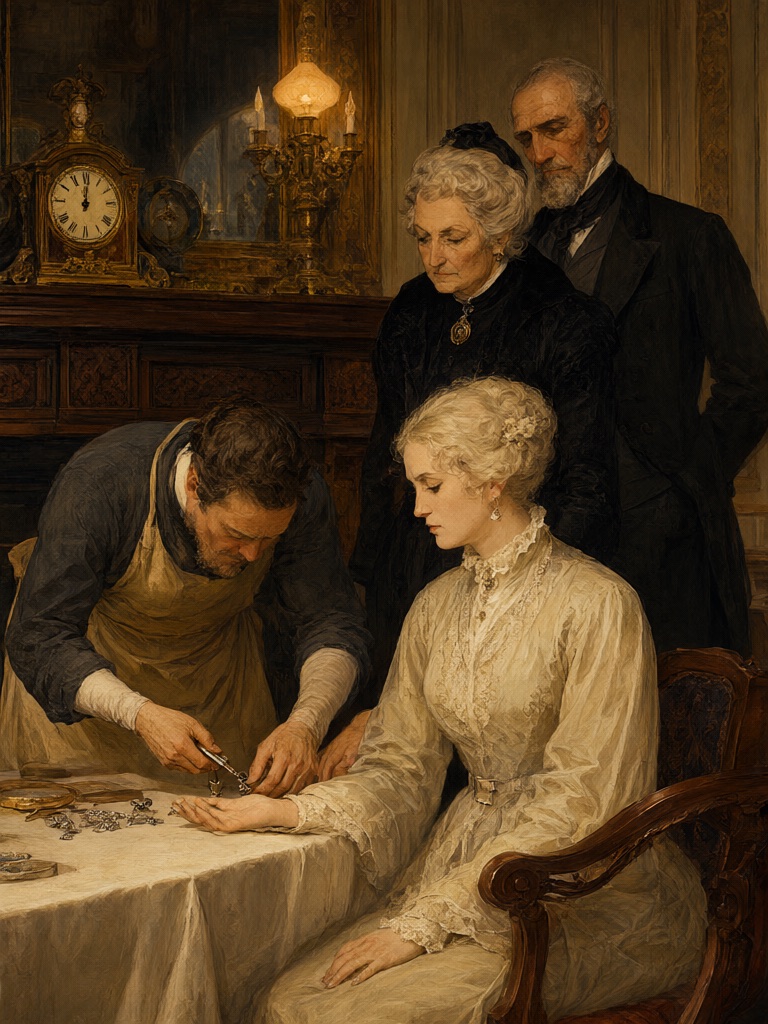
It is told that in the capital there lived a venerable elder named Weng Jian, very wealthy, generous with his money and fond of giving. He looked after and helped his neighbors and kinsmen; whenever he came upon a brawl he would talk the parties round, and whenever there was a lawsuit he would usually broker a settlement. Everyone loved and admired him. At seventy-eight he still had no son, only a daughter named Ruiniang, who was married to Yang Qing. Yang Qing was a shrewd man and very greedy; seeing that his father-in-law had no son, he coveted the old man's fortune, and at drinking parties he would often say, "It's always been: if there's a son, it goes to the son; if not, to the daughter. My father-in-law is old and certainly has no son — why not hand the estate over to me to manage?" When Weng Jian heard of this he was indignant, but reflecting that he truly had no male heir, only a daughter, and no other relatives, he had to bear it. The villagers, seeing that so honest and kindly a man had no son, often sighed on his behalf: "If old Weng has no son, Heaven is truly unkind."
Two years later, when Weng Jian was nearly eighty, his wife Lady Lin unexpectedly bore a son, who was named Weng Long. Kinsmen and neighbors all came to offer congratulations; only Yang Qing was displeased, and though he forced a smile and joined in the talk, inwardly he was sullen. Weng Jian thought to himself: The father is old and the son is small; my sun is setting behind the western hills, and if I should die any day now, this child will end up as meat on another man's chopping block. So he devised a plan: A son-in-law, when all's said and done, is an outsider. He truly covets my fortune now — and what you wish to take, you must first give. This way both ends are served. Three months later Weng Jian fell gravely ill, and knowing he would not recover, he called Yang Qing to his bedside and said to him through tears, "I have only one son and one daughter. The son is my child, and the daughter is my child too. But if I look to the boy, he can't manage anything; better to look to the daughter — that's the longer-lasting plan. I am handing the whole estate over to you to manage." He brought out his will, handed it to Yang Qing, and read it aloud for him: "An old man of eighty begets a son people say not my son the family estate fields and gardens all given over to son-in-law outsider shall not dispute it." Hearing it read, Yang Qing was beside himself with joy; he locked the will away in a box and went off to take charge of the property. Not many days later Weng Jian died, and Yang Qing came into all that wealth.
Some twenty-odd years later, Weng Long had grown into a man who understood the ways of the world, and he thought: My father's estate — if even a son-in-law can manage it, why can't I, his own son? So he asked relatives to tell his brother-in-law he wanted the family property back. Yang Qing flew into a rage: "That property was handed over to me entirely by my father-in-law, and he said that fellow wasn't even his son — how can he contest it with me?" The matter dragged on unresolved, so it went to the authorities; it passed through several courts, and officials high and low all awarded it to Yang Qing according to the will. Weng Long never accepted it in his heart.
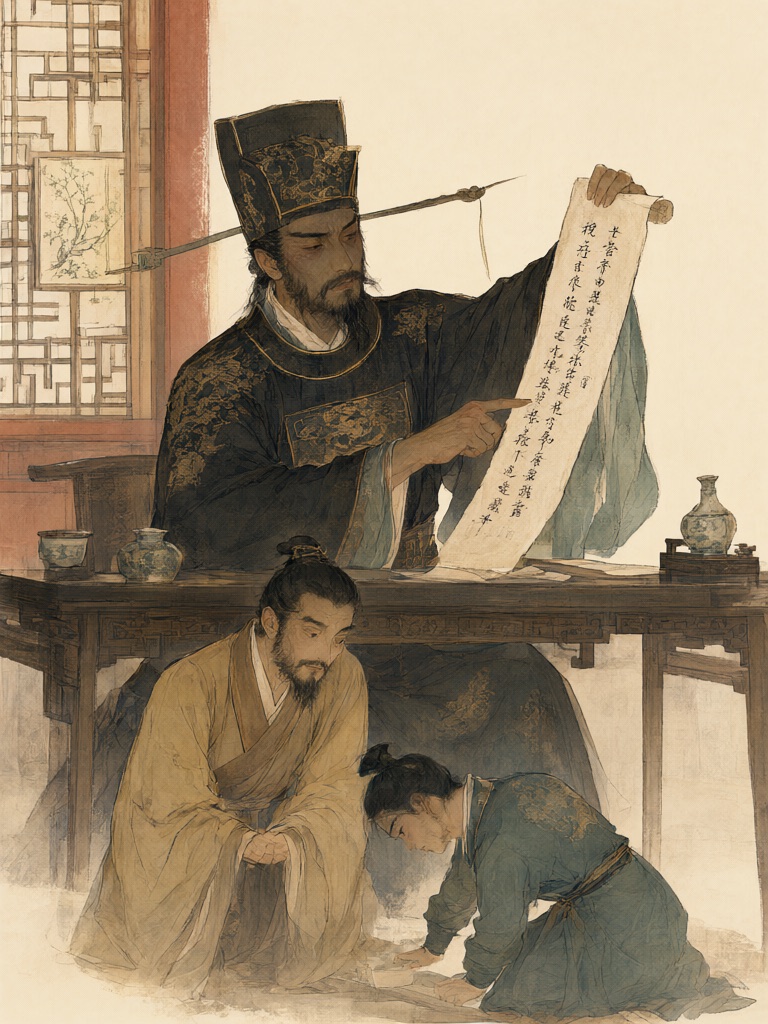
At that time Lord Bao was in the capital, and Weng Long secretly took a written complaint straight to him. Lord Bao read it and at once had Yang Qing brought in for questioning: "Why have you long occupied Weng Long's family property and still not returned it?" Yang Qing said, "This property was all handed to me by my father-in-law. It has nothing to do with Weng Long." Lord Bao said, "Weng Long is the true son. Even if there were no son, you're only a half-son — what claim have you?" Yang Qing said, "My father-in-law stated plainly that he may not dispute it, and here is the will to prove it." He presented the will. Lord Bao read it and laughed: "You've got it wrong. You don't know how to read it. It plainly says, 'An old man of eighty begets a son; the family estate, fields and gardens, all given over' — those two lines mean it is given to his own son." Yang Qing said, "Those two lines may read that way, but my father-in-law said Weng Long wasn't his son — the will says so in black and white." Lord Bao said, "That line was meant to fool you.
What he says is: 'People say no — he is my son.'" Yang Qing said, "My father-in-law handed the property to me and stated plainly that everyone else is an outsider and may not dispute it. By that line, everyone but me is an outsider." Lord Bao said, "Just look at your own son — would you treat him as an outsider? The word 'outsider' plainly belongs with 'son-in-law' before it. What he meant was: you, the son-in-law, are the outsider, and shall not dispute with his own son. Your father-in-law hid his true meaning in it, and you failed to see through it." Seeing that Lord Bao's reading made sense, Yang Qing had no answer, and at once returned every deed he had been given to Weng Long. Those who knew of it called it a divine judgment.