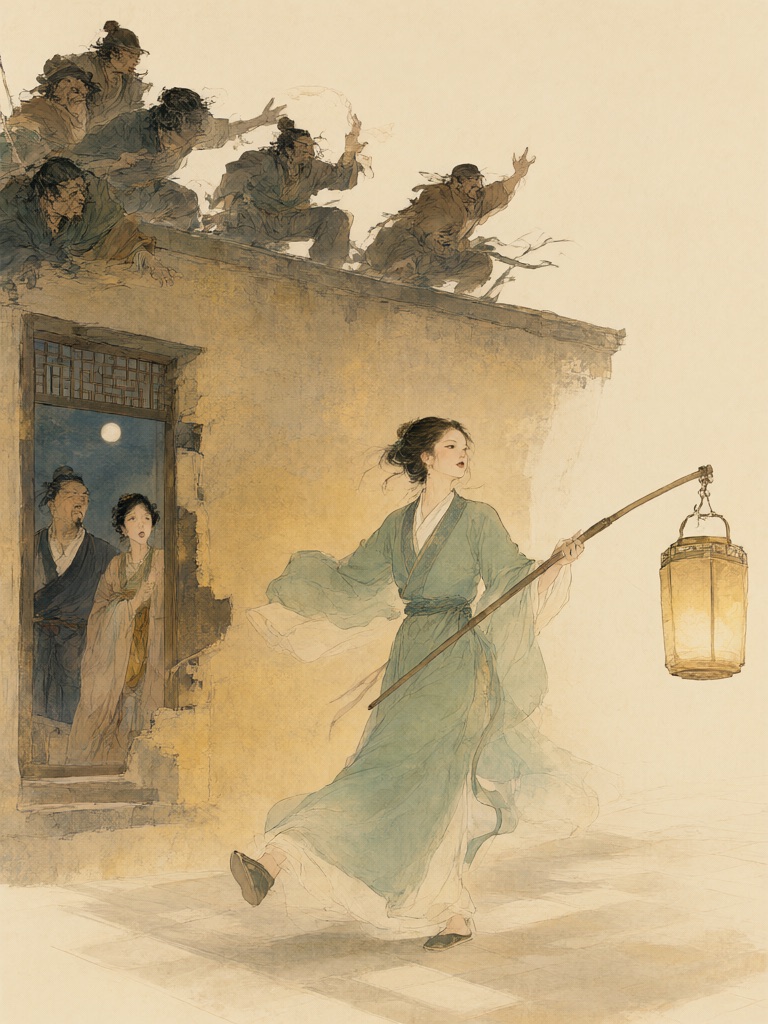
In the western outskirts of Yidu there lived a man of a great and very rich family, who kept a concubine, gentle and lovely. But his principal wife bullied and crushed her, whipping and beating her without restraint, while the concubine served her with the utmost care. The husband pitied her and often comforted her in private, but she never uttered a word of complaint. One night several men climbed over the wall and battered at the door until it was nearly broken in. The husband and his wife trembled with terror and had no idea what to do. The concubine got up without a sound, felt about in the dark room until she found the wooden pole used for carrying water, pulled back the bolt, and burst out. The robbers were in a tangle like a heap of hemp. The concubine set the pole whirling—the wind whistled and the hooks rang—and in an instant four or five men lay on the ground. The robbers broke and fled in terror, but the wall was too high to climb in a hurry; they tumbled and sprawled, groaning and yelping, scared out of their wits. The concubine planted the pole on the ground, looked round and laughed: “Things like you aren't even worth hitting—and you want to play at being thieves! I won't kill you; killing you would disgrace me.” And she let them all get away.
The husband, astounded, asked, “How can you do that?” And she said, “My father was a master of spear and staff, and he taught me all he knew. I'm probably a match for more than a hundred men.” The wife was even more aghast, and regretted that she had been so blind to what the girl really was. From then on she treated her well, even as though she were the principal wife; yet the concubine never once showed the slightest lack of courtesy. A neighbour woman said to her, “Sister, you beat robbers as if they were pigs and dogs. How can you bow your head and take her whippings?” The concubine said, “That is my place. What else is there to say?” Those who heard of it thought all the more highly of her.