Old Mr. Bai was from Zhili. His eldest son, Jia, had gone south to take up office, and for three years nothing had been heard from him. It happened that a distant relation named Ding came to call, and the old man entertained him. Ding was known to be one of those living men who run errands for the underworld. As they talked, the old man kept asking him about the world of the dead, and Ding's answers were full of the fantastic; the old man did not really believe him and merely smiled faintly. A few days after they parted, the old man was lying down when he saw Ding come again and invite him out on an excursion. He followed Ding and they entered a walled city. After a while Ding pointed at a gate and said, "This is where your nephew is." At that time the old man's sister's son was a county magistrate in Shanxi, and he said in surprise, "How could he be here?" "If you don't believe me," said Ding, "go in and see." The old man went in, and there indeed was his nephew, seated in the hall in a cicada-crested cap and a robe embroidered with the unicorn of justice, with rows of halberds and banners on either side, and no one could get through to him. Ding pulled him out and said, "Your son's yamen is not far from here. Would you like to see him too?" The old man agreed.
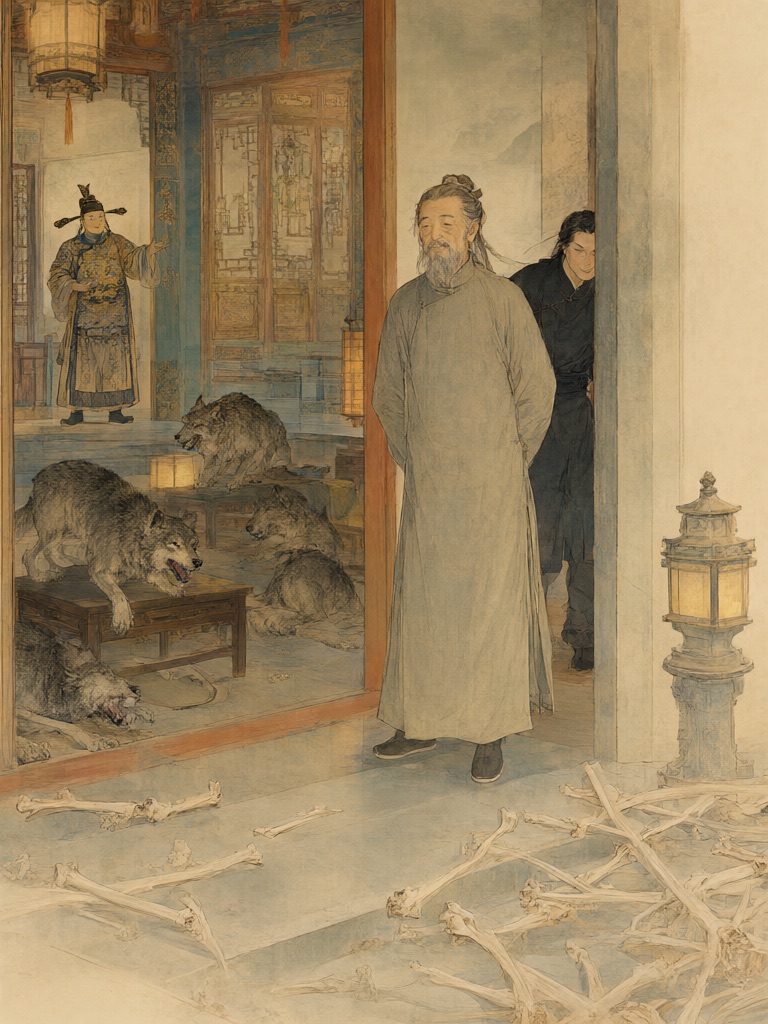
Soon they came to a mansion. "Go in," said Ding. The old man peered through the gate and saw a huge wolf blocking the way, and he was too frightened to enter. "Go in," Ding said again. They passed through another gate, and in the hall and below it, sitting and lying everywhere, were nothing but wolves. Looking down into the courtyard he saw white bones piled up like a mountain, and he grew even more afraid. So Ding shielded him with his own body and led him in. Just then his son Jia came out from the inner rooms and was delighted to see his father and Ding. After they had sat a little while, Jia called his attendants to prepare food. Suddenly a huge wolf came in carrying a dead man in its jaws. Trembling, the old man rose and said, "What is this for?" "Just something for the kitchen," said Jia. The old man hurriedly stopped him. Uneasy at heart, he wanted to take his leave, but a pack of wolves blocked his way. As he stood not knowing whether to go forward or back, all at once the wolves scattered howling: some bolted under the couch, some cowered beneath the tables. He was bewildered and could not understand why. A moment later two fierce warriors in golden armour strode in with glaring eyes and brought out a black rope to bind Jia. Jia flung himself to the ground and turned into a tiger, with jagged, fearsome teeth. One warrior drew a sharp sword to cut off its head. But the other said, "Wait, wait—that's for the fourth month of next year. Better just knock out its teeth for now." So he took out a great hammer and hammered the tiger's teeth, and they fell clattering to the floor. The tiger let out a mighty roar that shook the mountains.
In great fear the old man suddenly woke, and knew that it had been a dream. Thinking it strange, he sent for Ding, but Ding excused himself and did not come. The old man wrote down his dream and sent his second son to Jia with a letter of earnest, heartfelt warning. When the younger son arrived, he found that all his brother's front teeth were gone; shocked, he asked why, and learned they had been broken when Jia fell from his horse while drunk. When he checked the date, it was the very day of their father's dream. More alarmed than ever, he brought out the letter. Jia read it and changed colour, but after a pause he said, "It's just an illusory dream that happened to coincide. Nothing strange about that." At the time he was bribing those in power and had secured first place in the recommendations for promotion, so he paid no heed to an uncanny dream.
The younger brother stayed several days and saw the hall full of parasitic clerks, while people bringing bribes and pulling strings came and went until midnight. In tears he begged his brother to stop. Jia said, "Brother, you spend your days in a thatched hut, so you don't understand the workings of an official career. The power to promote or dismiss lies with one's superiors, not with the common people. Please your superiors and you're a good official. Love the people—and how is that supposed to please your superiors?" Seeing there was no persuading him, the younger brother went home and told their father. The old man wept aloud when he heard it. There was nothing he could do, so he gave away his family's wealth to help the poor and prayed to the gods every day, asking only that the retribution due his wayward son should not fall on the son's wife and children.
The next year word came that Jia had been recommended for a post in the Ministry of Personnel, and well-wishers crowded the gate; but the old man only sighed, kept to his pillow pleading illness, and would not come out. Before long he heard that his son had met with bandits on his way home and that master and servants alike had been killed. Only then did the old man get up. "The wrath of the gods and spirits has fallen on him alone," he told people. "The protection they have given my family cannot be called anything but generous." And he burned incense to give thanks. Those who came to console him all said it must be a false rumour from the road; only the old man believed it without doubt, and he set a date to prepare a grave for his son.
—But Jia was not in fact dead. In the fourth month, Jia had left his post, and no sooner had he crossed out of his county than he ran into bandits. Jia offered them all his baggage. The bandits said, "We've come to avenge the wrongs of the people of a whole county. Do you think we're here just for this?" And they cut off his head. Then they asked his household, "Which of you is Si Dacheng?"—Si was Jia's right-hand man, who had helped him in his cruelties.—The servants all pointed him out, and the bandits killed him too. There were also four corrupt clerks—Jia's tax-gougers, whom he had meant to take with him to the capital.—The bandits searched them out and executed them as well, and only then divided the loot into their bags and galloped away.
Jia's ghost lay crouched by the roadside, and saw a high official passing by, who asked, "Who is this that has been killed?" The outrider in front answered, "Magistrate Bai of such-and-such county." "This is old Mr. Bai's son," said the official. "The old man should not have to see so gruesome a sight in his last years. His head should be put back on." At once someone picked up the head and set it on the neck, saying, "A crooked man shouldn't be set straight—just let his shoulder hold up his chin." Then they went on their way. Some time later Jia came back to life. When his wife and children went to collect his body, they found he was still breathing, so they carried him away in a cart; they gave him water a little at a time, and he was able to drink. But they had to lodge at an inn, too poor to get home. Only after half a year or so did the old man receive certain news, and he sent his second son to bring Jia home. Though Jia had come back to life, his eyes could look down at his own back, and from then on he was no longer counted among men. The old man's nephew, who had a fine record in office, was called to the capital that year as a censor. Everything matched the dream.
The chronicler comments: "I sigh to think how common it is in this world for the officials to be tigers and their underlings wolves.—Even when the official is no tiger, his clerks will turn into wolves; and what of those who are fiercer than tigers! A man's failing is that he cannot look behind himself. To bring him back to life and make him look behind himself—how subtle is the teaching of the gods and spirits!"
Li Kuangjiu of Zouping, a palace graduate, was a fairly honest and clear-sighted official. Once a rich man was framed on false charges, and a yamen runner frightened him, saying, "His Honour wants two hundred taels from you. Get it ready fast, or you're done for!" The rich man, terrified, promised to raise half. The runner waved his hand: not enough. The rich man pleaded bitterly. "I'll do my very best," said the runner, "only I'm afraid he won't agree. When the case is heard, watch with your own eyes as I speak up for you, and whether he agrees or not, you'll see I mean you nothing but good." Presently Lord Li took up the case. The runner, knowing that Li had given up tobacco, stepped close and asked, "Will you smoke, sir?" Li shook his head. The runner at once hurried down and said, "I just told him the sum and His Honour shook his head—you saw it, didn't you?" The rich man believed him and, in fear, agreed to pay the full amount. The runner, knowing Li loved tea, stepped close and asked, "Will you take some tea, sir?" Li nodded. On the pretext of brewing tea, the runner hurried down and said, "It's settled! He just nodded—you saw it, didn't you?" When the case was concluded, the rich man was indeed let off, and the runner pocketed the bribe and demanded a thank-you fee besides. Alas! The official thinks himself honest, yet the roads are full of people cursing his greed. This is another who has let the wolves loose without knowing it. There are many more such cases in the world; let it serve as a mirror for those who hold office.