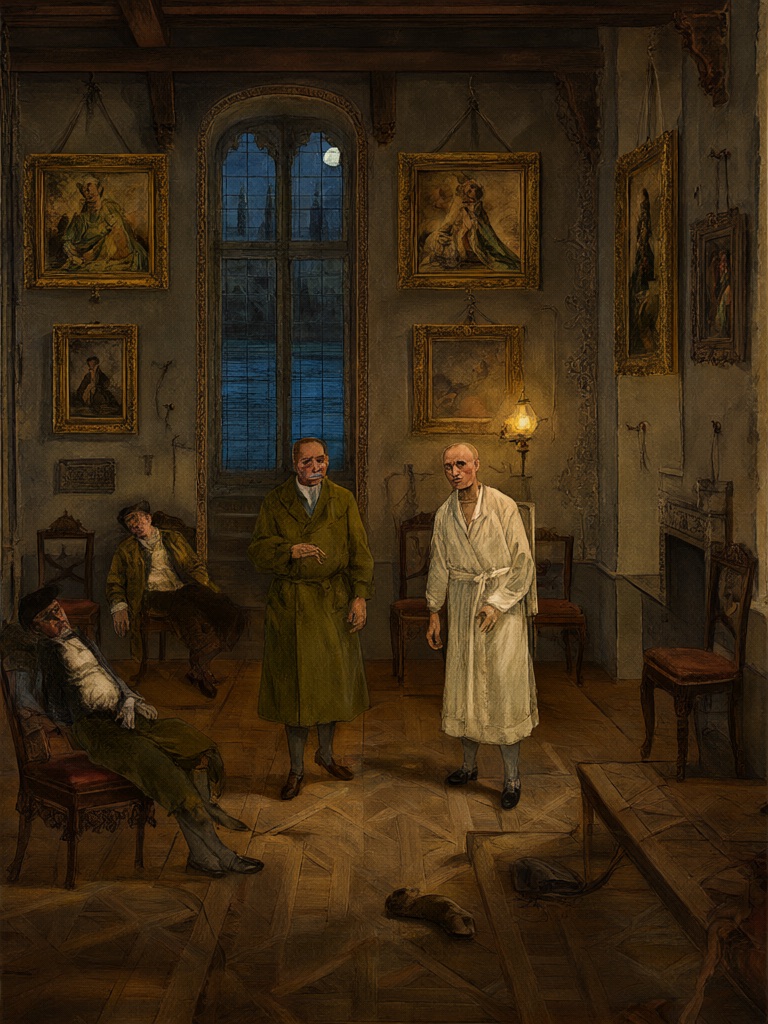
Old Feng of Guangping had a son styled Xiangru. Father and son were both licentiates. The old man was nearly sixty, square and stiff-necked by nature, and the household was often penniless. Within a few years his wife and daughter-in-law died one after the other, and he had to draw the water and pound the grain himself. One night Xiangru was sitting in the moonlight when he suddenly saw the girl from the house to the east peeping over the wall. He looked at her: she was beautiful. He came closer: she smiled faintly. He beckoned: she neither came nor went away. He begged her earnestly, and at last she climbed over on a ladder, and they slept together. When he asked her name, she said, "I'm Hongyu, the girl next door." He was utterly smitten and pledged to love her forever, and she agreed. She came every night, for about half a year. Then one night the old man got up, heard laughter in his son's room, and peeked in. Seeing his son, he was furious, called him out and cursed him: "You animal, what are you doing! Our family has come down so low, and instead of working hard you take up debauchery? If people find out, it will ruin your good name; if they don't, it will shorten your life!" Xiangru fell on his knees and wept that he was sorry. The old man scolded the girl: "A girl who doesn't keep to the rules of the women's quarters disgraces herself and disgraces others too. If this ever comes out, it won't just be my poor house that's shamed!" Having said his piece, he went back to bed in a rage.
Hongyu wept and said, "To be rebuked like this by your father—I'm truly ashamed! Our time together is over." Xiangru said, "While my father lives I can't decide for myself. If you love me, please swallow the insult and stay with me." She refused him flatly, and he burst into tears. She stopped him: "There was no matchmaker between us, no parents' consent—slipping over walls and through gaps, how could we ever grow old together? There's a good match around here you could marry." He told her he was poor. She said, "Wait for me tomorrow night. I'll find a way for you." The next night she came as promised and gave him forty taels of silver. "Sixty li from here," she said, "in Wu Village, there's a family named Wei with a daughter of eighteen. They've set a high price on her, so she's still unmarried. Offer them plenty and they're sure to agree." With that she said goodbye and left.
At a suitable moment Xiangru told his father he wanted to go and look at the girl, but he kept the gift of money secret. The old man reckoned they had no money, and for that reason told him not to go. Xiangru said gently, "Let me just try; if it doesn't work, that's the end of it." The old man nodded. So Xiangru borrowed a servant and a horse and went to the Weis. Old Wei was a plain farmer. Xiangru called him out and drew him aside to talk privately. Wei knew Xiangru came of a good family and saw how open and handsome he was, and was willing at heart, but worried he would be stingy with the betrothal money. Hearing him hem and haw, Xiangru caught his meaning and emptied his purse onto the table. Wei was delighted; he asked a neighboring scholar to act as go-between, and they wrote out the red betrothal paper and sealed the match. Xiangru went in to pay his respects to Wei's wife. The room was cramped, and the girl stood pressed against her mother, half hidden. He stole a glance: though she wore a bramble hairpin and a plain cotton skirt, her face was radiant, and he was secretly overjoyed. Wei borrowed a neighbor's room to entertain his son-in-law and said, "No need for you to come and fetch the bride, sir. As soon as I've made her a few clothes, we'll carry her over in a sedan chair." Xiangru fixed the date and went home. He told his father that the Weis valued a respectable family and asked no money, and the old man was pleased too. On the appointed day the Weis duly delivered the girl. She was hardworking and thrifty, gentle and dutiful, and the couple were deeply in love. Two years later she bore a son, whom they named Fu'er.
At the Qingming festival she carried the child to visit the family graves and met a local gentleman named Song. Song had been a censor until he was dismissed for bribery, and now, living in retirement, he threw his weight around viciously. He too was returning from the graves that day; he saw the young wife, was struck by her beauty, asked the villagers, and learned she was Feng Xiangru's wife. Reckoning that Feng was a poor scholar who could be tempted with a large bribe, he sent a servant to drop a hint. When Xiangru heard it, the anger showed on his face; then, realizing he was no match for Song's power, he swallowed his rage, put on a smile, and went home to tell his father. The old man was enraged. He ran out and, before Song's servants, gestured at heaven and earth and cursed them every way he could. The servants scurried off like rats. Song was angered in turn, and actually sent several men into the Feng house, who beat the old man and his son in an uproar like a boiling cauldron. Hearing it, the young wife dropped the baby on the bed and ran out with her hair flying, screaming for help. The gang seized her, hoisted her up, and went off in a roar. Father and son lay injured on the ground, groaning. The baby wailed in the room. The neighbors took pity on them and helped them onto their beds. After a day Xiangru could get up on a cane, but the old man, too furious to eat, vomited blood and soon died. Xiangru wept bitterly and, carrying his son, lodged a lawsuit; he took it all the way up to the governor-general and the governor, appealing almost everywhere, but never got justice. Later he heard that his wife had refused to submit and had died, and his grief deepened. The injustice choked his chest and throat, and he had no way to right it. He often thought of ambushing Song on the road and stabbing him to death, but Song had a large retinue, and there was no one to entrust the child to. Grieving and brooding day and night, he could not close his eyes.
Suddenly a man came to his house to offer condolences—curly-bearded, broad-jawed, someone he had never met. Xiangru drew him to a seat and was about to ask where he was from, when the visitor said abruptly, "Your father has been killed and your wife stolen, and you've forgotten about revenge?" Suspecting him of being Song's spy, Xiangru answered him evasively. The stranger's eyes blazed with anger as if they would split, and he made for the door. "I took you for a man," he said. "Now I see you're a worthless wretch not worth mentioning!" Seeing there was something unusual about him, Xiangru knelt and held him back. "I was truly afraid you were one of Song's people trying to draw me out," he said. "Now I'll open my heart to you: I've been sleeping on brushwood and tasting gall for a long time now. But I pity this child in swaddling clothes and fear my family line will be cut off. You are a man of honor—will you be my Chujiu and save the orphan?" The stranger said, "That's women's work; I'm no good at it. What you want to entrust to someone else, please take on yourself; what you want to do yourself, I'd like to do for you." Hearing this, Xiangru knocked his head on the ground again and again. The stranger walked out without a backward glance. Xiangru ran after him to ask his name, and he said, "If I fail, I won't take your blame; if I succeed, I won't take your thanks either." And he left. Fearing disaster would follow, Xiangru took his son and fled.
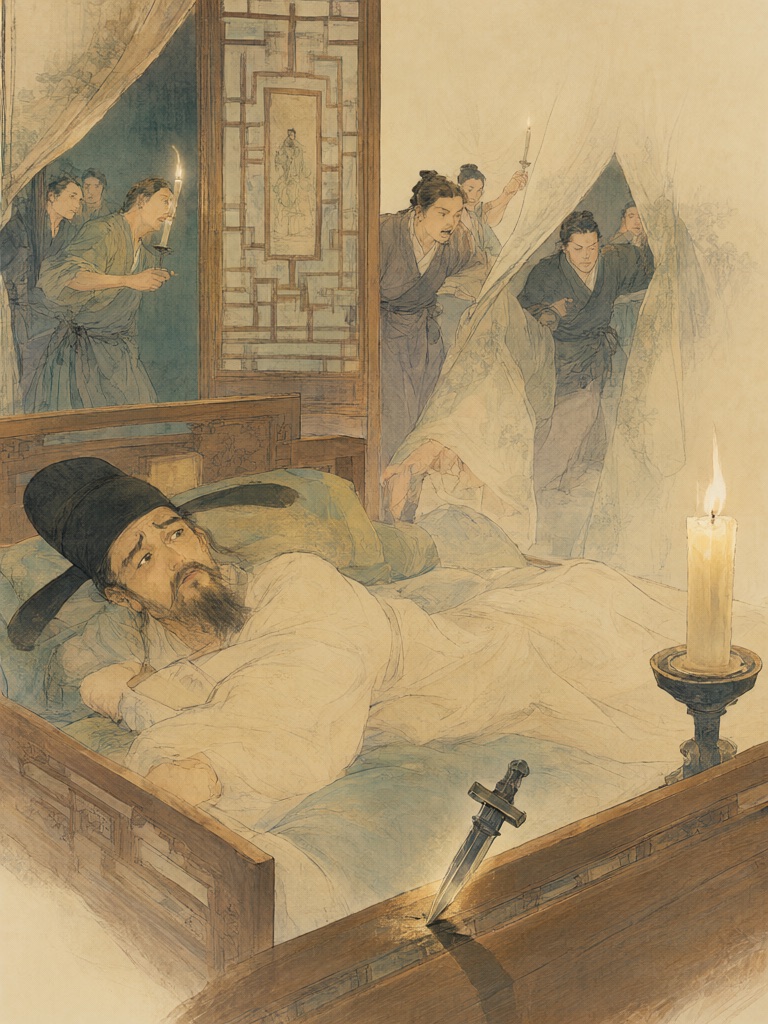
That night, when the whole Song household was asleep, someone climbed over the high walls and killed the censor, his two sons, a daughter-in-law and a maid. The Song family filed a complaint with the authorities. The magistrate was horrified. The Songs insisted it was Xiangru, so the magistrate sent constables to arrest him; he had fled and no one knew where, which made the charge seem all the more certain. Song's servants and the constables searched everywhere. At night they reached the southern hills, heard a child crying, tracked it down, and found him; they tied him up and led him away. The child cried harder and harder, so they snatched him away and threw him aside. Xiangru was beside himself with grief and outrage. Brought before the magistrate, he was asked, "Why did you kill them?" Xiangru said, "I'm innocent! They died at night, I left in daylight, and I was carrying a squalling baby—how could I climb walls and kill anyone?" The magistrate said, "If you didn't kill them, why did you run?" Xiangru had no answer and could not defend himself. He was thrown into prison. He wept, "My death is no great loss, but what crime has my orphan committed?" The magistrate said, "You've killed plenty of other people's sons. Why complain if yours is killed?" Xiangru was stripped of his degree and tortured again and again, but would not confess. That very night, just as the magistrate lay down, something struck his bed with a resounding thud, and he screamed in terror. The whole household woke and gathered round with candles: a short knife, keen and bright as frost, had been driven more than an inch into the wood of the bed, so firmly it could not be pulled out. At the sight the magistrate nearly lost his wits. Men with spears searched everywhere but found no trace. He was secretly shaken. And since the Songs were dead and there was nothing to fear from them, he wrote a full report to his superiors arguing for Xiangru's release, and Xiangru was actually set free.
Xiangru came home to an empty grain jar, a lone shadow facing four bare walls. Fortunately the neighbors took pity and brought him food and drink, and he scraped by. When he thought of how his great enemy had been paid back, his face would brighten with joy; when he thought of the horror that had all but wiped out his family, the tears would stream down; and when he thought of half a lifetime of bone-deep poverty and his family line cut off, he would burst out sobbing where no one could see, unable to stop himself. After half a year the hunt for the killer slackened. He begged the magistrate to order his wife's remains returned to him. When he came back from burying her, he wanted to die of grief. Tossing and turning on his empty bed, he saw no way to go on living. Suddenly there was a knock at the door. He held his breath and listened: someone outside was murmuring to a little child. He jumped up and peeked out; it seemed to be a woman. The moment the door opened, she asked, "Now that your great wrong has been righted, are you safe and well?" The voice was very familiar, but in his confusion he could not place it. He held up a candle: it was Hongyu. She was leading a little boy, who was laughing and playing about her legs. Without stopping to ask questions, Xiangru threw his arms around her and sobbed. She too was deeply moved. Then she nudged the boy and said, "Have you forgotten your father?" The boy clung to her clothes and stared at Xiangru with bright eyes. Looking closely, Xiangru saw that it was Fu'er. Astonished, he asked through his tears, "Where did you find him?" Hongyu said, "I'll tell you the truth. When I said I was the girl next door, it wasn't true. I'm really a fox. I happened to be out that night and saw the child crying at the mouth of a ravine, so I took him to Shaanxi and raised him. When I heard the great trouble had blown over, I brought him back to be with you again." Xiangru wiped his tears and bowed in thanks. The boy nestled in Hongyu's arms as if she were his mother; he no longer even recognized his father.
Before dawn Hongyu was up in a hurry. When he asked why, she said, "I'm leaving." Xiangru knelt naked at the head of the bed, weeping so hard he could not raise his head. She laughed: "I was only teasing you. The household is just being rebuilt; we'll have to rise early and work late." Then she cut back the weeds and swept with a broom, working like a man. Xiangru fretted that they were too poor to support themselves. Hongyu said, "Just draw your curtain and study. Don't ask whether we have enough or not; we probably won't starve." She brought out money to set up a loom, rented several dozen mu of land, and hired laborers to farm it. Shouldering a hoe to clear the thatch-grass, pulling vines to patch the roof—so it went every day. Hearing what a good wife he had, the neighbors were all the more glad to help them. After about half a year the household was thriving, like a family that had been rich for generations. Xiangru said, "Out of the ashes you've rebuilt everything with your bare hands. But one thing still isn't settled. What can we do about it?" When she asked what he meant, he said, "The examinations are almost here, and my degree still hasn't been restored." Hongyu laughed: "I sent four taels to the director of studies some time ago, and your name is already back on the roll. If I'd waited for you to say something, it would have been far too late." He thought her more marvelous than ever. That year he passed the provincial examination. He was thirty-six, with rich fields stretching field after field and a tall, spacious house. Hongyu was so slender and graceful she seemed about to float away on the wind, yet she worked harder than any farm wife; though she toiled through the bitter winter, her hands stayed as smooth as cream. She said she was twenty-eight, but to everyone she always looked about twenty.