Xue Song, military governor of Luzhou under the Tang, had a maidservant named Hongxian, "Red Thread," who played the ruan lute beautifully and was well read in the classics and histories. Xue put her in charge of his official correspondence and called her his "inner secretary." Once, at a great banquet for the army, Hongxian said to Xue, "The sound of the Jie drum is terribly mournful. The drummer must be in some trouble." Xue, who had always understood music, said, "It is just as you say." He summoned the drummer and questioned him. The man said, "My wife died last night, but I didn't dare ask for leave." Xue sent him home at once.
This was after the Zhide reign, when the lands north and south of the Yellow River were still unsettled. The court made Ganyang a garrison town and ordered Xue to hold it firmly and keep the region east of the mountains under control. After all the killing, the military government had only just been set up. The court had Xue marry his daughter to the son of Tian Chengsi, military governor of Weibo, and had Xue's son marry the daughter of Linghu Zhang, military governor of Hua-Bo. Thus the three garrisons were bound together by marriage, and envoys went back and forth daily. But Tian Chengsi had long suffered from a lung ailment that grew worse in the heat. He often said, "If I could move my garrison east of the mountains and enjoy its cool air, I could add a few years to my life." So he recruited from his army men ten times braver and stronger than the rest, three thousand of them, called his "Outer Household Sons," and kept them lavishly. He had three hundred of them keep watch at his residence every night, and divined to choose an auspicious day to annex Luzhou.
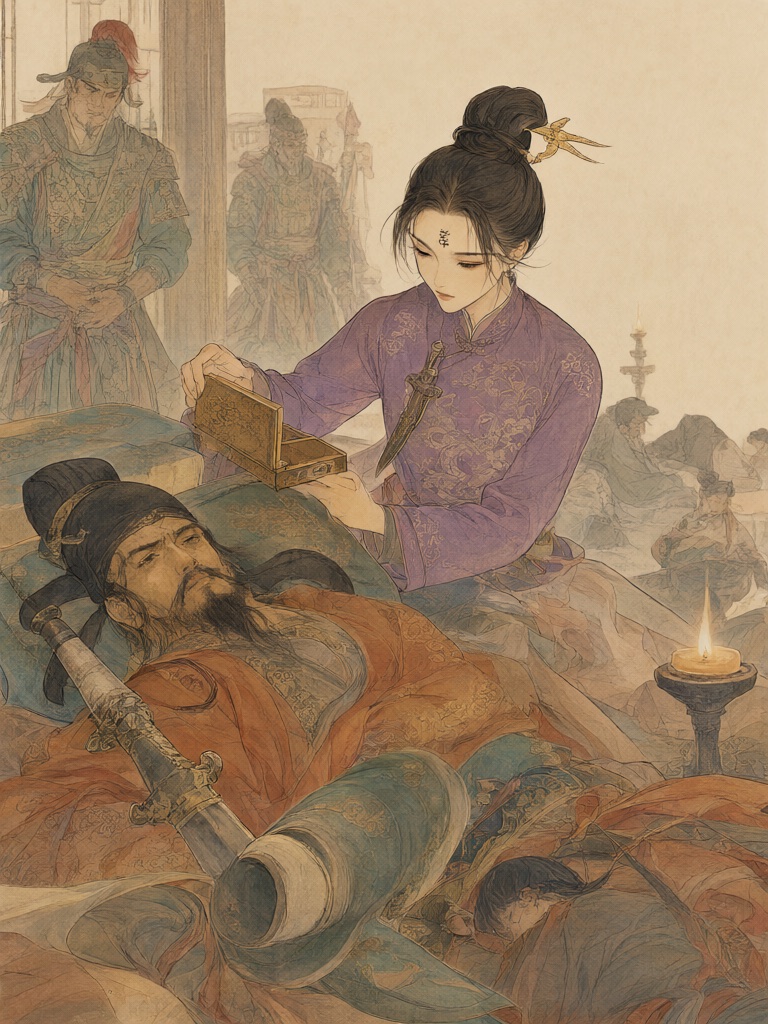
When Xue heard of this, he was anxious and gloomy day and night, sighing and muttering to himself, unable to think of any plan. One night, as the water clock was about to strike the hour and the camp gates were already shut, he paced the courtyard leaning on his staff, with only Hongxian following him. Hongxian said, "For a month now, my lord, you have hardly slept or eaten. Something weighs on your mind. Surely it concerns our neighbor?" Xue said, "This is a matter of life and death. It is beyond you." Hongxian said, "I may be of lowly station, but I can still relieve my lord's worry." Struck by her strange words, Xue said, "So you are an extraordinary person, and I was too dull to see it." Then he told her the whole affair: "I inherited my grandfather's legacy and have received great favor from the state. If I lose my territory in a single day, the honors of several hundred years will be gone." Hongxian said, "That is easily handled, not worth my lord's worry. Let me go to the city of Wei for a while to see how things stand and find out what they are up to. If I set out now at the first watch, I can report back by the second. Please first appoint a mounted messenger and have a letter of polite greetings ready. Everything else can wait until I return." Xue said, "But if it fails, and only hastens disaster, what then?" Hongxian said, "This mission of mine cannot fail." She went into her chamber and prepared her gear. She combed her hair into a Wuman topknot, pinned it with a golden sparrow hairpin, put on a short purple embroidered robe, tied on light shoes of blue silk, hung a dragon-patterned dagger at her breast, and wrote the name of the god Taiyi on her forehead. She bowed twice and set off, and in an instant she was gone.
Xue went back inside, shut the door, and sat bolt upright with his back to the candle. Ordinarily he drank no more than a few cups of wine, but that night he raised his cup more than ten times without getting drunk. Suddenly he heard the dawn horn moaning on the wind, and a single dewy leaf dropped. He started up to ask, and it was Hongxian, back already. Overjoyed, Xue welcomed her and asked, "Did it go well?" Hongxian said, "I did not fail my mission." He asked again, "No one was killed or hurt?" "It didn't come to that. I only took the golden box from beside his bed as a token."
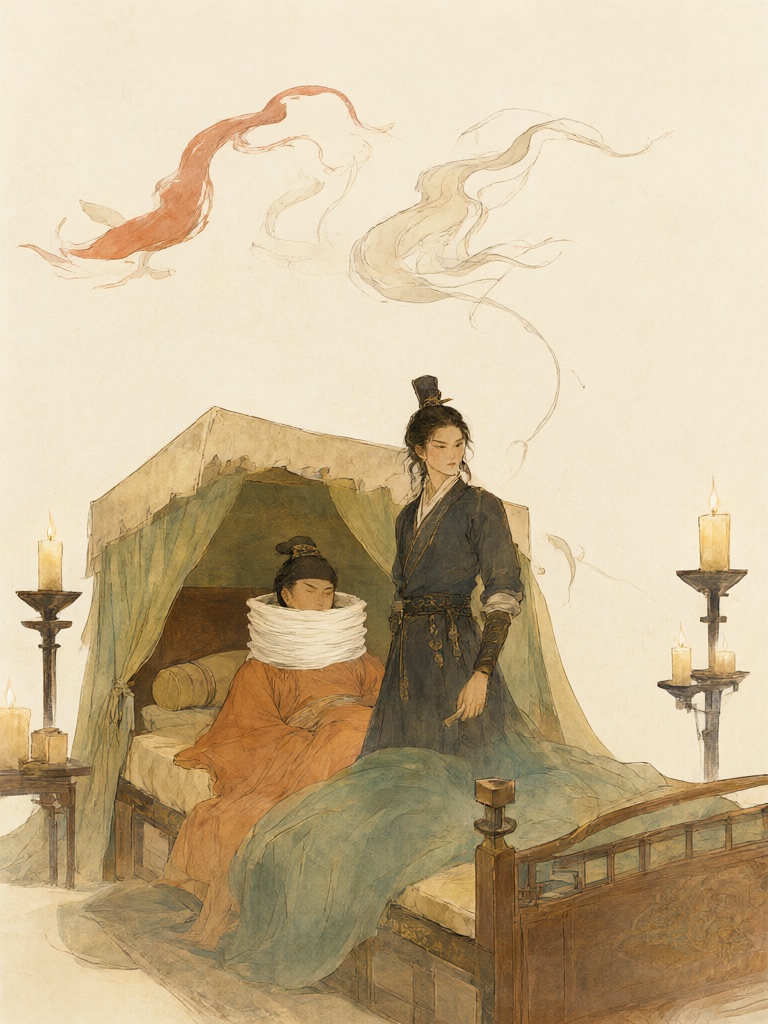
Hongxian said, "Three quarters before midnight I reached the city of Wei. I passed through several gates and came to his bedchamber. I heard the Outer Household Sons sleeping in the corridors, snoring like thunder, and saw soldiers of the central guard pacing the courtyard, calling out the watch like a rising wind. I opened the left-hand door and went right up to his bed curtains. There lay your in-law Tian inside the curtains, toes up, sound asleep, his head on a figured rhinoceros-horn pillow and his topknot wrapped in yellow gauze. By the pillow lay a star-patterned sword, bare, and in front of the sword stood a golden box, open, with his birth date and the names of the gods of the Northern Dipper written inside, and precious incense and fine pearls scattered over them. There he was, flaunting his might in his jade tent, his heart easy while he lived; sleeping soundly in his orchid hall, never sensing that his life hung under my hand. What need was there to seize him or let him go? It only made me sigh. By then the candle smoke had thinned and the incense in the burner had burned to ash. His attendants lay all around, weapons crossed among them. Some slumped against the screens, snoring; others lay stretched out, still clutching towels and whisks. I pulled out their hairpins and earrings and knotted their clothes together; they were as if sick or drunk, and none of them woke. Then I took the golden box and came back. Out of the west gate of the city of Wei, after nearly two hundred li, I saw the Bronze Terrace towering high and the Zhang River flowing east; the morning cocks were stirring in the fields and the setting moon hung in the woods. I set out in anger and came back in joy, and forgot all the toil of the road. Grateful to you for knowing my worth, and wishing to repay your kindness, I have tried in some small way to live up to the trust placed in me. And so, in the three watches of a single night, I have gone seven hundred li and back, entered a dangerous land, and passed through five or six cities, hoping only to lighten my lord's worries. How could I dare speak of hardship?"
Xue then sent a messenger into Wei with a letter for Tian Chengsi: "Last night a visitor came from Wei and said he had taken a golden box from beside the commander's bed. I dare not keep it, and respectfully return it under seal." The messenger galloped through the night and arrived only at midnight. He found them searching for the golden box, the whole army anxious and suspicious. He beat on the gate with his riding crop and demanded an audience at that unseemly hour. Tian Chengsi hurried out, and the messenger handed him the golden box. As he took it in his hands, Tian was so terrified he fell down in a faint. He kept the messenger in his residence, entertained him privately at a feast, and loaded him with gifts. The next day he sent a special envoy to Xue with thirty thousand bolts of silk, two hundred fine horses, and all manner of rare treasures, saying: "My head remains on my shoulders only by your grace. I ought to know my faults and mend my ways, and bring no more trouble on myself. From now on I am yours to command; how could I presume on our ties of marriage? I will serve behind your carriage, holding its wheel, and run before your horse with whip in hand. The men I kept as my 'Outer Household Sons' were only to guard against robbers, with no other design. Now I have stripped them all of their armor and sent them home to their fields." After that, for a month or two, envoys from north and south of the Yellow River came and went in a steady stream.
Then one day Hongxian asked to take her leave. Xue said, "You were born in my house. Where would you go now? Besides, I depend on you; how can you talk of leaving?" Hongxian said, "In a former life I was a man. I traveled the rivers and lakes as a wandering scholar, read the Divine Farmer's book of herbs, and tried to save people from illness and suffering. Once a pregnant woman in my village suddenly fell ill with a swelling of the belly, and I purged her with wine of daphne flowers. She and the twins in her womb all died. With a single act I had killed three people. For that the powers of the underworld punished me and sent me back as a woman, made a lowly servant with a common, vulgar nature. Fortunately I was born in your house, and nineteen years have passed. I have worn silks and gauzes till I tired of them and tasted every delicacy. You favored me more and more; my honor was great indeed. Moreover, the state has established its rule, and its blessings know no bounds. A scheme like his defied Heaven and ought to be wholly quelled. So I went to Wei, and by that I have repaid your kindness. Now both lands keep their cities, ten thousand people keep their lives, rebellious subjects have learned fear, and loyal men can plan in peace. For one woman, that is no small merit. Surely it is enough to atone for my former crime and restore my original form. Now I must hide myself in the dust of the world, set my heart beyond worldly things, purify my vital breath, and live on beyond life and death." Xue said, "Don't go like that. Let me give you a thousand in gold to build a dwelling in the mountains." Hongxian said, "This concerns my next life. How could it be planned in advance?" Knowing he could not keep her, Xue gave her a grand farewell, gathering all his guests and friends for a night banquet in the main hall. Xue sang a song as he offered Hongxian wine, and asked Leng Chaoyang, a guest at the feast, to write the words. The verse went: "The water-chestnut song laments the magnolia boat; / Seeing a guest off, my soul melts in the hundred-foot tower. / She goes like the Goddess of the Luo riding the mist; / Blue sky without end, and the river flows on in vain." When the song was done, Xue was overcome with grief, and Hongxian bowed and wept. Then, pretending to be drunk, she left the banquet, and no one ever knew where she had gone.