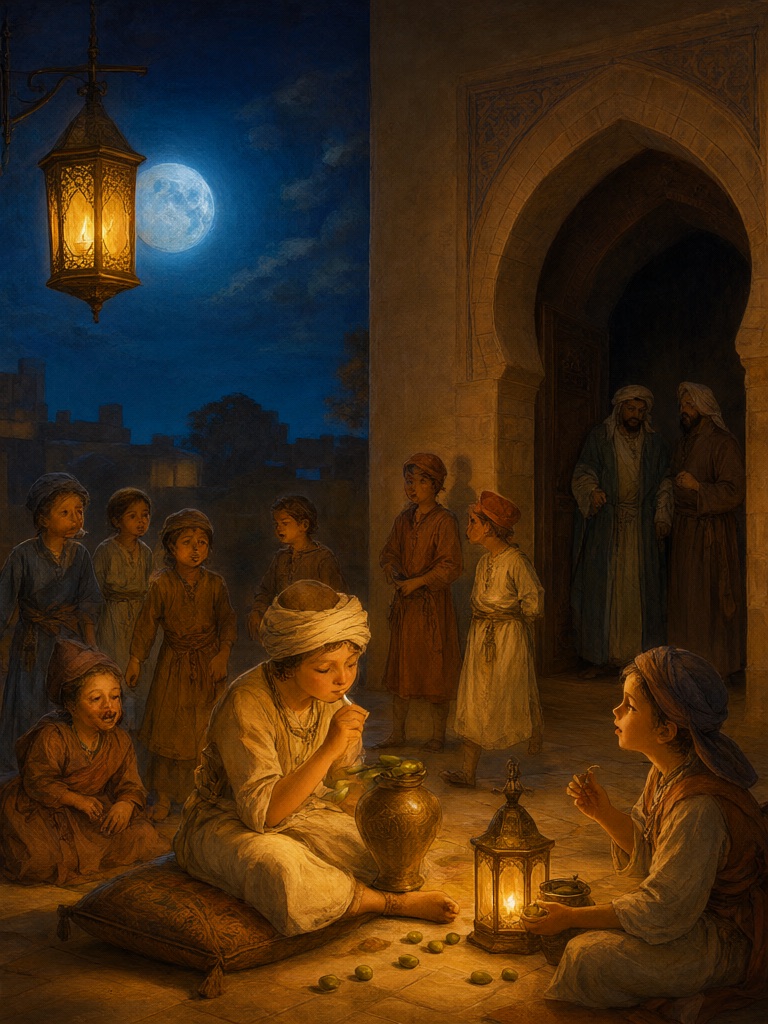
Liu Fanghua was a man of Baoding. His wealth was the greatest in the district; he was generous and loved company, and often a hundred guests sat at his table. He would rush to help anyone in trouble and never begrudge a thousand taels. Guests and friends who borrowed from him often never paid him back. There was only one guest, Gong Mengbi, a native of Shaanxi, who had never asked him for anything in his life. Whenever Gong came, he would stay a whole year. His conversation was refined and free-spirited, and of all the guests he was the one Liu spent most time with, day and night. Liu's son, named He, was then a little boy with his hair in tufts, and called Gong "Uncle." Gong, too, liked playing with the boy. Every time He came home from school, Gong would pry up the floor bricks with him and bury pebbles, pretending to bury gold for fun. There were five rooms in the house, and they had dug and buried in nearly every one. Everyone laughed at Gong for behaving so childishly, but He alone adored him and was closer to him than to any other guest.
Over the next ten years or so, the family's fortune gradually ran low, and it could no longer meet the demands of so many guests, so the guests grew fewer; still, a dozen or more talking and feasting all night was nothing unusual. In his old age, as the family declined day by day, Liu still sold off fields to pay for food and wine for his guests. He was a spendthrift too, imitating his father by making friends among the young, and Liu did nothing to stop him. Before long Liu fell ill and died, and there was not even enough to pay for the funeral. Gong took gold from his own purse and managed the funeral for the family. He was all the more grateful to him, and entrusted every matter, great or small, to Uncle Gong. Gong would often come in from outside with his sleeves full of broken tiles and rubble, and once inside he would throw them into the dark corners of the rooms. No one could make out what he meant by it. He often fretted to Gong about being poor. Gong said, "You don't know how hard it is to earn a living. Never mind having no money; even if I handed you a thousand taels, you would run through it at once. A man should worry about not standing on his own feet, not about being poor."
One day Gong announced that he was going home. He wept and begged him to come back soon. Gong promised, and left. He could not support himself, and bit by bit he pawned everything he had. Every day he waited for Gong to return and set his affairs in order, but Gong had vanished without a trace, gone like the yellow crane of the old poem, never to return. Years before, while Liu was still alive, he had arranged a marriage for He with the Huang family of Wuji, a wealthy house. Later, hearing that the Lius had fallen on hard times, Huang secretly began to regret it. When Liu died and the news was sent to him, he did not even come to offer condolences; the Lius made excuses for him because of the distance. When He's mourning period was over, his mother sent him to his father-in-law's house himself to set a wedding date, hoping the Huangs would take pity on him. When he arrived, Huang heard that his clothes and shoes were worn through and ordered the gatekeeper not to let him in. He sent word: "Go home and raise a hundred taels, and then you may come again; otherwise, consider it finished." Hearing this, He wept bitterly. Old Mrs. Liu who lived across the street took pity on him, brought him in and fed him, gave him three hundred cash, and comforted him and sent him home. His mother was grieved and furious but had no remedy. She remembered that eight or nine of every ten old guests had debts outstanding, and told him to pick out the rich and powerful ones and ask for help. He said, "Those who befriended us before did it only for our money. If I came riding in a fine carriage and asked to borrow a thousand taels, it would be easy enough; but in this state, who will remember old kindnesses or old friendships? Besides, when Father lent people money he never had them sign contracts or name guarantors, so there's no proof to collect the debts." His mother insisted, and He did as she said. For more than twenty days he could not raise a single coin; only an actor named Li Si, who had once received help from the family, heard of it and out of loyalty gave him one tael. Mother and son wept bitterly, and from then on gave up all hope.
The Huangs' daughter had come of age. When she heard her father had broken with He, she secretly thought it wrong. Huang wanted her to marry someone else. She wept and said, "Young Master Liu was not born poor. If he becomes twice as rich as he was, could those who wronged him take that from him? To cast him off now because he is poor is heartless!" Huang was displeased and tried every way to talk her round, but she would not be moved. Both her parents grew angry and cursed her morning and night, and she bore it calmly. Not long after, robbers broke into the house one night; Huang and his wife were burned and branded nearly to death, and the house was stripped bare. Three years slipped by, and the family grew poorer still. A merchant from the west heard of the daughter's beauty and offered fifty taels as a betrothal gift. Huang, eager for the money, accepted, meaning to force her to change her mind. The girl found out their plan, tore her clothes, smeared her face, and fled by night, begging for food along the way. After two months she reached Baoding, asked where He lived, and went straight to his house. His mother took her for a beggar woman and shooed her away. The girl, sobbing, told her who she was. The mother took her hands and wept: "Child, how did you come to look like this?" The girl, heartbroken, told her why. Both of them wept. The mother had her washed and bathed, and her face came out glowing, her eyes and brows radiant. Mother and son were overjoyed. But the household of three could eat only one meal a day. The mother said tearfully, "My son and I deserve this, but it grieves me that my good daughter-in-law must suffer for us!" The girl laughed and comforted her: "I've lived among beggars and know what that tastes like. Compared with that, today feels like heaven after hell." That made her mother-in-law smile.
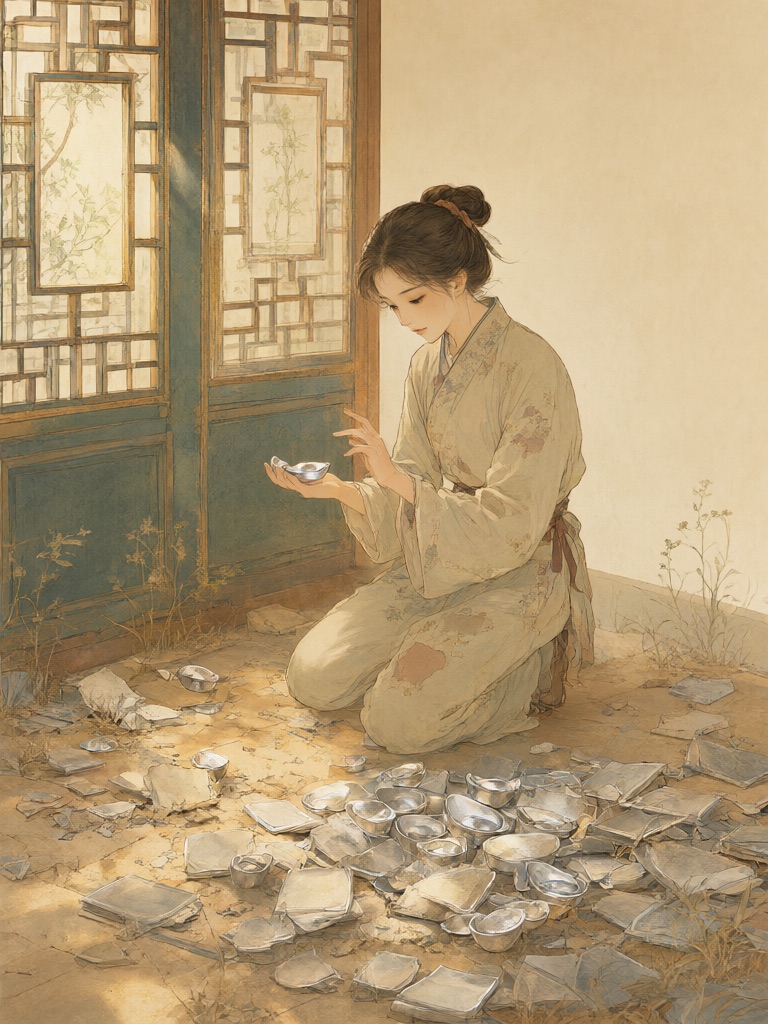
One day the girl went into an unused room. Weeds grew in clumps everywhere, leaving no bare ground. Going farther into the inner room, she found it thick with dust, and something heaped up in a dark corner. She kicked at it and stubbed her foot; she picked some up to look, and it was all silver. Astonished, she ran to tell He. He went with her to see, and found that all the broken tiles and rubble Gong had thrown about in the old days had turned into silver. That made him think of the pebbles he had buried with Gong as a child: might those all be gold too? But the old house had been pawned to the neighbor to the east. He hurried to redeem it. The floor bricks were cracked and broken, and the buried pebbles lay there plain to see, which disappointed him a good deal; but when he lifted other bricks, there underneath was gleaming silver. In no time he had tens of thousands of taels. With it he redeemed his lands, bought servants, and his house became grander than ever before. He resolved: "If I do not make something of myself, I will have failed Uncle Gong!" He shut himself away to study with fierce determination, and three years later passed the provincial examination. Then he personally took silver to repay old Mrs. Liu. His clothes were dazzling, and more than ten servants rode behind him on spirited horses like dragons. Mrs. Liu had only a single room, so He sat on her bed. The noise of men and the stamping of horses filled the whole lane. As for old Huang: after his daughter disappeared, the western merchant had forced him to return the betrothal money, nearly half of which was already spent, and only by selling his house could he pay it back. So now he was as hard up as He had once been. Hearing how gloriously his former son-in-law had risen, he could only shut his door and grieve. Mrs. Liu bought wine and prepared food to entertain He, and spoke of the Huang girl's virtue and how sad it was that she had run away. She asked He whether he had married. "I have," said He. After the meal he insisted that Mrs. Liu come and see his new bride, and took her home with him in his carriage. When they arrived, the girl came out in full finery, surrounded by a crowd of maids, like an immortal. Mrs. Liu was astounded at the sight; they talked over old times, and the girl asked anxiously after her parents' health. Mrs. Liu stayed several days and was treated lavishly; they had fine clothes made for her, new from head to foot, before sending her home.
Mrs. Liu went to the Huangs to tell them news of their daughter and pass on her greetings. The couple were stunned. Mrs. Liu urged them to go to their daughter for help, but Huang looked reluctant. Before long, though, cold and hunger became unbearable, and he had no choice but to go to Baoding. At the gate he saw towering, splendid doors, and the gatekeeper glared at him; all day long no one would announce him. A woman came out, and Huang, with a mild face and humble words, told her his name and begged her to let his daughter know in secret. After a while the woman came out again and led him into a side room. "Our lady very much wants to see you," she said, "but she's afraid the master will find out, so she must wait for a chance. When did you arrive, sir? You must be hungry." Huang told her of his hardships. The woman brought out a pot of wine and two bowls of food and set them before him. She also gave him five taels, saying, "The master is feasting in her rooms, so I'm afraid our lady can't come. Tomorrow morning you had better leave early, so the master doesn't hear of it." Huang agreed. He rose early and packed, but the gate was still locked, so he stopped just inside it and sat on his bundle to wait. Suddenly there was a stir: the master was coming out. Huang was about to slip out of sight, but He had already seen him and asked in surprise who he was; none of the servants could answer. He said angrily, "This must be a thief! Seize him and take him to the magistrate." The servants came out at his word and tied Huang to a tree with short ropes. Huang, ashamed and frightened, did not know what to say. Soon the woman from the night before came out and knelt: "This is my uncle. He arrived late last night, so I didn't tell the master." He ordered him untied. The woman saw Huang out of the gate and said, "I forgot to tell the gatekeeper, and that's how this mix-up happened. Our lady says: when you miss her, have the old lady disguise herself as a flower seller and come with Mrs. Liu."
Huang agreed, went home, and told his wife. Longing for her daughter as the thirsty long for water, she told Mrs. Liu, and Mrs. Liu did indeed go with her to He's house. Only after passing through more than ten gates did they reach the daughter's quarters. The daughter wore a cape over her shoulders and her hair piled high, all pearls, jade, silk and damask, and a fragrance came off her that filled the air. At her soft call, maids and serving women, old and young, ran in and crowded about her, carried in a golden chair, and set out two knee cushions. A clever maid brewed tea. Mother and daughter exchanged greetings in veiled words, gazing at each other with tears glistening. In the evening a room was made ready for the two old women; the quilts and mattresses were so warm and soft that even in their own rich days they had never known the like.
After three or five days, the daughter's attentions were warm and generous. Her mother kept drawing her aside where no one could hear, tearfully confessing her past wrongs. The daughter said, "Between mother and daughter, what fault can't be forgotten? But my husband's anger hasn't eased, and I'm afraid he'll overhear." Each time He came in, the mother ran off to hide. One day, as mother and daughter sat knee to knee, He walked in suddenly, saw them, and cursed angrily: "What village hag is this, daring to sit side by side with my lady? Someone pull every hair from her head!" Mrs. Liu hurried forward: "She's a relative of mine, Sister Wang the flower seller. Please don't blame her." At that He raised his hands and apologized. Then he sat down and said, "Granny, you've been here several days and I've been too busy to have a proper talk. Is that old beast Huang still alive?" Mrs. Liu smiled. "They're both well, only too poor to get by. Now that you are so rich and grand, sir, won't you spare a thought for the bond between father-in-law and son-in-law?" He pounded the table. "If you hadn't taken pity on me that year and given me a bowl of porridge, how would I ever have got home? Now I'd like to skin him and sleep on his hide. Why should I spare him a thought?" As his anger mounted, he stamped his feet and jumped up cursing. The daughter grew angry. "Heartless he may be, but he is my father. I came all that long way, my hands cracked with frostbite and my toes worn through, and I believe I've done you no wrong. How can you curse a father in front of his daughter? How is anyone to bear that?" Only then did He hold back his anger, rise, and leave. Her mother, mortified and white-faced, said she must go home. The daughter secretly gave her twenty taels.
After her mother went home, no word came from them for a long time, and the daughter worried about them deeply. So He sent someone to invite them. When the couple arrived, they were so ashamed they did not know where to put themselves. He apologized: "Last year you honored us with a visit, but you didn't say who you were, and so I gave great offense." Huang could only murmur assent. He gave him new clothes and shoes and kept him for more than a month, but Huang never felt at ease and several times asked to leave. He gave him a hundred taels of silver, saying, "The western merchant offered fifty; now I give you double." Red-faced with shame, Huang accepted it. He sent him home with a carriage and horses, and in his last years Huang lived in modest comfort.
The chronicler comments: "After Yongmen Zhou's lute brought Lord Mengchang to tears, his guests in pearl-studded shoes were nowhere to be seen; such things make a man shut his door in disgust and never wish to befriend another guest. Yet a good friend who buried his patron's bones and turned stones into gold must surely count as a reward for generous hospitality. As for a woman sitting at ease amid lavish service, like a palace consort, who but one as steadfast and extraordinary as Miss Huang could enjoy it without shame? So it is that Heaven never bestows good fortune lightly."
In my district there was a rich man who hoarded everything he could and counted every coin to the bone. He had several hundred ingots of silver buried in a cellar, and fearing above all that anyone would find out, he deliberately wore tattered padding and ate husks and chaff to look poor. When relatives or friends dropped by, he never once provided them a meal. If anyone said his family was not poor, he glared in fury and hated that person as a mortal enemy. In his old age he ate a pint of elm-bark meal a day, and the skin on his arms hung in folds an inch long, yet he would never dig up his hoard. Later he grew thin and frail. On his deathbed his two sons gathered round to ask him, and still he did not tell them right away; when he felt the end was truly near and wanted to tell them, by the time they came his tongue had stiffened and he could not speak. He could only claw at his chest, making a croaking sound. After he died, his descendants could not even afford a coffin, and he was buried wrapped in straw. Alas! If burying silver in a cellar counts as being rich, then why not point at the millions in the state treasury and call them mine? What folly!