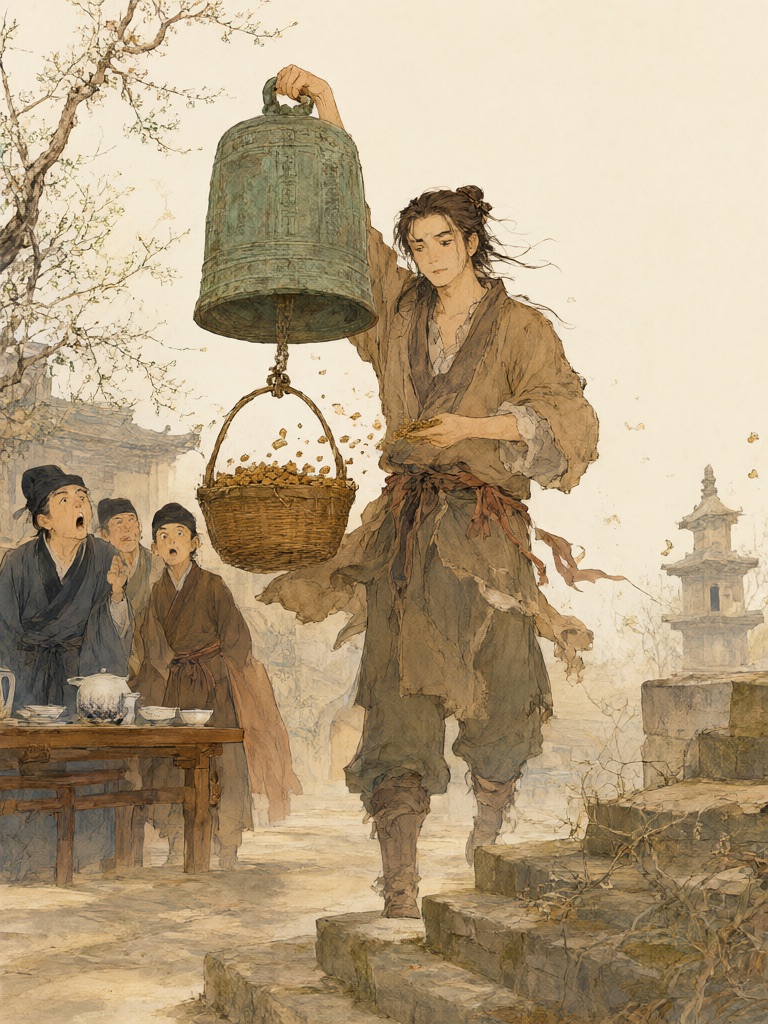
Zha Yihuang was a man of Zhejiang. At the Qingming festival he was drinking at a temple out in the country when he noticed an ancient bell in front of the main hall, bigger than two stone vats; yet the dirt marks and handprints all over it, top and bottom, were smooth and fresh. This struck him as odd. Bending down to peer beneath it, he saw a bamboo basket that would hold about eight pints, though he could not tell what was in it. He had several men grip the bell's lugs and heave with all their might, but it did not budge in the least. More astonished than ever, he sat down to drink and wait for whoever it was. Before long a beggar came in carrying the dry rations he had been given, and piled them by the bell. Then with one hand he lifted the bell, and with the other scooped the food into the basket, going back and forth several times until it was all in. Then he set the bell down again and left. A while later he came back, reached in, took out some food and ate it. When he had finished he reached in again, as lightly as opening a box. Everyone present was dumbfounded. Zha asked him, "A strong man like you — why are you begging?" He answered, "I eat too much. Nobody will hire me." Seeing how strong he was, Zha urged him to join the army. The beggar looked glum, fearing he had no way in. So Zha took him home and fed him; by his reckoning the man ate about as much as five or six people. He got him new clothes and shoes, and gave him fifty taels of silver to send him on his way.
More than ten years later, Zha's nephew was serving as a county magistrate in Fujian when a General Wu Liuyi suddenly came to call. In the course of their conversation the general asked, "What relation is Yihuang to you?" "He is my uncle," the nephew replied. "Where did you come to know him, General?" "He is my teacher. In ten years apart I have thought of him often. May I trouble you to ask him to honour me with a visit?" The nephew gave a vague yes, thinking to himself: my uncle is a renowned scholar — how would he come to have a military disciple? As it happened, Yihuang arrived, and his nephew told him about it. Yihuang had no recollection at all. But because the general had asked after him so warmly, he had his servants bring his horse and went to present his card at the general's gate. The general hurried out and welcomed him outside the main gate. Zha looked at him: he had never seen the man in his life. He privately suspected the general had made a mistake, but the general only bowed lower and grew more respectful still.
The general ushered his guest in, through three or four gates one after another, deep into the house, until suddenly Zha saw women coming and going and realised he was in the private quarters, and stopped short. The general bowed again for him to go on. Shortly they entered the hall, where those who rolled up the blinds and those who set out the seats were all young concubines. When they were seated, Zha was about to ask his question when the general gave the slightest movement of his chin, and a concubine came bearing his court robes. The general rose at once to change. Zha had no idea what he was doing. When the old serving women had finished straightening his sleeves and collar, the general first had several people hold Zha down in his seat so he could not move, and then made him the full court obeisance, as if appearing before his sovereign or his father. Zha was utterly astonished and could make nothing of it. When the bows were done, the general changed back into ordinary clothes and sat with him. He smiled: "Sir, don't you remember the beggar who lifted the bell?" Only then did Zha understand. Then a splendid banquet was spread, and the household musicians played below the hall. When the wine ran low, a line of concubines stood in attendance. The general went into the bedroom and asked how his guest would like his bed made before taking his leave. Zha, having drunk too much, rose late, and the general had already come three times to the bedroom door to ask after him. Feeling uneasy, Zha said he must go home. But the general threw away the linchpins of his carriage and locked the gates to keep him in. Zha noticed that the general did nothing all day but count up his concubines, maids, servants and grooms, and his mules, horses, clothing and furnishings, supervising the drawing up of registers and warning that nothing be left out. Zha took this for the general's household business and did not inquire too closely.
One day the general took the registers and said to Zha, "Whatever I am today, I owe entirely to your great kindness. I would not presume to keep a single maid or a single thing for myself — allow me to offer you half." Zha was astounded and refused, but the general would not listen. He brought out the tens of thousands of taels of silver he had stored away and divided that in two as well. Going through the registers item by item, he set out antiques, beds and tables until the hall and the rooms around it were almost full. Zha firmly tried to stop him, but the general paid no heed. When he had checked the names of the maids and servants, he ordered the men to pack the baggage and the women to gather up the goods, and charged them to serve their new master respectfully. A hundred voices answered in awe. Then he personally saw the concubines and maids into their carriages and the grooms leading out the mules and horses, and when the whole noisy throng had set off together, he came back to bid Zha farewell. Later Zha was implicated in the case over the compiling of a history and arrested, but in the end he was spared — all through the general's efforts.